Valuation (appraisal): What Every Real Estate Student Needs to Know to Pass the PSI Exam in 2026

Valuation and Market Analysis (Appraisal): Your Complete PSI Exam Study Guide

By Capital Real Estate School | Real Estate Licensing Exam Prep Series

If you’re studying for your real estate salesperson license exam, one of the most important topic areas you’ll face is Valuation and Market Analysis, also called appraisal. This section shows up in multiple PSI exam questions, so understanding it well can make a real difference in your score.

Don’t worry, we’re going to explain everything clearly. Think of this as your go-to guide for understanding how properties get their price tags and what the exam expects you to know. Let’s dive in!

What Is an Appraisal, Anyway?

An appraisal is simply a professional opinion of what a property is worth. It’s not a price guarantee, it’s an educated estimate backed by research, data, and specific methods.

Appraisals are used for all kinds of purposes: getting a mortgage, settling an estate, figuring out property taxes, or deciding how much to list a home for. One of the most common uses is in the mortgage lending process, banks want to make sure a home is worth at least as much as they’re lending you.

📌 PSI Exam Tip: The PSI exam will ask you to distinguish between market price (what a property actually sold for) and market value (what it should sell for under normal conditions). These two things are NOT always the same. A house can sell above or below its market value depending on the situation.

Part 1: Basic Concepts of Value

The Five Types of Value

Before the exam, you need to know the five main types of value in real estate. Each one is used for a different purpose:

Type of ValueWhat It MeansWho Uses It
Market ValueThe most likely price in an open, competitive market with no pressure on buyer or sellerLenders, buyers, sellers
Value-in-UseWhat the property is worth to a specific user for a specific purposeBusinesses, owner-occupants
Investment ValueWhat a property is worth to a specific investor based on their goalsReal estate investors
Assessed ValueValue set by the government to calculate property taxesTax assessors
Insured ValueThe cost to rebuild or replace a property in case of damageInsurance companies


📌 PSI Exam Tip: The exam loves to test market value because it’s the standard used in most real estate transactions. Know that market value assumes a willing buyer, a willing seller, a reasonable time on market, and no pressure or unusual deals.

The DUST Formula: Four Characteristics of Value

Here’s a memory trick that shows up on the PSI exam all the time: DUST. Value only exists when all four of these elements are present:

  • D – Demand: People want it
  • U – Utility: It’s useful for something
  • S – Scarcity: There isn’t an unlimited supply
  • T – Transferability: You can actually sell or transfer ownership of it

A vacant lot in the desert might have utility (you can camp on it), but if nobody wants it, there’s no demand and no real value. All four must work together.

📌 PSI Exam Tip: DUST is one of the most common “fill in the blank” style concepts on the PSI exam. Memorize all four letters and what they stand for!

The Principles of Value

The PSI exam also tests you on economic and appraisal principles that help explain how value changes. Here are the big ones you need to know:

  • Substitution: A buyer won’t pay more for a property if they can get a similar one for less. This principle drives all three appraisal approaches.
  • Supply and Demand: When demand goes up and supply stays low, prices rise. Simple economics.
  • Conformity: Properties tend to hold their value better when they match the neighborhood. A $600,000 mansion in a neighborhood of $200,000 homes won’t appraise well.
  • Contribution: An improvement adds value only equal to what buyers are willing to pay for it, not what it costs to build.
  • Highest and Best Use: A property should be used in the way that produces the highest value, is legally permitted, physically possible, and financially feasible.
  • Anticipation: Value is based on what buyers expect the property to do in the future.
  • Competition: When profits are high in an area, more development follows, which eventually reduces those profits.
  • Change: Real estate values don’t stay the same forever. Neighborhoods grow, decline, and change over time.

📌 PSI Exam Tip: “Highest and best use” comes up often in PSI questions, especially for land and commercial properties. Remember, it must be legally permitted, physically possible, financially feasible, and maximally productive.

Part 2: The Three Approaches to Value

One of the biggest sections on the exam is the three approaches appraisers use to estimate value. Let’s go through each one.

Approach #1: The Sales Comparison (Market Data) Approach

This is the most common approach for single-family homes and condos. The appraiser finds recently sold properties that are similar to the one being valued. Those similar properties are called comparables (or “comps”).

Since no two properties are exactly the same, the appraiser adjusts the comps’ sale prices to account for differences. The key rule here is simple:

If the comparable is BETTER than the subject property, → adjust DOWN.
If the comparable is WORSE than the subject property, → adjust UP.

Think of it this way: you’re trying to figure out what the comp would have sold for if it were just like your subject property.

The adjustments can cover:

  • Time (market conditions change)
  • Location (school district, traffic, proximity to amenities)
  • Physical features (square footage, bedrooms, garage, pool)
  • Terms of sale (seller concessions, seller financing)

📌 PSI Exam Tip: The exam will give you a scenario with a subject property and a comparable, ask you to identify differences, and expect you to adjust the comp’s price, NOT the subject’s price. This concept trips up a lot of test-takers!

Approach #2: The Cost Approach

The cost approach asks: “What would it cost to build this property from scratch today, minus the wear and tear it’s already experienced?” It’s most useful for special-use properties like schools, churches, and government buildings, places that don’t sell often enough to use comparable sales data.

The basic formula is:

Value = Land Value + (Cost to Build – Depreciation)

There are two ways to estimate the building cost:

  • Reproduction Cost: The cost to build an exact copy of the structure using the same materials
  • Replacement Cost: The cost to build a functionally equivalent building using today’s modern materials and methods

Depreciation is the reduction in value from various causes, and there are three types:

Type of DepreciationDefinitionCurable?
Physical DeteriorationWear and tear from normal use (leaky roof, old HVAC)Sometimes
Functional ObsolescenceLoss of value from outdated design (only 1 bathroom in a 4-bedroom home)Sometimes
External (Economic) ObsolescenceCaused by forces outside the property (nearby factory, traffic noise)No — incurable


📌 PSI Exam Tip: External obsolescence is always incurable because the problem is outside the property — the owner can’t remedy it. The PSI exam regularly asks which type of depreciation is incurable.

Approach #3: The Income Approach

The income approach is used for investment properties — apartment buildings, rental homes, and commercial spaces. It estimates the value based on the income the property generates.

Here’s the income flow you need to understand in order:

  1. Potential Gross Income (PGI): Total rent if the property was 100% occupied all year
  2. Less: Vacancy & Credit Loss: Allowance for empty units and unpaid rent
  3. = Effective Gross Income (EGI): Actual expected income
  4. Less: Operating Expenses: Property taxes, insurance, management, maintenance
  5. = Net Operating Income (NOI): What’s left after expenses (before mortgage payments)

Then, to turn income into value, appraisers use the capitalization rate (cap rate):

Value = Net Operating Income ÷ Cap Rate

For example, if a property produces $50,000 in NOI and the market cap rate is 5%, the value is $50,000 ÷ 0.05 = $1,000,000.

Two quick multiplier tools are also used with the income approach:

  • Gross Rent Multiplier (GRM): Used for 1~4-unit residential rental properties
  • Gross Income Multiplier (GIM): Used for commercial properties, based on annual income.

📌 PSI Exam Tip: Know that NOI does NOT subtract mortgage payments (debt service). The income approach and cap rate math calculations are frequently tested on PSI. Practice the formula: Value = NOI ÷ Cap Rate.

Part 3: Competitive Market Analysis (CMA) and Broker Price Opinions (BPO)

Now, here’s something really important to understand, especially as a future real estate agent.

You are NOT a licensed appraiser. That means you cannot prepare a formal appraisal. But you can prepare a Competitive Market Analysis (CMA) or a Broker Price Opinion (BPO) to help clients make decisions.

CMA vs. Formal Appraisal

A CMA is an informal estimate of value that real estate agents prepare for their clients. It uses similar methods to the sales comparison approach; you look at recently sold homes, active listings, and expired listings in the area, but it is NOT the same as an official appraisal for legal or lending purposes.

A BPO (Broker Price Opinion) is similar to a CMA but may be ordered by banks or mortgage companies in situations that don’t require a full appraisal (like short sales or REO properties). In many states, the broker must sign off on a BPO.

How a CMA Helps Your Clients

  • For sellers: A CMA helps set a realistic listing price — neither too high (which drives away buyers) nor too low (which misses out on potential earnings).
  • For buyers: A CMA helps determine how much to offer on a property so they don’t overpay.

📌 PSI Exam Tip: The exam will ask you when a licensed or certified appraiser is required. The answer: federally related mortgage transactions, estate disputes, divorces, eminent domain cases, and tax disputes. Agents doing CMAs or BPOs are NOT performing appraisals.

Quick Reference: The Three Appraisal Approaches

ApproachBest Used ForKey PrincipleKey Formula/Tool
Sales ComparisonResidential homes, condosSubstitutionAdjust comps up or down
Cost ApproachSpecial-use, new constructionReproduction/ReplacementLand + Cost – Depreciation
Income ApproachInvestment/rental propertiesAnticipationNOI ÷ Cap Rate = Value


Final PSI Exam Tips: Valuation Section

Here’s a quick summary of the most important things to remember as you prep for the exam:

  1. Know DUST: All four elements must exist for the value to be real.
  2. Market value ≠ Market price: One is what it should sell for; the other is what it actually sold for.
  3. Sales comparison adjusts the comp, not the subject property.
  4. External obsolescence is always incurable.
  5. NOI does NOT include mortgage payments.
  6. Agents do CMAs and BPOs; only licensed/certified appraisers do formal appraisals.[5]
  7. Highest and best use must be legal, physical, financial, and maximally productive.[1]
  8. Cap rate formula: Value = NOI ÷ Cap Rate. Practice this math!

📖 Additional Study Resources:

Good luck on your PSI exam! Remember — understanding valuation isn’t just about passing the test. It’s one of the most practical skills you’ll use every single day in your real estate career.

Tags: PSI Exam Prep | Real Estate Appraisal | Valuation | CMA | Income Approach | Cost Approach | Sales Comparison | DUST | Market Value | Real Estate Licensing

Property Management & CAMS: What Every Real Estate Student Needs to Know to Pass the PSI Exam in 2026.

PROPERTY MANAGER MEETING with vendors and maintenance team

PROPERTY MANAGER MEETING with vendors and maintenance team

🏢 Property Management & the CAM Role: Your Complete PSI Exam Guide

By Capital Real Estate School | PSI Exam Prep Series — Topic 10

If you’re studying for your real estate salesperson license exam, property management is one of those topics you absolutely need to nail down. The PSI exam will test you on the real-world duties of a property manager — from signing a management agreement to keeping tenant money safe in a trust account. About 3% of your licensing exam questions will relate to property management, so every point in this outline counts.

Let’s explain it clearly so you can enter that testing center with confidence. 🎯

What Is a Property Manager?

A property manager is a licensed real estate professional who takes care of a property on behalf of the owner. Think of it like this: the owner is the boss, and the property manager is the trusted employee hired to keep things running smoothly.

The primary goal of a property manager is simple — produce the greatest net return for the property owner while always acting in that owner’s best financial interest. That means collecting rent on time, keeping the building in good shape, finding great tenants, and making sure all the bills get paid.

A property manager can also be referred to as a Community Association Manager (CAM) — especially when managing homeowners associations (HOAs) or condominium communities. The CAM role involves the same core responsibilities but within a shared-ownership community structure.

  1. The Management Agreement: Your Authority Document

Before a property manager can do anything, there must be a written property management agreement. This is a legal contract between the owner and the manager: and it defines everything.

What’s in a Management Agreement?

Here are the key items the PSI exam expects you to know:

  • Property description: Identifies the specific property being managed
  • Term of the agreement: Start date, end date, and how it can be terminated
  • Owner’s purpose: What does the owner want the manager to accomplish?
  • Scope of authority: What decisions can the manager make without asking the owner?
  • Reporting requirements: How often and in what format will the manager report to the owner?
  • Compensation: Management fee calculation (often a percentage of collected rent)
  • Antitrust provision: Fees are always negotiable (no price-fixing)
  • Equal opportunity statement: All activity must comply with Fair Housing laws.

📌 PSI Exam Tip: The management agreement creates an agency relationship between the property manager (agent) and the property owner (principal). The manager owes the owner fiduciary duties, not the tenant.

  1. Fiduciary Duties to the Owner

This is a big one on the PSI exam. As a property manager, you are a fiduciary to the owner. That means you have a legal and ethical duty to act in the owner’s best interest, period.

The six fiduciary duties you must know, often remembered with the acronym OLD CAR or COLD/AC, are:

DutyWhat It Means
ObedienceFollow the owner’s lawful instructions
LoyaltyPut the owner’s interests above your own
DisclosureShare all material facts with the owner
ConfidentialityProtect information that could weaken the owner’s position
AccountingAccount for all money and property belonging to the owner
Reasonable CareAct with the skill and diligence of a competent professional


A property manager must disclose all rental offers received, along with any supporting documentation, so the owner can make informed decisions about potential tenants. The manager cannot act against the owner’s interests, even in small matters.

Importantly, property managers owe fiduciary duties to the owner, but they do have separate (non-fiduciary) legal obligations to treat tenants fairly under Fair Housing laws.

If an exam question asks to whom the property manager’s fiduciary duty goes, the answer is the owner (principal), not the tenant.

  1. Setting Rents, Budgets, and Operating Statements

One of the manager’s most important jobs is figuring out how much rent to charge. Charge too little and the owner loses money; charge too much, and the property sits empty.

A good property manager will:

  • Research the rental market: Compare similar properties in the area
  • Set competitive rental rates: Based on location, amenities, and market data
  • Prepare an operating budget: Estimate income and all expected expenses for the year
  • Produce cash flow reports: Show how much money is coming in versus going out
  • Deliver budget comparison reports: Compare actual performance against the budget.

Sample Monthly Operating Statement

Income/Expense CategoryAmount
Gross Rental Income$12,000
Vacancy Loss (5%)−$600
Effective Gross Income$11,400
Management Fee (8%)−$912
Maintenance & Repairs−$800
Insurance−$300
Property Taxes−$500
Net Operating Income (NOI)$8,888


Understanding how to read and prepare a basic operating statement like this is an essential skill for property management, and the PSI exam may test you on it.

📌 PSI Exam Tip: Know the difference between Gross Rental Income (all possible rent if 100% occupied) and Effective Gross Income (after vacancy and collection losses). NOI is always before mortgage payments.

  1. Tenant Screening and Lease Administration

Finding the right tenant is one of the most important things a property manager does. But you must carry out this process carefully and legally.

How to Screen Tenants Properly

A standard rental application and screening process includes the following reviews:

  • Income stability: Tenant typically needs income 2.5–3× the monthly rent
  • Credit history: Payment patterns and outstanding debts
  • Employment verification: Current employer and job stability
  • Rental history: References from previous landlords
  • Background check: Reviewed carefully under Fair Housing guidelines

All applicants must go through the same consistent process. You cannot ask about or make decisions based on race, color, religion, sex, national origin, disability, or familial status, these are the protected classes under the Fair Housing Act.

HUD guidance also cautions managers against overbroad use of criminal records, eviction records, or credit history in ways that could create a discriminatory effect.

📌 PSI Exam Tip: Using different screening criteria for different applicants is a Fair Housing violation. Always apply the same written standards to everyone.

Once a tenant is selected, the property manager handles lease administration, getting the lease signed, collecting the security deposit, completing move-in inspections, collecting monthly rent, and handling renewals or non-renewals.

  1. Maintenance and Risk Management

Keeping the property in good condition is a core responsibility. The PSI exam breaks maintenance down into three types:

Maintenance TypeDescriptionExample
PreventiveDone on a schedule to stop problems before they startAnnual HVAC servicing, roof inspections
CorrectiveRepairs made after something breaksFixing a broken water heater
RoutineRegular upkeep to keep the property clean and functionalLawn care, snow removal, and cleaning common areas


Beyond these three, capital improvements are major upgrades that increase the property’s value or extend its useful life, like replacing a roof, installing new windows, or upgrading an elevator. Capital improvements are typically budgeted separately from regular operating expenses.

Risk Management: Insurance & Safety

A property manager is also responsible for making sure the property is properly insured and safe. Key insurance types to know for the PSI exam include:

  • Property insurance: Covers the building against damage from fire, storms, etc.
  • Liability insurance: Protects against lawsuits from injuries on the property
  • Loss of rents insurance: Covers lost income if the property becomes uninhabitable
  • Workers’ compensation: Covers maintenance staff injuries on the job

📌 PSI Exam Tip: Risk management is about reducing and transferring risk. Insurance transfers financial risk; proper maintenance reduces the likelihood of accidents

  1. Trust Accounts: Keeping Money Safe and Separate

This is one of the most tested topics on the PSI exam related to property management. Pay close attention. 🚨

When a property manager collects rent or security deposits from tenants, that money does not belong to the property manager; it belongs to the tenant (deposit) or the owner (rent). It must be held in a trust account, completely separate from the manager’s own business funds.

The Two Big Violations to Know

Commingling: Mixing client funds (rent or deposits) with the property manager’s personal or business funds. This is illegal and can result in loss of license.

Conversion: Using one client’s funds to pay for another client’s property expenses. Also, illegal.

Trust Account Best Practices

  • Keep a dedicated trust account with “Trust,” “Escrow,” or “Client Benefit” in the account name
  • Security deposits and rents may need to be kept in separate accounts (varies by state)
  • Perform a three-way reconciliation monthly: bank balance + checkbook balance + sum of all client ledgers
  • Keep records (leases, deposit slips, owner reports, invoices) for 4–6 years
  • Require dual approval for large disbursements

In Connecticut, Connecticut General Statutes § 47a-21 requires security deposits to be treated as trust funds — the money continues to belong to the tenant and must be held in a separate escrow account at a Connecticut-based financial institution and must never be commingled with the landlord’s personal or business funds.

📌 PSI Exam Tip: The key rule is “separate, separate, separate.” Client money is never your money. Any mixing = commingling = license in jeopardy.

  1. Recordkeeping, Owner Reports, and Compliance

A property manager’s job doesn’t end when the rent check clears. You also have a duty to keep detailed records and report to the owner regularly.

Reports a Property Manager Must Provide

  • Operating budget: Annual projection of income and expenses
  • Cash flow reports: Monthly income vs. expenses
  • Profit and loss statements: Overall financial performance
  • Budget comparison reports: Planned vs. actual spending

State law often dictates the minimum reporting requirements — including how often reports must be delivered and what information they must contain.

Legal Compliance

Property managers must stay current with:

  • Fair Housing Act: No discrimination in renting, advertising, or screening
  • Americans with Disabilities Act (ADA): Reasonable accommodations must be provided
  • State landlord-tenant laws: Including security deposit limits and timelines
  • Local building codes: Health and safety standards for rental units

🧠 Quick PSI Exam Study Tips for Property Management

Here’s a rapid-fire review of the most commonly tested points in this section:

  1. The primary goal of a property manager = greatest net return for the owner
  2. Management agreement = creates the agency relationship + defines the scope of authority
  3. Fiduciary duties = OLD CAR (Obedience, Loyalty, Disclosure, Confidentiality, Accounting, Reasonable Care)
  4. Fair Housing = same screening criteria for ALL applicants, no exceptions.
  5. Trust accounts = client money is NEVER the manager’s money
  6. Commingling = illegal mixing of funds; Conversion = using one owner’s money for another
  7. NOI = Effective Gross Income minus Operating Expenses (before debt service).
  8. Capital improvements = major upgrades (not routine maintenance) that add long-term value.
  9. Three-way reconciliation = must be done monthly to verify trust account balances
  10. License required — in most states, including New York, a broker’s license is needed to manage property for others.

📚 Additional Study Resources

Here are 8 external resources to strengthen your understanding of these PSI exam points:

  1. 🔗 PSI Exam Prep: Leasing & Property Management (Video): Great walkthrough of exam questions
  2. 🔗 National Real Estate Exam Prep: Property Management & Leasing: Covers lease types and PM duties
  3. 🔗 5 Key Insights on Fiduciary Duty for Property Managers: Fiduciary duty deep dive
  4. 🔗 DoorLoop: Property Management Trust Accounting Guide: Full trust account rules
  5. 🔗 How to Comply with the Fair Housing Act for Tenant Screening: Fair Housing and Screening
  6. 🔗 NYC Security Deposit Laws: Landlord Duties & Commingling: State-specific deposit rules
  7. 🔗 Tenant Screening Best Practices for Property Managers: Comprehensive screening guide
  8. 🔗 Justia: Rental Property Management & Legal Considerations: Legal overview for landlords and managers

📝 Chapter Review: Key Terms to Know

TermDefinition
Property Management AgreementWritten contract defining the manager’s authority, duties, and compensation
Fiduciary DutyLegal obligation to act in the owner’s best interest with loyalty and full disclosure
NOI (Net Operating Income)Effective Gross Income minus operating expenses; before mortgage payments
ComminglingIllegally mixing client funds with the manager’s own funds
ConversionUsing one client’s funds to pay another client’s expenses, also illegal
Trust AccountDedicated bank account where client rent and deposit funds are held separately
Preventive MaintenanceScheduled upkeep to prevent problems before they occur
Capital ImprovementMajor upgrade that increases property value or extends useful life
CAMCommunity Association Manager, manages HOAs and condo communities
Three-Way ReconciliationMonthly matching of bank balance, checkbook balance, and client ledgers


Property management may only be a small percentage of your PSI exam, but a solid understanding of these concepts will not only help you pass, it will make you a much more well-rounded real estate professional. Master the management agreement, respect your fiduciary duties, keep tenant funds properly separated, and stay compliant with Fair Housing laws, and you’ll be ready for any property management question the exam throws your way. 🏆

Next Up in the PSI Exam Prep Series, Stay tuned for more topic breakdowns to help you pass on your first try!

This article is part of our CRES Real Estate License Exam Prep Series. For more PSI outline topics, visit our course library

Math Caclulations in Real Estate: What Every Real Estate Student Needs to Know to Pass the PSI Exam in 2026

REAL ESTATE LICENSE EXAM CALCULATIONS - CRES LLC

REAL ESTATE LICENSE EXAM CALCULATIONS

🏡 Real Estate Calculations: Your Complete Guide to Passing the PSI Exam Math Section

By Capital Real Estate School | PSI Salesperson Exam Prep Series

If the word “math” makes you nervous, take a deep breath. Real estate calculations on the PSI salesperson exam are not as scary as they sound. In fact, once you learn the formulas and practice them a few times, these questions can become some of the easiest points you earn on test day. This guide will walk you through every major calculation topic you need to know, give you real practice problems with step-by-step solutions, and share tips to help you crush the math section on exam day.

💡 PSI Exam Tip: The Real Estate Calculations section makes up approximately 5 questions out of 80 on the national PSI salesperson exam. That’s about 6% of your total score — enough to make the difference between passing and failing. Every point counts!

📐 Part 1: Basic Arithmetic and Measurement

Before we dive into the money math, let’s start with the foundation, area, and volume calculations. Whether you’re helping a buyer figure out the size of a lot or calculating square footage for a listing, this is essential real estate math.

Key Formulas You Must Know

MeasurementFormula
Area of a RectangleLength × Width
Area of a Triangle½ × Base × Height
VolumeLength × Width × Height
Acres to Square Feet1 acre = 43,560 sq ft
Miles to Feet1 mile = 5,280 feet

The PSI exam will provide these conversion numbers either in the problem itself or as a reminder at the top of the math section. However, memorizing them before exam day is a significant advantage because it saves you time.

Quick Example: Finding Square Footage:
A rectangular lot is 150 feet long and 80 feet wide. What is the area?

150 × 80 = 12,000 square feet

Quick Example: Converting to Acres:
How many acres is 87,120 square feet?

87,120 ÷ 43,560 = 2 acres

💰 Part 2: Commission Calculations

Commission math is one of the most common types of calculations on the PSI exam. Real estate agents earn a commission — a percentage of the sale price — when a property sells. That commission is typically split between the listing broker and the buyer’s broker, and then again between brokers and their agents.

The Commission Triangle Formula

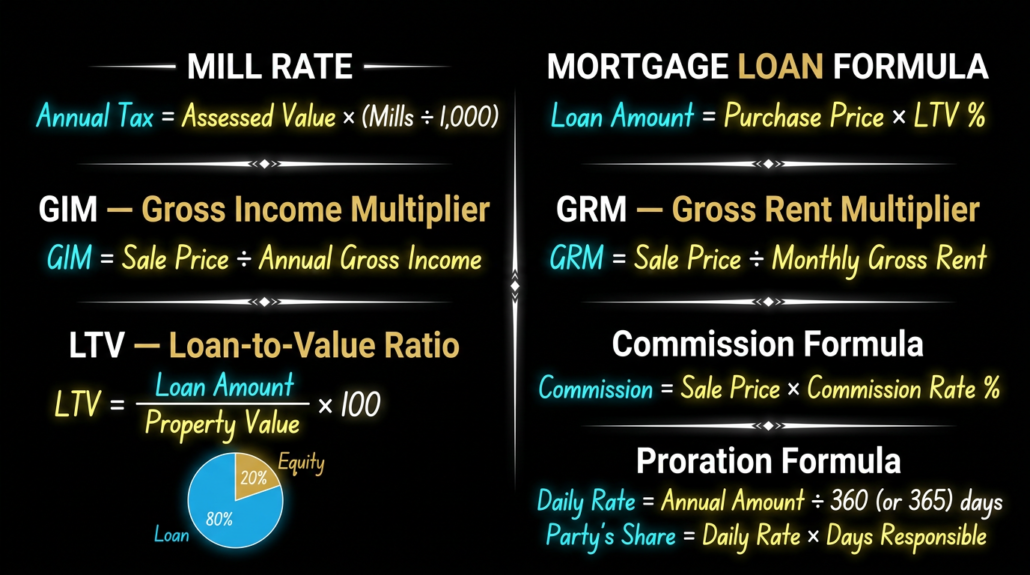
The three key formulas are the following:

  • Total Commission = Sale Price × Commission Rate
  • Sale Price = Total Commission ÷ Commission Rate
  • Commission Rate = Total Commission ÷ Sale Price

🧮 PSI Exam Tip: Think of these three formulas as a triangle. If you know two pieces of the puzzle, you can always ascertain the third.

🧮 Calculation #1 — Commission Split Problem

Problem: A home sells for $425,000. The listing broker charges a 6% commission. The commission is split 50/50 between the listing broker and the buyer’s broker. The listing agent receives 60% of the commission from her broker’s side. How much does the listing agent earn?

Solution:

  1. Total Commission: $425,000 × 0.06 = $25,500
  2. Listing Broker’s Half: $25,500 ÷ 2 = $12,750
  3. Listing Agent’s Share: $12,750 × 0.60 = $7,650

The listing agent earns $7,650.

🏦 Part 3: Loan-to-Value Ratio (LTV) and Equity

The Loan-to-Value (LTV) ratio is a number lenders use to decide how risky a loan is. It compares the loan amount to the property’s appraised value. The higher the LTV, the more risk for the lender.

LTV Formulas

  • LTV Ratio = Loan Amount ÷ Property Value × 100
  • Loan Amount = Property Value × LTV %
  • Down Payment = Sale Price × (1 − LTV %)
  • Equity = Property Value − Loan Balance

💡 PSI Exam Tip: Lenders commonly require private mortgage insurance (PMI) when the LTV is above 80%. This concept may appear in exam questions on buyer qualification.

🧮 Calculation #2 — LTV (Word Problem Version)

Problem: Maria wants to buy a home appraised at $320,000. Her lender requires a maximum LTV of 80%. How much must Maria put down, and what is her loan amount?

Solution:

  1. Loan Amount: $320,000 × 0.80 = $256,000
  2. Down Payment: $320,000 − $256,000 = $64,000

Maria must make a $64,000 down payment and borrow $256,000.

🧮 Calculation #3 — LTV (Math Problem Version)

Problem: A buyer takes out a $189,000 mortgage on a home that sold for $210,000. What is the LTV ratio?

Solution:

LTV = $189,000 ÷ $210,000 = 0.90 = 90%

The LTV ratio is 90%.

🏠 Part 4: Gross Rent Multiplier (GRM)

The Gross Rent Multiplier is a quick tool investors use to compare income-producing properties. It tells you how many years of gross rent it would take to equal the property’s price. A lower GRM typically indicates a better deal.

GRM Formulas

  • GRM = Sale Price ÷ Monthly (or Annual) Gross Rent
  • Sale Price = GRM × Monthly Rent
  • Monthly Rent = Sale Price ÷ GRM

🧮 Calculation #4 — Gross Rent Multiplier (GRM)

Problem: A duplex sells for $288,000. Each unit rents for $1,200/month. What is the GRM?

Solution:

  1. Total Monthly Rent: $1,200 × 2 = $2,400/month
  2. GRM: $288,000 ÷ $2,400 = 120

The GRM is 120, meaning it would take 120 months (10 years) of gross rent to equal the purchase price.

📊 Part 5: Gross Income Multiplier (GIM)

The Gross Income Multiplier is similar to the GRM but uses annual gross income instead of monthly rent. It’s often used for larger commercial or multi-family properties.

GIM Formulas

  • GIM = Sale Price ÷ Annual Gross Income
  • Sale Price = GIM × Annual Gross Income
  • Annual Gross Income = Sale Price ÷ GIM

🧮 Calculation #5 — Gross Income Multiplier (GIM)

Problem: A six-unit apartment building sells for $900,000. The annual gross rent income is $90,000. What is the GIM?

Solution:

GIM = $900,000 ÷ $90,000 = 10

The GIM is 10, meaning the property costs 10 times its annual gross income.

💡 PSI Exam Tip: Don’t confuse GRM (monthly rents) with GIM (annual income). Read the problem carefully — if it says “annual income,” use GIM. If it says “monthly rent,” use GRM.

🏛️ Part 6: Mill Rate and Property Tax Calculations

The mill rate is how local governments express property tax rates. One mill = $0.001, or $1 of tax for every $1,000 of assessed value.

Property Tax / Mill Rate Formulas

  • Assessed Value = Market Value × Assessment Ratio
  • Annual Tax = Assessed Value × Tax Rate (in decimal)
  • Mill Rate to Decimal: Divide mills by 1,000 → 30 mills = 0.030
MillsDecimal EquivalentTax per $1,000 Assessed
10 mills0.010$10.00
20 mills0.020$20.00
30 mills0.030$30.00
45 mills0.045$45.00
60 mills0.060$60.00


🧮 Calculation #6 — Mill Rate Property Tax Problem

Problem: A home has a market value of $350,000. The town assesses property at 70% of market value. The mill rate is 28 mills. What is the annual property tax?

Solution:

  1. Assessed Value: $350,000 × 0.70 = $245,000
  2. Convert mill rate: 28 mills ÷ 1,000 = 0.028
  3. Annual Tax: $245,000 × 0.028 = $6,860

The annual property tax is $6,860.

📅 Part 7: Prorations — Splitting Costs at Closing

Prorations are adjustments made at closing to divide ongoing expenses fairly, such as property taxes, HOA dues, homeowners’ insurance, and prepaid rent, between the buyer and seller.

The PSI exam will specify:

  1. Whether to use the 360-day (banker’s year) or the 365-day (calendar year) method
  2. Whether closing day belongs to the buyer or seller

Key Proration Formulas

  • Annual Amount ÷ 360 (or 365) = Daily Rate
  • Daily Rate × Days Responsible = Party’s Share

💡 PSI Exam Tip: Unless the problem tells you otherwise, the seller pays for closing day under standard PSI exam rules. Always re-read the problem to verify before calculating.

🧮 Calculation #7 — Proration Problem (Property Tax)

Problem: The annual property tax on a home is $3,600. Closing is on March 31. The seller owns the closing day. Using a 360-day year, how much does the seller owe in prorated taxes?

Solution:

  1. Daily Rate: $3,600 ÷ 360 = $10/day
  2. Days from Jan 1 through March 31 (seller’s period):
  • January = 30 days, February = 28 days, March = 31 days = 89 days
  • (In a 360-day year, each month is 30 days: 30 + 30 + 30 = 90 days, including closing)
  • Using 30-day months: Jan (30) + Feb (28) + Mar (31) = 89 days
  1. Seller’s Share: 91 × $10 = $910

The seller owes $910 in prorated taxes at closing

💵 Part 8: Interest Calculations and Points

Simple interest is used in many real estate financing calculations. It’s the cost of borrowing money, calculated on the principal loan balance.

Simple Interest Formulas

  • Annual Interest = Loan Balance × Interest Rate
  • Monthly Interest = Annual Interest ÷ 12
  • Interest Rate = Annual Interest ÷ Loan Balance

What is a Point?
One discount point = 1% of the loan amount. Points are paid at closing to “buy down” the interest rate.

Example:
A buyer borrows $200,000 at 7% interest. What is the first month’s interest?

Annual Interest: $200,000 × 0.07 = $14,000
Monthly Interest: $14,000 ÷ 12 = $1,166.67

📋 PSI Exam Math: Quick Reference Cheat Sheet

FormulaEquation
CommissionSale Price × Commission %
Sale Price (from commission)Commission ÷ Commission %
LTV RatioLoan Amount ÷ Property Value × 100
Down PaymentSale Price × (1 − LTV %)
GRMSale Price ÷ Monthly Rent
GIMSale Price ÷ Annual Gross Income
Mill Rate TaxAssessed Value × (Mills ÷ 1,000)
Assessed ValueMarket Value × Assessment Ratio
Proration Daily RateAnnual Amount ÷ 360 or 365
Simple Interest (Annual)Loan Balance × Rate
AcreageSquare Feet ÷ 43,560


✅ Top PSI Exam Tips for the Math Section

Here’s a quick list of strategies to boost your score on real estate calculations:

  1. Write down your formulas first, before reading the question; jot the key formulas on your scratch paper
  2. Identify what you’re solving for. Is the question asking for the sale price, commission, or tax? Know your target
  3. Convert percentages to decimals: 6% becomes 0.06; 28 mills becomes 0.028
  4. Check whether the problem says 360 or 365 days for prorations; a wrong assumption changes the answer.
  5. Read: Who owns closing day, the seller or the buyer? This changes proration amounts significantly
  6. Don’t overthink it. Most PSI math problems involve only two to three steps.
  7. Practicing daily, even five problems per day in the week before your exam, builds tremendous confidence.

🎓 Final Thoughts from Capital Real Estate School

Real estate math doesn’t require a calculator or a finance degree. It requires knowing your formulas, reading carefully, and practicing consistently. The topics covered in this guide — mill rates, commissions, LTV, GRM, GIM, prorations, and interest — are the exact areas that are tested on the PSI salesperson exam. Master these seven calculation types, and you’ll walk into your exam with confidence.

At Capital Real Estate School, we’re here to help every step of the way. Whether you’re studying for your first attempt or retaking the exam, our PSI prep materials are designed to give you exactly what you need — no fluff, just results.

📌 Ready to test your skills? Try our full PSI Math Practice Quiz [available in your student portal] and review our full 11-topic PSI exam prep series.

Capital Real Estate School | Serving Connecticut Real Estate License Candidates | Visit Our Website.
This article is part of our CRES Real Estate License Exam Prep Series. For more PSI outline topics, visit our course library

Transfer of Title: What Every Real Estate Student Needs to Know to Pass the PSI Exam in 2026

Transfer of Title: What Every Real Estate Exam covers and Students Need to Know

Study Guide for the PSI Real Estate Salesperson Licensing Exam | Topic Weight: ~8% of the National (General) Exam

If you’re getting ready to take the PSI Real Estate Salesperson Exam, the Transfer of Title section is one topic you absolutely cannot skip. It shows up on roughly 8% of your national exam questions, which means you can expect at least 10~12 questions in this category alone. The good news? Understanding the logic behind how property changes hands, legally and officially, makes this section one of the most straightforward on the entire exam.

Let’s break it all down in plain English, so you walk into test day with confidence.

What Is Transfer of Title?

“Title” is simply the legal right to own a piece of real property. Transferring title means handing over that ownership right from one person (or entity) to another. There are two broad ways this happens: voluntarily, when the owner chooses to do it, and involuntarily, when it happens without — or against — the owner’s wishes.

Think of it this way: if you sell your house, you’re voluntarily transferring title. If the government takes your land to build a highway, that’s an involuntary transfer. Both situations are fair game on the PSI exam.

Voluntary Transfer: Deeds and Their Essential Elements

The most common method of voluntary transfer is through a deed, a written, signed, and delivered document that legally conveys real property from a grantor (seller/giver) to a grantee (buyer/receiver).

🔑 PSI Exam Tip: Don’t confuse “title” and “deed.” The deed is the document. Title is the legal right. A deed transfers title, but they are not the same thing. This distinction is a common trap on the exam!

For a deed to be legally valid, it must contain all of the following essential elements:

Essential ElementWhat It Means
GrantorThe seller/owner must be legally competent (legal age, sound mind)
GranteeThe buyer/new owner must be identifiable
ConsiderationSomething of value exchanged (can be $1 or “love and affection”)
Granting ClauseThe words of conveyance, e.g., “does hereby grant and convey.”
Legal DescriptionMetes and bounds, lot/block, or government surveyor, NOT a street address
Grantor’s SignatureThe grantor must sign; the grantee does NOT need to sign
Delivery and AcceptanceThe deed must be delivered to AND accepted by the grantee to complete the transfer


🔑 PSI Exam Tip: Title does not transfer when the deed is signed. It transfers when the deed is delivered and accepted. If the grantor signs the deed but never delivers it, ownership has NOT changed. This is a heavily tested point.

Types of Deeds: Know These Cold

Different deeds offer different levels of protection to buyers. You need to know all of them for the exam.

Deed TypeWho Uses ItLevel of Protection to Grantee
General Warranty DeedStandard sales transactionsHighest, grantor warrants title against ALL defects, even from before they owned it
Special Warranty DeedCommercial sales, REO propertiesModerate, the grantor only warrants against defects from their ownership period
Bargain and Sale DeedTax sales, foreclosuresLow, implies the grantor has title but makes no warranties
Quitclaim DeedDivorces, family transfers, clearing titleNone; grantor transfers whatever interest they have, with zero guarantees
Sheriff’s DeedCourt-ordered foreclosure salesConveys property sold at judicial auction
Executor’s DeedEstate transfers after deathConveys property from a deceased person’s estate
Trustee’s DeedTrust transfersConveys property held in trust
Tax DeedDelinquent property tax salesIssued by the government after a tax sale


🔑 PSI Exam Tip: The General Warranty Deed is the gold standard for buyers, offering the most protection. The Quitclaim Deed offers the least. If a question asks which deed a buyer would want in a typical sale, the answer is almost always a General Warranty deed. If someone is clearing a title cloud between family members, think Quitclaim.

Recording Acts: Protecting Your Ownership

Once a deed is executed and delivered, the new owner should record it with the county recorder or register of deeds. Recording doesn’t transfer title — we already know delivery and acceptance does that — but recording protects the new owner against future claims by giving the public constructive notice.

  • Actual Notice: You personally know about something (e.g., someone tells you the property is already sold)
  • Constructive Notice: The law presumes you know because it was publicly recorded (even if you didn’t actually check)

Most states use one of three recording act systems to determine priority when two parties both claim ownership:

  1. Race Statute: Whoever records first wins (rare)
  2. Notice Statute: A subsequent buyer who purchases without notice of a prior claim wins
  3. Race-Notice Statute: A subsequent buyer wins only if they record first AND purchased without notice (most common)

🔑 PSI Exam Tip: The PSI exam may test you on the concept that recording gives constructive notice to the world. If a buyer fails to record their deed and someone else later records an interest in the same property, the buyer who recorded first may have priority.

Involuntary Transfer: When Owners Don’t Choose

Not all title transfers are consensual. The PSI exam tests several ways ownership can change without the owner’s full agreement:

  • Judicial Foreclosure: Lender sues in court; property sold by court order; owner has a redemption period after sale in many states
  • Nonjudicial Foreclosure (Deed of Trust): Faster process using a trustee; lender uses a “power of sale” clause; no court required
  • Tax Sale: The government sells property after the owner fails to pay property taxes; a tax deed is issued
  • Adverse Possession: A person openly, continuously, and hostilely uses another’s land for a statutory period and can eventually claim ownership
  • Escheat: When a property owner dies with no heirs and no will, the property reverts (“escheats”) to the state
  • Eminent Domain: The government’s power to take private property for public use; must pay just compensation; the act of taking is called condemnation

🔑 PSI Exam Tip: Know the difference between eminent domain (the power the government has) and condemnation (the process of exercising that power). The PSI exam frequently uses both terms and tests whether you know the distinction.

Title Insurance and Marketable Title

When you buy property, you want to be sure no one can later claim ownership or that there’s an unknown lien. That’s what title insurance is designed to protect against.

Marketable vs. Insurable Title

  • Marketable Title: Title that is free from reasonable doubt or litigation risk; a buyer can refuse to close if the title is not marketable
  • Insurable Title: Title that a company is willing to insure, even if there are minor defects; broader than marketable title

The Title Search and Abstract

Before issuing a policy, a title company performs a title search — a review of all public records affecting the property going back through the chain of title. The results are compiled into a title abstract, which a real estate attorney then reviews to issue an opinion of title.

Owner’s vs. Lender’s Policy

Policy TypeProtectsRequired?
Owner’s PolicyThe buyer/new ownerOptional (but strongly recommended)
Lender’s Policy (Mortgagee’s Policy)The lender/mortgage companyRequired by virtually all lenders


Both policies protect against title defects that existed before the closing date, but do not cover issues that arise after closing.

🔑 PSI Exam Tip: A lender’s title insurance policy protects the lender, NOT the buyer. If a buyer wants their own protection, they need a separate owner’s policy. This is a classic PSI trick question!

Closing and Settlement: Where It All Comes Together

The closing (also called “settlement”) is the final step where ownership officially changes hands, documents are signed, and money is exchanged. Understanding the roles, documents, and especially the debit/credit entries on the closing statement is essential for the PSI exam.

Parties at Closing

  • Buyer and Seller (or their attorneys/agents)
  • Escrow Officer / Settlement Agent: A neutral third party who collects all documents and funds, verifies that all conditions are met, and disburses money accordingly
  • Lender representative (if applicable)
  • Real estate agents for both sides
  • Title company representative

Key Closing Documents

  1. Closing Disclosure (CD): Required by federal law (TRID/RESPA) for most mortgage transactions; must be delivered to the buyer at least 3 business days before closing; details all loan terms, closing costs, and fees
  2. Settlement Statement (HUD-1): Still used in some cash and commercial transactions; itemizes all credits and debits for buyer and seller
  3. Deed: The document conveying ownership to the buyer
  4. Affidavits: Sworn statements, such as a seller’s affidavit confirming no undisclosed liens

🔑 PSI Exam Tip: Know the 3-business-day rule for the Closing Disclosure. If it is not delivered on time, the closing must be delayed. The CFPB requires lenders to provide the CD at least 3 business days before closing.

Debits and Credits on the Closing Statement

This topic is one of the most confusing and most tested areas of the entire Transfer of Title section. Here’s the simple way to think about it:

  • Debit = Money the party owes (a charge)
  • Credit = Money the party receives or is owed back (a benefit)
ItemBuyerSeller
Purchase PriceDebitCredit
Earnest Money DepositCredit
New Loan (Mortgage)Credit
Existing Mortgage PayoffDebit
Property Taxes (unpaid, prorated)CreditDebit
Property Taxes (prepaid, prorated)DebitCredit
Prepaid Rent (tenant in place)CreditDebit
Broker CommissionDebit
Title Insurance (Owner’s Policy)Debit


🔑 PSI Exam Tip: Prorations are always the trickiest part of closing statements. For items paid in advance (such as prepaid taxes or prepaid rent), the seller receives a credit, and the buyer receives a debit. For items paid in arrears (such as unpaid taxes), the seller records a debit, and the buyer records a credit. When in doubt, ask yourself: “Who benefited from this transaction, and who’s being compensated?”

Quick-Reference PSI Study Checklist

Before your exam, ensure you can answer YES to each of these:

  • [ ] I can name all 7 essential elements of a valid deed without looking
  • [ ] I know the difference between General Warranty, Special Warranty, Quitclaim, and Bargain & Sale deeds
  • [ ] I understand delivery and acceptance as the moment the title transfers
  • [ ] I can explain actual vs. constructive notice and why recording matters
  • [ ] I know all 5 types of involuntary transfer (foreclosure, tax sale, adverse possession, escheat, eminent domain)
  • [ ] I understand the difference between an owner’s policy and a lender’s policy for title insurance
  • [ ] I know what the Closing Disclosure is and the 3-business-day rule
  • [ ] I can correctly apply debits and credits for buyer and seller on a settlement statement

This post is part of our ongoing PSI exam prep series. The Transfer of Title section represents approximately 8% of the national salesperson exam. Master this section, and you’re well on your way to passing on your first attempt.

Good luck,  you’ve got this

INVESTMENT AND INCOME PROPERTIES: What Every Real Estate Student Needs to Know to Pass the PSI Exam in 2026.

INVESTOR WITH multiple properties behind him

INVESTOR WITH multiple properties behind him

🏢 Investment & Income Properties: Your Complete PSI Exam Study Guide

A real estate school post for future licensees preparing for the PSI Real Estate Salesperson Exam

Whether you’re dreaming of owning a rental house down the street or a strip mall across town, understanding investment and income properties is a must, both in real life and on the PSI licensing exam. This topic makes up a meaningful chunk of your test, and the good news is that the math and concepts are pretty straightforward once you get the hang of them. Let’s break it all down in plain language, with plenty of exam tips sprinkled throughout.

📌 PSI Exam Tip: The PSI outline for Investment and Income Properties covers investment concepts, property types, income analysis, cap rates, cash-on-cash return, depreciation, and 1031 exchanges. Expect 5–8 questions touching on these themes.

🏘️ What Is an Investment Property?

An investment property is any real estate you buy primarily to earn money, either through rental income, appreciation in value, or both. Unlike your personal home, you’re not living in it; you’re putting your money to work. Real estate has long been considered one of the most reliable ways to build wealth over time, but like any investment, it comes with trade-offs.

Types of Investment Properties

The PSI exam expects you to know the main categories of investment property. Here’s a quick overview:

Property TypeExamplesKey Characteristic
ResidentialSingle-family rentals, duplexes, apartment buildingsIncome from housing tenants
CommercialOffice buildings, retail stores, shopping centersBusiness tenants, often longer leases
IndustrialWarehouses, manufacturing plants, distribution centersLarge spaces, often triple-net leases
AgriculturalFarms, ranches, timberlandIncome from crops, livestock, or land lease
Special-PurposeHotels, gas stations, churches, car washesDesigned for a specific use; harder to repurpose


📌 PSI Exam Tip: You may see a question asking which type of property a hotel or gas station is. The answer is special-purpose, designed for one specific use and not easily converted to another.

⚖️ Advantages and Disadvantages of Real Estate Investment

Real estate offers significant benefits, but it’s not a perfect investment. The PSI exam will test you on four key concepts: liquidity, leverage, appreciation, and management. Here’s what you need to know about each.

✅ Advantages

Leverage is one of the biggest reasons people love real estate investing. Leverage simply means using borrowed money (a mortgage) to control a much larger asset than you could buy with cash alone. For example, if you put down $50,000 on a $250,000 rental property, you control an asset five times larger than your out-of-pocket investment. If the property goes up in value by 10%, you’ve made $25,000, a 50% return on your actual cash invested. That’s the power of leverage.

Appreciation means that, over time, real estate tends to go up in value. Unlike a car that loses value the moment you drive it off the lot, land and well-maintained property typically increase in worth. Historically, real estate has kept up with or outperformed inflation.

Tax Benefits are another major draw. Investors can deduct mortgage interest, operating expenses, and something called depreciation (more on that below) from their taxable income.

Steady Income from rent payments can provide a reliable monthly cash flow, especially with good tenants and low vacancy rates.

❌ Disadvantages

Lack of Liquidity is the biggest downside. You can’t sell a building as quickly as you can sell a stock. If you need cash quickly, real estate can leave you stuck. This is why the PSI exam consistently highlights liquidity as a key disadvantage of real estate investment.

Management Demands are real. Owning rental property means dealing with tenants, repairs, vacancies, and legal compliance. Professional property managers exist for a reason, and their fees eat into your profits.

Market Risk exists too. Property values can decline during economic downturns, and vacancies can dry up your rental income.

📌 PSI Exam Tip: On the exam, if a question asks about the biggest drawback of real estate investment compared to stocks or bonds, the answer is almost always illiquidity (lack of liquidity). Real estate is hard to sell fast without taking a loss.

📊 Investment Analysis: Breaking Down the Numbers

This is where the PSI exam really likes to test you. You need to understand a specific income “waterfall”, meaning how rental income flows through different categories to get to a final number.

The Income & Expense Ladder

Here’s the step-by-step breakdown every investor (and PSI test-taker!) needs to know:

TermDefinitionFormula
Potential Gross Income (PGI)Total rent if 100% occupied, all yearAnnual rent × units
Vacancy & Credit LossEstimated lost rent from empty units or non-paying tenantsSubtract from PGI
Effective Gross Income (EGI)Realistic income after vacanciesPGI – Vacancy Loss
Operating ExpensesCosts to run the property (taxes, insurance, maintenance, management fees)Listed costs
Net Operating Income (NOI)What’s left after paying operating expensesEGI – Operating Expenses


Important: NOI does not include mortgage payments (debt service) or income taxes. It’s purely a property-level performance number.[4]

📌 PSI Exam Tip: This is one of the most tested calculation sequences on the PSI exam. Always work from the top down: PGI → subtract vacancy → get EGI → subtract operating expenses → get NOI. Do NOT subtract the mortgage payment when calculating NOI.

Example:

  • A 10-unit apartment building charges $1,000/month per unit
  • PGI = $1,000 × 10 units × 12 months = $120,000
  • Vacancy (5%) = $6,000
  • EGI = $120,000 – $6,000 = $114,000
  • Operating Expenses = $40,000
  • NOI = $114,000 – $40,000 = $74,000

📐 Capitalization Rate and Property Value

The capitalization rate (cap rate) is the key formula for valuing income-producing properties on the PSI exam. It answers this question: “How much would an investor pay for a property that generates a certain amount of income?”

The formula is simple:

Cap Rate (%) = NOI ÷ Property Value

Or rearranged: Property Value = NOI ÷ Cap Rate

Example using the numbers above:
If the market cap rate for similar apartment buildings is 7%, and your NOI is $74,000:

Property Value = $74,000 ÷ 0.07 = $1,057,143

Higher cap rates mean the investor expects a higher return — which often signals more risk or a less desirable market. Lower cap rates tend to appear in prime, high-demand locations where investors are willing to accept lower returns for safety and stability.

You can learn more about how cap rates work in real-world commercial lending at JPMorgan Chase’s explainer on cap rates.[8]

📌 PSI Exam Tip: The PSI exam may give you the NOI and the cap rate and ask you to calculate value, OR give you the NOI and the value and ask for the cap rate. Practice both directions. Always use annual NOI numbers, not monthly.

💵 Cash-on-Cash Return

Cash-on-cash return measures how much cash income you earn compared to the actual cash you invested (your down payment plus closing costs). It’s different from the cap rate because it accounts for financing.

Cash-on-Cash Return = Annual Pre-Tax Cash Flow ÷ Total Cash Invested

Example:

  • You invest $80,000 cash (down payment + closing costs)
  • After paying the mortgage and all expenses, you net $6,400/year
  • Cash-on-Cash Return = $6,400 ÷ $80,000 = 8%

This tells you how your actual out-of-pocket dollars are performing — a very practical measure for real investors.

🧾 Tax Considerations: What the PSI Exam Expects You to Know

You don’t need to be a tax attorney to pass the PSI exam, but you do need to understand a few key tax concepts at a basic level.

Depreciation

Depreciation is an IRS-allowed deduction that lets investment property owners recover the cost of a building over time — even if the property is actually going up in value. Here’s the key distinction the PSI exam loves:

  • You can depreciate the building (improvements), but NOT the land.
  • Land never wears out, so it is never depreciated.
  • Residential investment property is depreciated over 5 years using straight-line depreciation.
  • Commercial property uses a 39-year depreciation period.

📌 PSI Exam Tip: A very common PSI question states: “An investor owns a rental property worth $300,000 — $50,000 is land value. What amount can be depreciated?” The answer is $250,000 (the improvement only — never the land).

Capital Gains Basics

When you sell an investment property for more than you paid, the profit is called a capital gain. Capital gains on property held for more than one year are taxed at long-term capital gains rates, which are lower than ordinary income tax rates. Properties sold in under a year are taxed as short-term capital gains (ordinary income rates).

🔄 The 1031 Like-Kind Exchange

One of the most powerful tax strategies in real estate is the 1031 Like-Kind Exchange, named after Section 1031 of the IRS Tax Code. It allows an investor to sell one investment property and buy another “like-kind” property — deferring the capital gains tax that would otherwise be owed immediately.

Think of it like upgrading your investment without Uncle Sam taking his cut right away. You’re not avoiding the tax forever — you’re pushing it down the road, often until the investor’s death, at which point the tax basis is “stepped up” and the deferred gain may never be taxed at all.

Key 1031 Rules to Know for the PSI Exam:

  • The property sold and the property purchased must both be held for investment or business use — NOT a personal residence.
  • You have 45 days from the sale to identify a replacement property
  • You have 180 days from the sale to close on the replacement property.
  • The replacement property must be of equal or greater value to fully defer taxes
  • A Qualified Intermediary (QI) must hold the proceeds; you can’t touch the money yourself
  • The exchange is reported to the IRS on Form 8824

The National Association of REALTORS® has excellent resources on the 1031 exchange at NAR’s 1031 Exchange page.

📌 PSI Exam Tip: The PSI exam typically tests 1031 exchanges at a conceptual level. Know what it does (defers capital gains tax), who it applies to (investors and business owners, NOT personal residences), and the basic timelines (45 days to identify, 180 days to close). You won’t be asked to calculate the tax deferral amount.

🗝️ Quick-Reference PSI Exam Tips Summary

Here’s a cheat-sheet of the most important takeaways before exam day:

ConceptKey Point to Remember
LiquidityReal estate is illiquid, hard to sell quickly; biggest disadvantage
LeverageUsing borrowed money to control a larger asset; magnifies both gains AND losses
NOIEGI minus operating expenses; does NOT include mortgage payments
Cap RateNOI ÷ Value; rearranged to find value: Value = NOI ÷ Cap Rate
Cash-on-CashAnnual cash flow ÷ Total cash invested; accounts for financing
DepreciationBuildings depreciate; land never depreciates
1031 ExchangeDefers capital gains; 45-day ID window, 180-day close window
Like-KindAny US real property to any other US real property (not personal residences)


📚 Additional Study Resources

To deepen your understanding, explore these key resources:

  1. 🔗 IRS: Like-Kind Exchanges, Real Estate Tax Tips: Official IRS guidance.
  2. 🔗 Fidelity: What Is a 1031 Exchange and How Does It Work?: Clear, investor-friendly overview
  3. 🔗 Investopedia: 1031 Exchange Rules: 10 things every exam student should know.
  4. 🔗 JPMorgan Chase: Cap Rates Explained: Practical cap rate discussion.
  5. 🔗 Origin Investments: What Is NOI?: Detailed NOI breakdown.
  6. 🔗 Boston Appraisal: Capitalization Rates in Real Estate Valuation — Professional appraisal perspective.
  7. 🔗 NAR: Section 1031 Like-Kind Exchange: REALTOR® association perspective.
  8. 🔗 IPX1031: What Is Qualified Like-Kind Property?: Detailed FAQ on what qualifies.

✏️ Practice These PSI-Style Questions

Before your exam, test yourself with these scenario-based questions (answers below):

  1. A property has a PGI of $96,000, vacancy loss of $4,800, and operating expenses of $32,000. What is the NOI?
  2. If NOI = $50,000 and the cap rate is 8%, what is the estimated value of the property?
  3. An investor purchases a rental home for $350,000. The land is worth $75,000. What amount is depreciable?
  4. Which of the following does NOT qualify for a 1031 exchange: (a) apartment building, (b) vacant land, (c) primary residence, or (d) warehouse?

Answers: 1) $59,200 | 2) $625,000 | 3) $275,000 | 4) (c) primary residence

Mastering investment and income properties is a huge confidence boost going into exam day, and it’s also genuinely useful knowledge you’ll use throughout your entire real estate career. The formulas are simple once you practice them a few times, and the concepts build on each other logically. Study the income ladder, know your cap rate formula cold, and understand the basics of depreciation and 1031 exchanges, and you’ll be well-positioned to handle this section of the PSI exam with ease.

tags: Real Estate Investing | Investment Properties | Income Properties | PSI Exam | Real Estate License Exam | Real Estate Salesperson Exam | PSI Exam Tips | Real Estate School | Net Operating Income | NOI | Cap Rate | Capitalization Rate | Cash-on-Cash Return | 1031 Exchange | Like-Kind Exchange | Real Estate Depreciation | Capital Gains Real Estate | Potential Gross Income | Effective Gross Income | Operating Expenses | Real Estate Tax Benefits | Leverage in Real Estate | Real Estate Appreciation | Liquidity Real Estate | Residential Investment Property | Commercial Real Estate .

Practice of Real Estate: What Every Real Estate Student Needs to Know to Pass the PSI Exam in 2026

Practices In Real Estate - Fair Housing Protected Classes & Familial Status Laws.

Practices In Real Estate – Fair Housing Protected Classes & Familial Status Laws.

Practice of Real Estate: What Every Future Salesperson Should Know for the PSI Exam

The practice of real estate is where the law meets real life. It covers how a real estate licensee should act, how money must be handled, how offers move through a transaction, and how professionals stay fair, legal, and careful in every deal. For the PSI real estate salesperson exam, this topic matters because many questions test day-to-day brokerage behavior, not just definitions, which means students need both the rule and the reason behind it.

A strong way to study this section is to think like a working agent. On the exam, the questions often ask what a licensee should do next, what action to prohibit, or which rule the licensee has violated. That is why this post breaks the PSI outline into plain-language sections, adds exam tips, and points to outside resources you can use for extra review.

Why this topic matters

Real estate is a service business built on trust. Buyers and sellers rely on licensees to handle money properly, present offers promptly, protect confidential information, and avoid unfair or illegal conduct. The PSI exam reflects that reality by asking about common brokerage situations, such as escrow mistakes, handling multiple offers, fair housing violations, and antitrust issues.

Students sometimes miss these questions because the answer choices look similar. The best answer usually follows three ideas: protect the public, obey the law, and stay within the licensee’s role. If one answer involves hiding information, delaying an offer, mixing trust funds, or giving legal advice, that answer is usually wrong.

PSI outline subtopics at a glance

The PSI outline for the Practice of Real Estate focuses on the core behaviors expected of licensees in the field. These subtopics are the main points to know before exam day.

PSI subtopicWhat to know for the test
Duties and responsibilities of licenseesAdvertising rules, escrow handling, commingling, and conversion are common test points.
Offers and counteroffersKnow how to present prompts, how counters work, and how to handle multiple offers.
Confidentiality, honesty, and fair dealingLicensees owe honesty to all parties and confidentiality to clients.
Fair housingKnow the seven federally protected classes and illegal acts, such as steering and blockbusting.
ADA basicsReal estate offices that serve the public must follow basic accessibility rules as public accommodations.
AntitrustBe ready to identify price-fixing, group boycotts, market allocation, and tie-in arrangements.
Risk managementE&O insurance helps cover claims arising from negligence and professional errors.
Unlicensed practice of lawAgents may use standard forms, but they may not give legal advice or draft custom legal language beyond their authority.


Duties and responsibilities of licensees

A real estate license is not just permission to sell houses. It is a legal duty to act with care, competence, and honesty while following brokerage and state rules. Licensees must disclose material facts when required, obey lawful instructions from clients, account for money and documents, and avoid misleading acts in advertising and negotiation.

Advertising is a major exam area because it is easy to test. Ads must be truthful, not misleading, and usually must identify the brokerage in a way that the public can understand. A hidden or “blind” ad is a warning sign on exam questions because the public has a right to know that a real estate professional is behind the message.

Another major duty is the proper handling of trust or escrow funds. When a buyer gives earnest money, that money does not become the broker’s or the seller’s money right away; it must be held and handled in accordance with the law and the agreement. This is where many students must clearly separate commingling from conversion.

Escrow mistakeMeaningWhy it matters on the PSI exam
ComminglingMixing client funds with personal or business funds.It is illegal even if the broker does not spend the money.
ConversionUsing client funds without authority for personal or business purposes.It is more serious because it involves unauthorized use or theft.
Proper escrow handlingKeeping trust funds in the correct account and following the rules for deposits and disbursements.This is often the “best answer” when an exam question asks what the broker should do.

PSI exam tips for escrow questions

  • If the facts say money was mixed with office funds, think commingling.
  • If the facts say money was spent, borrowed, or used, think conversion
  • If an answer choice says to place trust money in a separate escrow or trust account, that is often the correct direction.
  • If the scenario sounds casual, remember the exam still expects strict handling of client money.

Offers, counteroffers, and multiple-offer situations

Real estate agents do more than market property. They also move communication between the parties, especially offers and counteroffers. A key rule is that offers should be presented in a timely manner, because delay can harm a client and may violate the licensee’s duty.

A counteroffer does not accept the first offer as written. Instead, it rejects the original offer and proposes new terms, meaning the first offer is no longer open unless renewed. This is a common exam trap because students sometimes treat a counteroffer like a partial acceptance when it is really a new offer.

Multiple-offer situations also often appear on exams because they test ethics and procedure simultaneously. A listing agent should present all offers to the seller as quickly as possible unless the seller has given written instructions to the contrary. The seller decides which offer to accept, reject, or counter, and the agent should not secretly hide an offer just because another one looks better.

PSI exam tips for offer questions

  • Present all offers promptly unless lawful written instructions say otherwise.
  • A counteroffer ends the original offer and creates a new one.
  • The listing agent works for the seller but still owes honesty and fair dealing to buyers.
  • In a multiple-offer question, focus on timely presentation and full disclosure to the client, not favoritism.

Confidentiality, honesty, and fair dealing

One of the most important differences on the exam is the difference between duties owed to a client and duties owed to all parties. Confidentiality is a client-level duty, meaning private information obtained through the agency relationship should be protected. Honesty and fair dealing apply more broadly, so a licensee must not lie, hide material facts when disclosure is required, or mislead the other side.

For example, an agent should not tell a buyer that the seller is desperate unless the seller has allowed that disclosure. That information could weaken the seller’s bargaining position and break confidentiality. At the same time, the agent cannot lie about a known material defect or make false statements about the property to push a sale forward.

This area also ties into risk management. Many complaints and lawsuits stem from poor communication, careless statements, and failure to document what was said and when. On the PSI exam, the safer answer is usually the one that protects confidential facts, tells the truth, and avoids promises the licensee cannot support.

Fair housing and discriminatory practices

Fair housing is one of the highest-value topics in practice questions because it connects law, ethics, and day-to-day behavior. The federal Fair Housing Act prohibits discrimination in housing because of race, color, national origin, religion, sex, familial status, and disability. Students should know these seven classes in their exact form for the exam.

The exam also tests illegal conduct tied to those protected classes. Steering means guiding buyers or renters toward or away from certain neighborhoods based on a protected trait. Blockbusting means trying to scare owners into selling by suggesting that people from a protected class are moving into the neighborhood. Redlining means refusing loans, insurance, or services in certain neighborhoods because of the people who live there or are expected to live there.

Discriminatory advertising is another key point. Real estate ads should describe the property, not the type of person the advertiser prefers. Phrases that show preference or limitation based on a protected class can create fair housing problems, even when the advertiser claims there was no harmful intent.

Protected classes and prohibited practices

Fair housing pointTest-ready meaning
Protected classesRace, color, national origin, religion, sex, familial status, and disability.
SteeringDirecting people to or away from areas because of protected status.
BlockbustingEncouraging owners to sell by creating fear about neighborhood change tied to a protected class.
RedliningDenying lending, insurance, or service access based on neighborhood demographics.
Discriminatory advertisingAds that show preference, limitation, or discrimination tied to protected status.


PSI exam tips for fair housing questions

  • If the action treats people differently because of a protected class, it is likely illegal under federal fair housing rules.
  • If the ad describes the ideal buyer instead of the property, watch for discrimination.
  • If an agent says, “You would feel more comfortable in that area,” think steering.
  • Memorize all seven protected classes in one group, not as separate facts.

ADA basics for public accommodations

The Americans with Disabilities Act is not the same as the Fair Housing Act, and the exam may test the difference between them. The ADA primarily covers public accommodations and other commercial spaces open to the public, including real estate offices. That means the office should provide basic access and reasonable accommodation for people using its services.

The Fair Housing Act, by contrast, focuses on housing-related discrimination and disability protections in residential settings. A good exam habit is to link the ADA to public-facing business access and the Fair Housing Act to housing discrimination rules.

Antitrust laws in real estate

Antitrust law protects competition. In real estate, these laws help prevent brokers or firms from colluding in ways that harm consumers or impede fair competition. The exam usually focuses on four classic violations: price-fixing, group boycotts, market allocation, and tie-in arrangements.

Price-fixing occurs when competitors agree on commission rates or fees rather than competing independently. Group boycott means competitors agree not to do business with a certain person or company. Market allocation means competitors divide territory, customers, or business types among themselves. A tie-in arrangement occurs when one product or service is required as a condition of obtaining another service.

PSI exam tips for antitrust questions

  • If brokers “agree” on rates, fees, or territory, think antitrust violation.
  • Independent business decisions are usually legal; agreements among competitors are the danger point.
  • The test may use plain language instead of legal terms, so match the facts to the concept.

Risk management and E&O insurance

Risk management means reducing the chance of complaints, lawsuits, and costly mistakes before they happen. One important tool is errors and omissions insurance, often called E&O insurance, which is a form of professional liability coverage for claims arising from negligent acts, mistakes, or inadequate professional services. NAR explains that E&O coverage can help pay legal defense costs and settlements up to policy limits when claims arise from licensed real estate activities.

E&O insurance does not excuse careless conduct. In fact, some of the most common risk areas involve things licensees can control, such as missed disclosures, inaccurate property descriptions, poor recordkeeping, and giving advice outside the scope of the license. Strong office training, written procedures, and careful documentation reduce those risks.[7][5]

A simple way to remember this topic is with the chart below.

flowchart TD
A [real estate activity] –> B{Was the conduct within licensed activities?}
B –>|Yes| C [E&O coverage may help with defense costs and claims]
B –>|No| D [Coverage may not apply]
D –> E [Examples: acting like a lawyer or inspector]
C –> F [Still use disclosure, documentation, and office policies to lower risk.]

The exam may not ask in-depth insurance questions, but it may ask why E&O matters or which activity poses a risk. If the choice involves misrepresentation, missing disclosure forms, or going beyond licensed duties, it points toward a risk management problem.

Unlicensed practice of law vs. allowed licensee activity

Real estate agents work with contracts, but they are not attorneys unless they are separately licensed as attorneys. This is why the line between normal licensee activity and the unauthorized practice of law matters so much. In general, a licensee may use approved standard forms, fill in factual blanks, and explain business terms in a routine transaction.

Problems begin when a licensee starts drafting custom legal language, interpreting legal rights, advising on lawsuits, or handling complex title and legal disputes without an attorney. NAR also warns that E&O protection may not help when an agent steps outside licensed real estate activities and starts “acting like a lawyer.”

PSI exam tips for UPL questions

  • Using standard forms is usually allowed if the agent stays within brokerage practice and state rules.
  • Giving legal advice is not allowed.
  • If the issue turns on legal rights, title defects, or special contract drafting, the best answer is often to refer the client to an attorney.

How to study this PSI section effectively

This unit becomes easier when studied through scenarios, not just by memorization. Many questions are really asking, “What should the licensee do in this situation?” or “Which rule did the licensee break?” That is why it helps to sort questions into categories such as money handling, discrimination, document handling, confidentiality, and competition issues.

Try using these review steps:

  1. Memorize the seven federal protected classes as one group.
  2. Drill commingling versus conversion until the difference is automatic.
  3. Practice identifying whether a statement is a fair housing issue, an antitrust issue, or a confidentiality issue.
  4. For every contract or dispute question, ask whether the agent is crossing into legal advice.
  5. For every offer question, ask what must be presented, to whom, and how quickly.

Helpful outside reading

These sources are useful for extra review of the same topics tested in the PSI outline:

Final exam reminders for the practice of Real Estate

This PSI topic rewards students who think like careful professionals. The strongest answer usually protects the client, protects the public, obeys the law, and stays within the limits of a real estate license. When in doubt, separate trust money, present offers promptly, protect confidential facts, avoid discrimination, do not cooperate in antitrust conduct, and refer legal questions to an attorney.

That approach is not only a good test strategy. It is also how strong real estate careers are built in the real world, and again, you’ve got this!

This article is part of our CRES Real Estate License Exam Prep Series. For more PSI outline topics, visit our course library

Property Ownership: What Every Real Estate Student Needs to Know to Pass the PSI Exam in 2026

PROPERTY OWNERSHIP-2 -buying a colonial home by real estate investor

PROPERTY OWNERSHIP – buying a colonial home by a real estate investor

🏡 Property Ownership: What Every Real Estate Salesperson Needs to Know for the PSI Exam

Posted by Capital Real Estate School | PSI Exam Prep Series – Topic 1

If you’re studying for your real estate salesperson license exam, Property Ownership is one of the most important topics you’ll face. According to the PSI national exam content outline, this section makes up roughly 10% of your total exam score, so mastering it is a must.

The good news? Once you understand the key concepts, this topic is very manageable. In this post, we’ll walk through every major subtopic from the PSI outline, explain what each one means in plain English, and give you solid PSI Exam Tips to help you answer questions correctly on test day. Let’s dive in!

🔑 Section 1: Real vs. Personal Property — And What About Fixtures?

One of the first things you’ll need to master is the difference between real property and personal property.

  • Land = Natural items only (trees, rocks, soil, water)
  • Real estate = Land + man-made improvements (a house, garage, or fence)
  • Real property = Real estate + the bundle of legal rights (the right to sell, lease, mortgage, or use the property)
  • Personal property (also called chattel) = Movable items not permanently attached to land (furniture, a car, a portable microwave)

The tricky part comes with fixtures, items that started as personal property but got attached to the real estate and are now considered part of it. Think of a ceiling fan, built-in shelving, or a furnace.

📌 The MARIA Test for Fixtures

To determine whether something is a fixture, courts and the PSI exam use the MARIA test, five factors that help decide if personal property has become real property:

LetterStands ForWhat It Means
MMethod of AnnexationHow permanently is the item attached?
AAdaptability for UseWould removing it damage or change the property’s use?
RRelationship of the PartiesCourts tend to favor buyers over sellers, tenants over landlords
IIntention in PlacingWas it meant to be temporary or permanent?
AAgreement of the PartiesDid the buyer and seller have a written agreement about the item?


💡 PSI Exam Tip: The “Agreement of the Parties” (the last A in MARIA) is actually the most important factor. If both parties agree in writing on whether an item stays or goes, that agreement will almost always prevail. Always look for whether a contract specifies it!

Two other concepts to know here: Trade fixtures are items a business tenant installs for their trade (like a restaurant hood vent). These remain the tenant’s personal property and can be removed before the lease ends. Emblements are crops planted by a tenant, they’re considered personal property of the farmer, even after the land is sold.

🗺️ Section 2: Land Characteristics and Legal Descriptions

Physical and Economic Characteristics of Land

Before we talk about how to describe land, you need to understand what makes land unique. The PSI exam tests you on two groups of land characteristics:[3]

Physical Characteristics (these never change):

  • Immobility: You can’t pick up land and move it somewhere else
  • Indestructibility: Land itself cannot be destroyed (even after a fire, the land is still there)
  • Uniqueness (Non-homogeneity): No two parcels of land are exactly alike; every piece of property has its own location

Economic Characteristics (these affect value):

  • Scarcity: There’s a limited supply of land, especially in desirable areas
  • Improvements: Changes to or on the land (a road, a building) affect the value of the whole area
  • Permanence of Investment: Real estate improvements are long-term; buildings last for decades
  • Situs (Location): This is the big one! “Location, location, location”, where the property sits, drives its economic value

💡 PSI Exam Tip: Don’t confuse physical and economic characteristics. Immobility, indestructibility, and uniqueness are physical. Scarcity, improvements, permanence of investment, and situs are economic. The exam loves to test these categories!

Three Types of Legal Descriptions

A legal description is the official, court-recognized way to identify a property. A street address isn’t good enough for legal documents — you need one of these three methods:

  1. Metes and Bounds: The oldest method. Starts at a “Point of Beginning” (POB) and traces the property’s boundary using directions (bearings) and distances. Uses monuments (physical markers) and benchmarks (elevation reference points). Common in older East Coast states.
  2. Lot and Block (Recorded Plat): The most common method in suburban areas. The land is divided into a recorded plat map with numbered lots in named blocks. When you buy a home in a subdivision, this is usually the method used.
  3. Rectangular (Government) Survey System: Used mainly in states west of the Ohio River. Land is divided into townships (6 miles × 6 miles = 36 square miles) and sections (1 square mile = 640 acres). A township has 36 sections, and sections are further divided into halves and quarters.

💡 PSI Exam Tip: Remember that 1 section = 1 square mile = 640 acres. If a question asks about a “quarter section,” that’s 160 acres. The exam will often give you a fraction of a section and ask how many acres it contains, always start from 640.

🏠 Section 3: Estates in Land and Forms of Ownership

An estate is the degree, nature, and extent of interest a person has in real property. The PSI exam divides estates into two main categories: freehold and leasehold.

Freehold Estates (Ownership Interests)

Freehold estates are ownership interests, you actually own the property. There are three main types:

Freehold EstateDescriptionKey Feature
Fee Simple AbsoluteThe highest form of ownership; the owner has complete controlCan be passed to heirs with no conditions
Defeasible Fee (Fee Simple Defeasible)Ownership with conditions attachedIf the condition is violated, ownership can be lost
Life EstateOwnership only for the life of a specific personIncludes a remainderman (who gets the property after) or reversionary interest (goes back to the grantor)


💡 PSI Exam Tip: Fee simple absolute is the best type of ownership you can have, unlimited and unconditional. A life estate ends at someone’s death. Watch for the words “as long as,” “provided that,” or “upon condition that”, these signal a defeasible fee.

Leasehold Estates (Possession Without Ownership)

A leasehold estate gives a tenant the right to use property, but they don’t own it. There are four types:

  • Estate for Years: A lease with a specific start and end date (even if it’s just 6 months). It ends automatically, no notice needed. Despite the name, it doesn’t have to last years.
  • Periodic Tenancy: A lease that renews automatically (month-to-month or week-to-week). Either party must give proper notice to end it.
  • Tenancy at Will: Either party can end the tenancy at any time, for any reason.
  • Tenancy at Sufferance: The tenant has stayed past the lease expiration without permission. This is the lowest form of tenancy (sometimes called a “holdover tenant”).

Concurrent (Co-) Ownership

When two or more people own property together, that’s concurrent ownership. Here are the four types you need to know:

  • Tenancy in Common: Each owner has a separate, divisible interest. Ownership shares can be unequal. There is no right of survivorship; each owner can pass their share to heirs.
  • Joint Tenancy: Equal shares between owners, with right of survivorship (when one owner dies, their share passes automatically to the surviving owners). Requires the “Four Unities”: Time, Title, Interest, and Possession (TTIP).
  • Tenancy by the Entirety: Available only to married couples in some states. Similar to joint tenancy, with right of survivorship, but neither spouse can sell their share without the other’s consent.
  • Community Property: In 9 states (including California, Texas, and Arizona), property acquired during marriage is owned 50/50 by both spouses.

💡 PSI Exam Tip: The biggest distinction on the exam is between Tenancy in Common (NO right of survivorship, unequal shares OK) and Joint Tenancy (YES right of survivorship, MUST have equal shares). The word “survivorship” is your signal.

Common Interest Ownership

These are popular in today’s market and tested regularly on the PSI exam:

  • Condominium: You own your individual unit plus a share of the common areas
  • Cooperative (Co-op): You don’t own real property; instead, you buy stock in a corporation that owns the building, and your shares give you the right to lease a unit
  • Planned Unit Development (PUD): You own your lot and home outright, plus shared common areas through a homeowners’ association (HOA)
  • Time-Share: You purchase the right to use a property for a specific period each year

💡 PSI Exam Tip: The key difference between a condo and a co-op is what you own. Condo = real property. Co-op = personal property (shares of stock). This distinction shows up on the exam!

⛓️ Section 4: Encumbrances and Property Interests

An encumbrance is anything that affects the title or use of property but doesn’t necessarily prevent its transfer. Think of it as a burden on the property.

Liens: Financial Claims Against Property

lien is a financial claim; it means someone is owed money, and the property is used as security. Liens come in two major categories:

Voluntary vs. Involuntary:

  • Voluntary lien: The owner chose to create it (e.g., a mortgage)
  • Involuntary lien: Created by law, without the owner’s consent (e.g., a tax lien)

Specific vs. General:

  • Specific lien: Attached to one specific property (e.g., a mortgage, mechanic’s lien)
  • General lien: Attached to all property the debtor owns (e.g., a judgment lien)

Common lien types to know for the PSI exam:

Lien TypeVoluntary or InvoluntarySpecific or General
Mortgage lienVoluntarySpecific
Property tax lienInvoluntarySpecific
Mechanic’s lienInvoluntarySpecific
Judgment lienInvoluntaryGeneral


💡 PSI Exam Tip: Tax liens are given priority over most other liens, regardless of when they were recorded. Don’t assume it’s always “first recorded = first paid.”

Easements, Profits, and Licenses

An easement gives someone the right to use another’s property for a specific purpose — but not to own it.

  • Easement Appurtenant: Benefits an adjacent property. It involves two parcels: the dominant tenement (the property that benefits) and the servient tenement (the property that is burdened). This easement “runs with the land”; it stays even when the property is sold.
  • Easement in Gross: Benefits a person or company, not a neighboring property. A utility company’s right to run power lines across your property is a classic example.
  • Profit: Similar to an easement but allows someone to remove something from the land (like timber or minerals).
  • License: A personal, revocable permission to use property (like a ticket to a concert venue). A license is NOT an easement and can be taken away at any time.

💡 PSI Exam Tip: An easement appurtenant involves TWO properties. The dominant tenement benefits; the servient tenement serves. Remember: “Dominant” = Dominates (gets the benefit). “Servient” = “serves (carries the burden).”

Encroachments, Deed Restrictions, and CC&Rs

  • Encroachment: When a structure (like a fence or shed) physically crosses the property line onto a neighbor’s land. You’d discover this from a survey.
  • Deed Restrictions (CC&Rs): Private limitations placed in a deed. CC&Rs stands for Covenants, Conditions, and Restrictions, commonly used in subdivisions and HOAs.
    • A covenant is a promise to do or not do something (less severe, usually just money damages if violated)
    • A condition is more serious: violating it could cause the property to revert to the original owner

💡 PSI Exam Tip: If the exam asks what can happen when a deed condition is violated, the answer is that the grantor can reclaim the property. A deed covenant violation typically only results in a lawsuit for damages, not loss of property.

Water Rights

Water rights determine who has the legal right to use water on or near their property. There are three doctrines:

  • Riparian Rights: Used in most eastern U.S. states (where water is plentiful). Property owners whose land borders a stream or river have the right to use that water reasonably.
  • Littoral Rights: Similar to riparian rights, but apply to land bordering large navigable bodies of water (lakes, oceans, seas). The owner has rights to the shoreline but the government usually owns the water itself.
  • Prior Appropriation: Used mainly in western U.S. states (where water is scarce). The right to use water belongs to whoever first put it to beneficial use, regardless of whether they own adjacent land. “First in time, first in right.”

💡 PSI Exam Tip: The exam may ask which water rights doctrine applies in a specific region. East = Riparian. West = Prior Appropriation. Shoreline/ocean/lake = Littoral.

🏛️ Section 5: Public and Private Land Use Controls

So far, we’ve talked about how you can own property and what kinds of interests and encumbrances can be attached to it. But here’s something equally important: even after you own real property, the government and private parties can still control how you use it. This section covers the rules, regulations, and tools that limit what owners can do with their land.

This is a hot area on the PSI exam, so pay close attention!

⚖️ Police Power: The Government’s Right to Regulate Land

The term police power doesn’t just mean law enforcement — in real estate, it refers to the government’s broad authority to create laws that protect public health, safety, morals, and general welfare. Police power is one of the most important concepts in land use law.[1]

The government exercises police power through four main tools, easy to remember with the acronym PETE:

LetterToolWhat It Does
PPolice PowerZoning, building codes, subdivision regulations
EEminent DomainGovernment takes private property for public use (with compensation)
TTaxationProperty taxes; failure to pay can result in a tax lien or tax sale
EEscheatProperty reverts to the state if an owner dies with no heirs and no will


💡 PSI Exam Tip: Police power does NOT require the government to pay compensation to the property owner. Eminent domain DOES require “just compensation.” This is one of the most commonly tested distinctions on the PSI exam. If the government regulates your property through zoning, that’s police power, no payment required. If they take your property, that’s eminent domain; they must pay.

Three of the most common exercises of police power are the following:

🏗️ Zoning

Zoning is a local government tool that divides a community into specific zones or districts and sets rules for how land in each zone can be used. Zoning protects neighborhoods by making sure a factory can’t be built next to a school, or a nightclub can’t open up in a quiet residential area.

Common zoning classifications include:

Zoning TypeExamples of Permitted Uses
Residential (R)Single-family homes, multi-family buildings, apartments
Commercial (C)Retail stores, offices, restaurants, hotels
Industrial (I)Factories, warehouses, manufacturing plants
Agricultural (A)Farms, ranches, open land, rural uses
Mixed UseCombination of residential + commercial in one area


💡 PSI Exam Tip: Zoning is a function of local government (cities, towns, counties), not federal or state government. Always remember: zoning is local.

🔨 Building Codes

Building codes are minimum construction standards set by local governments to ensure that buildings are safe for people to occupy. They cover things like electrical wiring, plumbing, structural integrity, fire safety, and accessibility. Before you can build or make major renovations, you’ll typically need a building permit, and inspections will happen throughout the project.

💡 PSI Exam Tip: Building codes are another exercise of police power. They protect public safety and are enforced through the permit and inspection process. A seller who made unpermitted improvements could face issues at closing.

🏘️ Subdivision Regulations

When a developer wants to divide a large piece of land into multiple lots for sale, they must follow subdivision regulations — rules set by local governments that govern how land is divided. These regulations typically require the developer to submit a plat map for approval and may also require the developer to install roads, utilities, and drainage systems before homes are built.

🗂️ Zoning Classifications, Nonconforming Uses, Variances & Special Permits

Zoning sounds simple, but in practice, strict zoning rules can create several serious situations that become complicated. The PSI exam loves to test these edge cases!

🔄 Nonconforming Uses

A nonconforming use is a property use that was legal when it started, but then a new zoning law was passed that made that use no longer permitted in that zone. Because the use existed before the law, the owner is typically allowed to continue, but only under specific conditions.

Key rules to know:

  • The nonconforming use generally cannot be expanded
  • If the building is destroyed by more than a certain percentage, the owner may not be allowed to rebuild it as a nonconforming use.
  • Over time, governments may try to phase out nonconforming uses through a process called “amortization.”

💡 PSI Exam Tip: A nonconforming use is also called a “legal nonconforming use” because it was legal before the zoning change. Don’t confuse it with an illegal use, which was never permitted at all.

📋 Variances

A variance is an official permission to deviate from the current zoning rules for a specific property. If a homeowner wants to build a garage that’s slightly closer to the property line than zoning allows, they can apply to the local zoning board for a variance.

There are two types:

  • Use variance: Permission to use land for a purpose not normally permitted in that zone (harder to get)
  • Area (bulk) variance: Permission to build outside the normal size, height, or setback requirements (more commonly granted)

💡 PSI Exam Tip: Variances are granted by the Board of Zoning Appeals (BZA) or a similar local board, NOT the legislature. The property owner must show that enforcing the zoning rule would cause unnecessary hardship.

📄 Conditional Use / Special Use Permits

A conditional use permit (CUP), sometimes called a special use permit, allows a use that isn’t normally permitted in a zone, but could be allowed under specific conditions. For example, a daycare center might need a CUP to operate in a residential zone because it serves the community but brings extra traffic.

The difference between a variance and a CUP:

  • A variance says: “This property can break the rule.”
  • A CUP says: “This use is allowed, but only if certain conditions are met.”

🌱 Environmental and Growth Controls, Master Plans & Comprehensive Plans

Beyond basic zoning, governments also use bigger-picture planning tools to guide how entire communities grow and develop over time.

🗺️ Master Plans and Comprehensive Plans

A comprehensive plan (also called a master plan or general plan) is a long-range policy document that a local government creates to guide future land use, transportation, housing, and economic development across an entire city or county. It’s not a law itself — but zoning decisions are supposed to be consistent with the comprehensive plan.

Think of it this way:

  • The comprehensive plan is the vision, where the community wants to go over the next 20~30 years
  • Zoning ordinances are the tools, the actual regulations that implement the vision one parcel at a time

💡 PSI Exam Tip: The comprehensive plan is a guide, not a law. Zoning implements the comprehensive plan, but the plan itself doesn’t directly restrict individual property owners. The exam may test whether you understand this distinction.

🌿 Environmental and Growth Controls

Governments also use land-use controls to protect the environment and manage how quickly a community grows. These tools include:

  • Environmental Impact Reports (EIR): Required before large developments are approved; studies how the project will affect air, water, wildlife, and traffic
  • Wetlands regulations: Federal and state laws that restrict development on wetland areas (swamps, marshes, floodplains) to protect natural ecosystems
  • Floodplain regulations: Properties in FEMA-designated flood zones face special building restrictions and mandatory flood insurance requirements
  • Growth management laws: Some states and cities limit how fast they can grow by capping new building permits, requiring new development to pay for infrastructure improvements, or designating urban growth boundaries
  • Eminent Domain / Condemnation: When the government acquires private land for public use (roads, schools, parks), it must pay the owner just compensation. The legal process of taking the property is called condemnation.

💡 PSI Exam Tip: You may see the term “inverse condemnation” on the exam. This is when the government effectively reduces a property’s value through regulation or nearby public projects (such as building a noisy highway next to a neighborhood), and the owner sues for compensation. The government didn’t formally take the land, but the owner suffered a loss.

🏠 Private Land Use Controls

It’s not only the government that can control how land is used. Private parties, like sellers, developers, and homeowners’ associations, can also place restrictions on land through legal agreements recorded in deeds or other documents.

The most common forms of private land use control you’ll need to know are:

  • Deed Restrictions: Limitations placed directly in the deed that “run with the land” (they stay with the property even when it changes hands). Examples include minimum home size, exterior color restrictions, or prohibitions on commercial use.
  • CC&Rs (Covenants, Conditions & Restrictions): A common set of rules used in planned communities and HOAs. They govern everything from fence heights to whether you can park a boat in your driveway.
  • Homeowners’ Associations (HOAs): Private organizations that enforce CC&Rs and manage common areas in a subdivision, condo complex, or PUD. HOA dues are often a lien on the property if unpaid.

💡 PSI Exam Tip: Deed restrictions are private controls (created by individuals). Zoning is a public control (created by the government). Both can apply to the same property at the same time — and the more restrictive rule typically governs. If zoning says you can build a 35-foot fence but the CC&Rs say no fence over 6 feet, you’re limited to 6 feet.

📝 PSI Exam Tip Recap: Public & Private Land Use Controls

ConceptKey Fact to Remember
Police PowerGovernment’s right to regulate, no compensation required
Eminent DomainGovernment takes property; MUST pay just compensation
ZoningLocal government tool: divides land into use districts
Nonconforming UseWas legal before the new zoning law; can continue but not expand
VariancePermission to deviate from zoning rules is granted by the Board of Zoning Appeals
Conditional Use PermitAllows a use under specific conditions; not a rule exception
Comprehensive PlanA long-range guide, not a law itself
CC&RsPrivate restrictions in deeds, enforced by HOAs
More Restrictive RuleWhen zoning AND deed restrictions both apply, the stricter one wins
Inverse CondemnationOwner sues government for loss of value due to nearby public action


Land use controls are everywhere in real estate — from the zoning map at city hall to the CC&Rs in a subdivision’s master deed. Understanding who controls what and what remedies are available will help you answer these questions confidently on your PSI exam.

📝 Final PSI Exam Tips for Property Ownership

Here’s a quick cheat-sheet recap of the most important things to remember heading into your exam:

  • MARIA = the 5 fixture tests (Method, Adaptability, Relationship, Intention, Agreement)
  • 1 section = 640 acres; a township has 36 sections
  • Fee simple absolute = the best and most complete ownership
  • Joint tenancy = equal shares + right of survivorship (look for “Four Unities”)
  • Tenancy in Common = unequal shares OK + NO right of survivorship
  • Condo = own real property; Co-op = own stock (personal property)
  • Dominant tenement benefits; servient tenement serves
  • Tax liens = top priority, regardless of recording date
  • Riparian = East, Prior Appropriation = West, Littoral = shoreline/navigable waters
  • Condition in a deed = could lose the property; covenant = usually just damages

Property ownership is one of those topics that feels overwhelming at first but makes total sense once you see how the pieces fit together. Study each subtopic carefully, practice sample questions, and you’ll be well on your way to passing your PSI exam with confidence!

Good luck on your exam! Be sure to check out our other PSI Exam Prep posts on Agency, Contracts, Finance, Valuation and more.