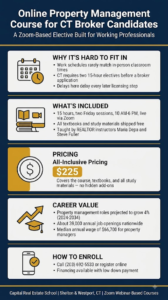
What is a Real Estate Broker Exam Prep Course & Why It Matters for Connecticut Broker Candidates

Most agents assume a broker license comes from one exam prep course. It does not. Connecticut requires four separate 15-hour components, each with its own hours, cost, and materials, before a candidate can even apply to sit the broker exam.

This article breaks down exactly what a real estate broker exam prep course in Connecticut includes, so you know what you are paying for before you enroll.

Quick Answer: A Connecticut broker candidacy consists of two mandatory 15-hour courses and two 15-hour electives, each priced separately, with materials either included or billed as an add-on depending on the school.

Real Estate Broker Exam Prep Simply Explained

Broker exam prep in Connecticut is not a single class; it is four DCP/REC-approved course components that each meet a specific licensing requirement before you can apply for your broker license.

“Connecticut requires broker candidates to complete a 15-hour Brokerage Principles and Practices course, a 15-hour Legal Compliance course, and two 15-hour elective courses before applying for a broker license,” according to the Connecticut Department of Consumer Protection.

Each course must be delivered by a school holding current DCP and REC approval, and the hours cannot be substituted with general real estate experience or self-study.

A candidate who completes all four components with an approved provider satisfies the education requirement and becomes eligible to schedule the PSI broker exam. In practice, this means a broker candidate is really enrolling in four distinct products, not one.

Principles and Practices covers brokerage operations and supervision. Legal compliance covers the regulatory and disclosure rules brokers are personally accountable for.

The two electives, commonly property management and real estate investment, round out the required hours with practical, job-relevant training rather than repeat exam theory.

Why the Hours-Cost-Materials Breakdown Matters to You

Understanding the full cost breakdown before you enroll protects you from add-on fees for books and materials that some schools bill separately from tuition.

Candidates who choose a course without checking what is included often discover that textbooks, study guides, or exam-specific materials are billed on top of the advertised tuition price.

Course transparency at enrollment directly affects whether a candidate completes their broker education on budget and on schedule, without unplanned mid-course costs. Courses that skip dedicated study support or charge separately for materials leave candidates more likely to face unplanned costs mid-course.

Knowing the complete breakdown in advance lets you compare offers accurately. A $300 course that includes a study book is not the same value as a $300 course that charges extra for the same book. The real cost of broker candidacy is tuition plus materials, not the advertised sticker price alone.

Common Misconceptions About Real Estate Broker Exam Prep Costs

Real estate broker exam prep courses are not priced or structured identically, and assuming otherwise leads to budgeting mistakes before you enroll.

Misconception 1: All Broker Courses Cost the Same

They do not. At Capital Real Estate School, the Broker Principles and Practices course is $300, Legal Compliance is $300, and each 15-hour elective is $225. 

Bundling Broker P&P and Legal Compliance together brings the combined cost to $500, a $100 savings over enrolling in each separately.

Misconception 2: Materials Always Cost Extra

Not with every provider. Capital Real Estate School includes the instructor study book in the price of the Broker P&P and Legal Compliance courses and full textbooks and study materials in the price of both elective courses, shipped free via USPS 2-day priority mail.

Confirming exactly what is included before enrolling, rather than assuming, is the single most useful check a broker candidate can make before committing to any course.

How Capital Real Estate School Breaks Down Hours, Costs, and Materials

Every real estate broker exam prep course at Capital Real Estate School lists its exact hours, price, and included materials upfront, so candidates can budget with no hidden fees.

Capital Real Estate School structures its broker candidacy offering around four confirmed components. The Broker Principles and Practices course runs two Friday-day sessions, 9:30 am to 5:30 pm, totaling 15 hours, priced at $300 and including the instructor’s study book.

The Legal Compliance course follows the same 15-hour, two-Friday-session format at $300, also with the instructor study book included. Students who take both together pay $500 as a bundle, saving $100 against the combined standalone price.

The two elective courses, Property Management and Real Estate Investment, each run two Friday-day sessions from 10:00 am to 6:00 pm, totaling 15 hours, priced at $225 with all textbooks and study materials included and shipped free of charge.

All four courses are Zoom webinar-based, letting working candidates complete broker education without traveling to a classroom, and all four are Connecticut DCP and REC-approved.

Frequently Asked Questions (FAQs)

Q1. How many hours does Connecticut require for a broker license?

Connecticut requires 60 Additional hours of approved broker candidacy education: a 15-hour Brokerage Principles and Practices course, a 15-hour Legal Compliance course, and two 15-hour elective courses. 

“This 60-hour requirement is confirmed by the Connecticut Department of Consumer Protection.”

Q2. Does the broker exam prep course include textbooks and study materials?

At Capital Real Estate School, yes. The Broker P&P and Legal Compliance courses include the instructor study book, and both elective courses include all textbooks and materials, shipped free via USPS 2-Day Priority Mail.

Q3. How much does the full broker candidacy course cost in Connecticut?

At Capital Real Estate School, the two mandatory courses cost $300 each, or $500 as a bundle, and each elective costs $225, with materials included in every course.

Q4. Can I bundle the Broker P&P and Legal Compliance courses?

Yes. Both Elective courses together cost $500, a $100 savings compared to enrolling in each separately at $300 a piece.

Q5. What is the difference between the Broker P&P course and the Legal Compliance course?

Broker Principles and Practices covers brokerage operations and business practice standards, while Legal Compliance focuses on regulatory and disclosure rules brokers must follow. Elective courses are 15-hour Friday day courses.

The Bottom Line

Understanding the full hours, cost, and materials breakdown puts you in control of your broker candidacy budget before you commit to a provider for a real estate broker exam prep course.

Capital Real Estate School’s Zoom-based Broker P&P, Legal Compliance, and elective courses are Connecticut DCP and REC approved; include all materials at no added cost; and offer a $100 bundle saving on the two mandatory courses.

Call Capital Real Estate School at (203) 692-5533 or register today to start your broker candidacy with a school that shows you exactly what you are paying for.

5 Things to Check Before Enrolling in a Property Investment Course in CT

One broker candidate asks five direct questions before enrolling in a property investment course. Another signs up for the first option she finds and pays full price without checking what’s included. 

A year later, the outcomes look very different; one candidate finished her elective without a single surprise cost, while the other is still tracking down a missing study guide. 

The difference comes down to five checks made before enrolling, not after. This article gives you deep insight into 5 things before enrolling in any property investment program.

Quick Answer: Checking approval status, fee inclusions, instructor background, schedule fit, and repeat policy before enrolling protects your time, your money, and your path to a Connecticut broker license.

How These Criteria Were Selected

These five checks reflect the questions Connecticut broker candidates should ask.

  • Regulatory approval, because unapproved hours do not count toward licensing eligibility.
  • Fee transparency, because hidden add-on costs are a common source of buyer frustration.
  • Instructor background, because real-world experience changes how useful the course actually is.
  • Schedule format, because working candidates need classes that fit around a current job.
  • Support policy, because unexpected delays should not mean losing your entire course fee.

Confirm About DCP/REC Approval First

Only a Connecticut DCP/REC-approved course counts toward your broker license, so this is the first thing to verify before paying for any property investment course.

Real estate schools operating in Connecticut must deliver all broker candidate courses, including Principles and Practices, Legal Compliance, and elective credits like Real Estate Investment, under approval from the Connecticut Department of Consumer Protection (DCP) and the Connecticut Real Estate Commission (REC). 

“Candidates must pass both portions of the state exam within one year of eligibility, and only approved coursework counts toward that eligibility window.” (Connecticut DCP) 

Schools without current DCP/REC approval cannot legally accept enrollments for state-qualifying courses, meaning hours completed elsewhere may never count toward a broker application.

Capital Real Estate School’s Real Estate Investment course is a 15-hour elective and priced at $225 with all textbooks and study materials included.

What it is

This elective covers investment principles for the real estate professional under full state approval, satisfying one of the broker candidate elective requirements.

Best for 

Candidates who need every course hour to count cleanly toward their broker license application.

One Honest Limitation

Approval confirms eligibility, not automatically course depth; candidates should still review what the curriculum covers.

Check What’s Actually Included in the Fee

A legitimate all-inclusive course fee covers textbooks and study materials with no separate add-on charges, so ask exactly what is bundled before you pay.

Some schools charge separately for textbooks, study guides, and practice materials, turning an advertised low price into a higher real cost once extras are added. 

A legitimate all-inclusive course covers textbooks, instructor study guides, and materials within the stated price. 

Capital Real Estate School’s Real Estate Investment elective is priced at $225, with all textbooks and study materials shipped free via USPS 2-Day Priority Mail or available for pickup at the Shelton Starbucks location.at it is

The stated course fee includes every material needed to complete the 15-hour elective, with no separate charges added later.

Best for

Cost-conscious candidates who want their total cost confirmed upfront.

One Honest Limitation

Inclusions vary by provider, so this must be confirmed directly before paying a deposit.

Ask Who Is Teaching the Course and What They Actually Do

An instructor who is an active real estate investor brings practical insight that classroom-only teaching cannot replicate, so ask about real-world experience before enrolling.

Active REALTORs® and professionals currently working in property management, investment, or brokerage bring practical experience to license preparation that purely academic instruction cannot replicate. 

Ask for instructor names, current licenses, and their real-world roles before committing to a course. This is a detail few Connecticut schools volunteer upfront in their published course listings.

Capital Real Estate School’s Real Estate Investment elective is taught by Melvin Hubbard, REALTOR® and real estate investor, bringing direct investment experience into the classroom rather than only theory.

What it is 

Verifying whether your instructor is an active investor tells you whether course content will reflect real market conditions.

Best for

Candidates want practical investment insight they can apply immediately.

One Honest Limitation

Not every provider publishes instructor credentials upfront, so this detail often has to be requested directly.

Verify the Schedule Fits Your Working Life

Confirming session format and timing before enrolling prevents scheduling conflicts that can derail your progress toward a broker license.

Working professionals need to know whether evening, weekend, or online Zoom-based options exist before committing and whether the schedule is fixed or revolving. 

Capital Real Estate School delivers its Real Estate Investment elective as a Zoom webinar-based course, held over two Friday-day sessions from 10:00 am to 6:00 pm, designed for candidates still working as licensed salespersons while completing broker requirements.

What it is

The elective runs as two structured Friday sessions rather than a drawn-out weekly schedule.

Best for

Candidates balancing current sales work with elective completion who need a compressed schedule.

One Honest Limitation

Fixed Friday sessions may not suit every candidate’s availability, so confirming dates in advance is essential.

Ask What Happens If You Need More Time

A repeat or extension policy enhances your course investment by providing flexibility for life’s unexpected events, so be sure to confirm this before you pay.

Ask whether a school allows you to repeat the course or access ongoing support if you cannot complete the material on your first attempt. 

Capital Real Estate School offers a free repeat of the full course for up to one year, so candidates who need more time are not forced to pay again from scratch.

What it is

This policy empowers candidates to retake the elective at no extra cost within a full year of enrollment.

Best for

Candidates who want a genuine safety net built into their enrollment.

One Honest Limitation

Repeat policies and terms can differ by provider, so it’s beneficial to confirm them in writing before making a deposit.

Frequently Asked Questions About Property Investment Course

Q1. Does a property investment course count toward my Connecticut broker license?

Only a course approved by the Connecticut DCP and REC counts toward broker licensing hours. Capital Real Estate School’s Real Estate Investment elective satisfies one of the required elective credits for broker candidacy.

Q2. How much does a property investment elective cost in Connecticut?

Capital Real Estate School’s Real Estate Investment course costs $225, and this price includes all textbooks and study materials shipped free via USPS 2-Day Priority Mail.

Q3. What if I cannot finish the course on my first attempt?

Candidates can repeat the full course at no additional cost within one year of their original enrollment, removing the financial risk of needing more time.

Q4. Who teaches the real estate investment elective?

The course is taught by Melvin Hubbard, REALTOR(R) and real estate investor, bringing direct real-world investment experience into the classroom.

Q5. Is the course available in an online format?

Yes, the elective is delivered live via Zoom webinar over two Friday-day sessions from 10:00 am to 6:00 pm, allowing candidates to attend from anywhere in Connecticut.

Ready to Complete Your Broker Elective the Right Way

Checking approval status, fee inclusions, instructor background, schedule fit, and repeat policy before you enroll turns an uncertain decision into a confident one for a property investment course in CT

Capital Real Estate School’s Real Estate Investment course meets all five checks.

Call (203) 692-5533 or register today to secure your seat in the next available session for our property investment course.

How to Choose the Right CT Real Estate Exam Prep School: Avoid Costly Mistakes

Most candidates only discover their school’s gaps after failing the PSI exam. By then, they have already paid for a repeat exam fee, lost weeks of progress, and started questioning whether real estate is even the right career move. 

The right CT real estate exam prep school prevents that outcome before it happens. This article walks through exactly what to check before you enroll, so you spend your money once and pass with confidence.

Quick Answer: Choosing a CT real estate exam prep school without checking approval status, cost inclusions, and retake support can cost candidates real time and real money.

What a CT Real Estate Exam Prep School Actually Involves

A CT real estate exam prep school is not just a classroom; it is your eligibility gateway to the PSI State Exam, and skipping the fine print here creates problems later.

Connecticut law requires every real estate salesperson candidate to complete a minimum of 60 hours of DCP and REC-approved instruction before they become eligible to sit the PSI State Exam. 

Broker candidates face separate requirements: a 15-hour Principles and Practices course and a 15-hour Legal Compliance course, both mandatory, plus elective credits in areas like property management or investment.

“Connecticut law also requires every course provider to hold current DCP and REC approval and to represent that approval accurately in all advertising and student communications, per the Connecticut Department of Consumer Protection real estate licensing approval standards.”

“The PSI State Exam itself follows a fixed format: 110 total questions, split into an 80-question national portion and a 30-question Connecticut state law portion,” according to the official PSI candidate examination handbook published for Connecticut real estate licensing.

Most candidates get one thing wrong when comparing schools: they assume all DCP-approved courses prepare them equally well for this exact structure. 

In reality, two approved schools can differ sharply in schedule flexibility, what is included in the price, and what happens if a student does not pass the PSI exam on the first attempt. These differences rarely surface until a candidate is already enrolled.

No competing CT real estate school currently publishes a structured, side-by-side evaluation checklist for choosing between schools. 

This article fills that specific gap for Connecticut candidates researching their options.

What to Look for in a CT Real Estate Exam Prep School Provider

Three criteria separate a school that sets you up to pass from one that leaves you exposed to hidden costs and wasted time.

1. DCP and REC Course Approval 

Confirm the specific course you plan to take: salesperson, broker principles and practices, legal compliance, or elective carries its own separate DCP and REC approval. 

Only approved courses count toward your 60-hour eligibility requirement for the PSI exam. Ask the school directly for written confirmation of approval status before you pay any deposit.

2. What is Included in the Course Fee?

Some schools charge separately for textbooks, study guides, and practice materials, which can add hundreds of dollars on top of the advertised tuition. 

A legitimate all-inclusive course covers textbooks, instructor study guides, online quizzes, and course videos within the stated price, with no add-on surprises after enrollment.

3. Course Retake and Repeat Policy

Ask what happens if you do not pass the PSI exam on your first try. 

Every failed attempt costs a non-refundable $59.00 examination fee payable directly to PSI, on top of the original $80.00 DCP application fee, per the Connecticut Department of Consumer Protection Real Estate Salesperson Initial Exam fee schedule. 

A school that lets you repeat the full course at no extra cost or join a dedicated retake program minimizes cost plus the failures. 

How Capital Real Estate School Approaches Exam Prep

Capital Real Estate School lets students repeat the full 60-hour Principles and Practices course at no extra cost for up to one year after enrollment, and every course includes 4 textbooks, which includes 2 instructor-authored study guides and practice exams shipped free via USPS 2-Day Priority Mail. 

This means there’s no hidden material fees added after enrollment. 

Classes run live via Zoom webinar, with evening sessions Tuesday and Thursday and Monday and Wednesday from 6:30 PM to 10:00 PM and Friday day sessions for broker candidates so working professionals can attend without disrupting their income.

Instructors Maria Depa and Steve Fuller are both active REALTORS, and Fuller also serves as an adjunct professor at Housatonic Community College, bringing current, practical real estate experience into the classroom rather than theory alone. 

Students who previously completed a 60-hour course at another school with valid receipts can join the P&P Salesperson Retake Course and attend any or all classes up to a year, at a total cost of $275.

Frequently Asked Questions (FAQs)

Q1. Is Capital Real Estate School approved by the CT DCP?

Yes. Every course offered by Capital Real Estate School, including the 60-hour Principles and Practices course, the Broker P&P course, Legal Compliance, and elective courses, holds full approval from the Connecticut Department of Consumer Protection and the Connecticut Real Estate Commission.

Q2. What happens if I do not pass the PSI exam on my first try?

You will owe a non-refundable $51.00 exam fee to retake it, on top of any application costs already paid to the DCP. Capital Real Estate School’s free one-year repeat policy and dedication to retaking the course

 Q3. Are textbooks included in the course price?

Yes. Capital Real Estate School includes all textbooks and instructor study guides in the listed course price, shipped free via USPS 2-Day Priority Mail, with no additional charges for materials.

Q4. What is the difference between evening and Friday schedules?

Evening classes run Tuesday and Thursday from 6:30 PM to 10:00 PM for the 60-hour Salesperson course, while broker candidate courses like Legal Compliance and Property Management run as Friday day sessions, typically 9:30 AM to 5:30 PM or 10:00 AM to 6:00 PM.

Q5. Can I switch schools if I already failed the PSI exam once?

Yes. Capital Real Estate School’s Retake Course specifically welcomes students who completed a 60-hour course at another school after January 1, 2025, or who hold  course school receipts after January 1, 2025.

Choosing the Right School Sets Up Everything That Follows

The right CT real estate exam prep school does more than get you into the classroom; it protects your time and your budget so you can pass on the first attempt. 

As though they have DCP and REC approval, ask exactly what is included in the fee, and check the retake policy before you commit to any provider.

Call Capital Real Estate School at (203) 692-5533 or register today to start your Connecticut real estate license journey with a school built around your schedule and your success.

Connecticut Real Estate License Requirements: Avoid These Mistakes Before You Enroll in 2026

Most aspiring agents only discover their course does not count toward PSI exam eligibility after they have finished every class. By then, the money is spent, and the only path forward is starting over. 

Understanding the Connecticut real estate license requirements before you enroll is what separates candidates who sit the PSI exam on schedule from those who repeat coursework at extra cost.

This article covers what Connecticut requires, what the PSI exam tests, how to vet any school before you commit, and what Capital Real Estate School delivers.

What Connecticut Requires Before You Can Sit the PSI Exam

Completing a 60-hour pre-licensing course does not automatically make you PSI exam-eligible; the course must come from a DCP/REC-approved provider. 

Schools without current Connecticut Department of Consumer Protection and Real Estate Commission approval cannot legally enroll students for state-qualifying courses.

The Four Official Requirements

Connecticut’s CT salesperson pre-licensing requirements apply to every candidate. All four must be met before you can sit the exam:

  • Age: You must be at least 18 years old at the time of application.
  • Education: You must complete a minimum of 60 hours in a DCP/REC-approved Principles and Practices course. Your completion certificate is required with your PSI exam application.
  • Examination: You must pass the two-part PSI State Exam covering national real estate law and Connecticut-specific state law.
  • Sponsorship: A licensed Connecticut broker must sponsor your application before your salesperson license activates.

Why DCP/REC Course Approval Is the Non-Negotiable First Step

Connecticut DCP/REC approval is course-specific. A school approved for the salesperson course may not hold separate approval for broker Principles and Practices or Legal Compliance. 

Confirm the specific approval for every course you plan to take before you pay a deposit.

Enrolling in an unapproved course means your hours may not count toward PSI exam eligibility, forcing a full restart at additional cost and lost time. 

What the PSI Exam Actually Tests, and Why Preparation Matters

The Connecticut PSI real estate exam tests two independent bodies of knowledge, and you must pass both sections separately to receive your license.

The Connecticut PSI real estate salesperson exam consists of 80 national questions and 30 Connecticut state-law questions, scored independently. You must achieve at least 70% on each section to pass. 

Failing either section, even if you pass the other, requires a full retake at $59 per attempt. 

Candidates may retake multiple times within their one-year eligibility window following course completion.” —Connecticut DCP PSI Candidate Handbook 

The national section covers property types, titles, contracts, agency law, and federal fair housing rules. The state section tests Connecticut-specific statutes, DCP licensing requirements, and CT disclosure obligations. 

Many candidates concentrate study time on the national content and underestimate the state section; that imbalance is one of the most common reasons for a second attempt.

The Real Cost of Failing Without the Right Preparation

Each retake costs $59 and delays the start of your real estate career. 

According to the U.S. Bureau of Labor Statistics Occupational Outlook Handbook (May 2024), The median annual wage for real estate sales agents is $56,320.” 

An income that only begins once your license is active. A course without structured PSI preparation and state-law review pushes that date back with every failed attempt.

What to Ask Before You Choose a Connecticut Real Estate School

Most Connecticut real estate school pages list the courses they offer, but not what happens when you struggle, what is actually included in the price, or whether instructors are actively working in real estate. 

These six questions close the gap that most candidates miss.

1. Is every course fully approved by Connecticut DCP and REC? 

Approval is course-specific; confirm each course you plan to take holds its own DCP/REC approval independently.

2. What is included in the course fee? 

A legitimate all-inclusive course covers textbooks, instructor guides, online quizzes, and course videos within the stated price.

3. What happens if you do not pass the PSI exam on your first attempt? 

Ask whether the school lets you repeat the course or join revolving classes within your one-year eligibility window at no extra charge.

4. Who are your instructors, and are they active in Connecticut real estate? 

Active REALTORS® bring current market knowledge and real transaction experience that classroom-only instruction cannot match.

5. What schedule options exist for working professionals? 

Evening and revolving enrollment options determine whether you can start without leaving your current job.

6. Is financing or an installment payment option available? 

Course fees between $225 and $425 represent a real upfront commitment; installment options lower the barrier for candidates managing existing financial obligations.

How Capital Real Estate School Meets Every Connecticut Requirement

Capital Real Estate School’s Principles and Practices The Real Estate Salesperson Course is a 60-hour, DCP/REC-approved, Zoom Webinar-based program priced at $425 all-inclusive. 

The $425 covers four textbooks, instructor study guides, online quizzes, and course videos, with no additional fees. 

Classes run Tuesday and Thursday evenings from 6:30 to 10:00 PM across 18 sessions, with revolving enrollment and a free one-year course repeat policy.

Course Delivery and What is Included

Textbooks and study materials ship free via USPS 2-Day Priority before your first class. The course satisfies the full DCP/REC 60-hour requirement, and your completion certificate is the document submitted with your PSI exam application. 

Capital Real Estate School holds DCP/REC approval for its salesperson, broker Principles and Practices, Legal Compliance, and approved elective courses and has served more than 9,000 Connecticut students across 16 years of operation.

The Instructors Behind the Preparation

Capital Real Estate School’s instructors are active Connecticut REALTORS® alongside an Adjunct Professor at Housatonic Community College. They teach PSI exam scenarios, state-law content, and CT disclosure requirements from current professional practice.

According to the 2025 NAR Realtor News, “With 16 or more years of experience, earn a median annual income of $78,900, compared to $8,100 for those with two years or less. 

The licensing stage is where that career foundation begins, and Capital Real Estate School’s curriculum is built around that foundation, not minimum exam compliance.

Frequently Asked Questions (FAQs)

1. Does Connecticut require a 60-hour course before I can take the real estate exam?

Yes. The Connecticut Department of Consumer Protection requires every salesperson candidate to complete a minimum of 60 hours of instruction in a DCP/REC-approved Principles and Practices course before sitting the PSI State Exam. 

2. What happens if I fail the Connecticut PSI real estate exam?

Connecticut candidates may retake the PSI exam multiple times within one year of their eligibility date at $59 per attempt, as confirmed by the Connecticut DCP PSI Candidate Handbook

3. How much does it cost to get a Connecticut real estate license in 2026?

Capital Real Estate School’s all-inclusive salesperson pre-licensing course costs $425, covering textbooks, instructor guides, quizzes, and videos with no add-on fees. 

4. How long does it take to complete the 60-hour pre-licensing course?

The full course runs across 18 Tuesday and Thursday evening sessions, approximately 9 weeks for most working professionals. Revolving enrollment means you join at the start of the next available class.

5. Is Capital Real Estate School approved by the Connecticut DCP and REC?

Yes. Capital Real Estate School holds full DCP/REC approval for its salesperson pre-licensing course, broker Principles and Practices, Legal Compliance, and approved elective courses. 

Your Next Step Toward a Connecticut Real Estate License

You now know what Connecticut real estate license requirements are, what the PSI exam tests, and which questions to ask before choosing a school. 

The path is clear: enroll in a DCP/REC-approved 60-hour course, prepare for both PSI sections with instruction grounded in Connecticut practice, and choose a school that supports you through every attempt without hidden costs.

Capital Real Estate School’s DCP/REC-approved Principles and Practices The Real Estate Salesperson Course is open for enrollment now; four textbooks ship to you before your first class at no additional charge. 

Enroll today and join your next available Tuesday/Thursday evening session with Capital Real Estate School!

CT Real Estate School With a Free Course Repeat: 5 Things to Check Before You Enroll

Most Connecticut real estate candidates only discover their school has no repeat policy after they fail the PSI exam. By then, they face a $59 retake fee, no class access, and a ticking one-year eligibility clock with no structured support to help them pass on the next attempt.

Nearly half of all candidates do not pass the first time, and most of them had no idea their school would not be there when it mattered most.

A CT real estate school with a free course repeat policy changes that equation. Before you enroll anywhere, here are five things in this guide you must confirm.

What a Course Repeat Policy Actually Covers

Not every school that mentions a “repeat” or “come until you pass” policy is offering the same thing. Understanding the operational difference before you enroll is the single most important step in protecting your investment.

Make-Up Classes vs. Course Repeat: They Are Not the Same

These two terms appear on many school websites, but they describe structurally different offers, and confusing them is a costly mistake.

  • A make-up class is attendance recovery. If you miss a scheduled session, you join a future session to cover that material. It does not give a candidate who has failed the PSI exam ongoing access to live instruction.
  • A course repeat means something different: a student who has completed the course and failed the PSI exam can re-enter live classes, attending as long as needed, with full instructor access, until they pass. That is the policy that protects you.

Connecticut real estate schools operate under DCP and REC approval for specific course content. Whether a school offers a true course repeat or only a make-up policy is a school-level decision, not a regulatory requirement. You must confirm it directly before you enroll.

The PSI One-Year Window and Why It Changes Everything

The Connecticut Department of Consumer Protection’s official PSI Candidate Information Bulletin confirms that candidates may retake the licensing exam on an unlimited basis for up to one year from the date of eligibility. 

Both the national portion and the Connecticut state law portion must be passed within that window, and each attempt carries a $59 examination fee.

A school whose repeat policy covers the full one-year window closes that gap. A school with no repeat policy leaves you self-studying between expensive attempts.

Five Things to Check in Any CT Real Estate School Before You Enroll

Before committing to any Connecticut pre-licensing course, confirm these five criteria. Each one directly affects your cost, your exam readiness, and your ability to pass within the PSI eligibility window.

When a school meets all five, DCP/REC approval, a genuine free repeat, all materials included, credentialed instructors, and a flexible delivery format, you have everything you need to pass the PSI exam and launch your career without unnecessary setbacks.

DCP/REC Approval: The Non-Negotiable Gate

The Connecticut Department of Consumer Protection requires completion of a 60-hour Real Estate Principles and Practices course from a DCP-approved school before a candidate is eligible to sit the PSI salesperson exam. 

Enrollment at an unapproved school means those hours do not count toward eligibility.

DCP/REC approval is course-specific. A school may hold approval for a salesperson P&P course but not for broker P&P, legal compliance, or elective credits. Ask for confirmation of active approval for every course you plan to take, not just the school name.

Every course at Capital Real Estate School holds full Connecticut DCP and REC approval, covering the 60-hour Salesperson P&P course, Broker P&P, Legal Compliance, and all broker candidate electives.

What the Free Repeat Actually Includes and What to Ask

Once a school confirms it offers a course repeat, go one level deeper with three specific questions:

  • Does the repeat provide ongoing access to live scheduled classes or just one additional session?
  • Are textbooks, study guides, and quizzes included for returning students at no added cost?
  • Is there any re-enrollment fee?

A genuine free repeat answers all three questions favorably. At Capital Real Estate School, students may repeat the full course for up to one year at no additional charge, with continued access to scheduled live instruction and no re-enrollment fees. 

Included Materials and Hidden Cost Protection

Many Connecticut real estate schools advertise a low tuition price but charge separately for textbooks, exam-prep resources, shipping, or supplemental study materials. Before enrolling, ask exactly what is included in the advertised tuition and whether any required materials carry an additional fee.

A complete pre-licensing package should include everything needed to complete the course and prepare for the PSI exam without unexpected costs appearing later in the process.

At Capital Real Estate School, the tuition includes four required textbooks, instructor-authored study guides, online quizzes, and course review videos. Textbooks are shipped directly to students, and there are no separate material fees added after enrollment. 

When comparing schools, calculate the total cost of attendance, not just the advertised course price.

Instructor Credentials and Active Field Experience

An instructor who is actively working as a REALTOR® in Connecticut brings current market knowledge to every session: how today’s transactions, buyers, and sellers actually behave, not just how they appear in a licensing exam. Ask any school you evaluate: Are your instructors currently licensed and working in Connecticut real estate?

Capital Real Estate School’s instructors are active REALTORS® with roles in property management, investment, and brokerage.

Flexible Delivery Format for Working Professionals

The best Connecticut real estate course is the one you can consistently attend. Many candidates are balancing full-time employment, family obligations, or changing work schedules, making flexibility an important factor in course completion.

Before enrolling, ask whether classes are offered live or self-paced, whether attendance can be completed remotely, and how quickly you can begin after registration. A format that fits your schedule reduces the risk of delays and missed sessions.

Capital Real Estate School delivers its courses through live Zoom Webinar-Based instruction, allowing students to attend from anywhere in Connecticut. Classes are held on a consistent Tuesday and Thursday evening schedule, making them accessible to working professionals. 

Because the program operates on a revolving schedule, students can join the current class in progress rather than waiting for a new semester or cohort to begin. 

Frequently Asked Questions (FAQs)

1. Does Connecticut allow you to retake the real estate exam more than once?

Yes. The Connecticut Department of Consumer Protection’s official PSI Candidate Information Bulletin confirms that candidates may retake the licensing exam on an unlimited basis for up to one year from the date of eligibility. Each attempt carries a $59 examination fee payable to PSI.

2. What is the difference between a make-up class and a free course repeat at a CT real estate school?

A make-up class covers a session you missed due to an absence; it is attendance recovery, not exam failure support. A course repeat gives a candidate who has failed the PSI exam ongoing access to live classes for as long as needed, without an additional fee. Only the course repeat protects you across the full one-year PSI eligibility window. Before enrolling, ask specifically which type of policy the school offers.

3. What should I ask a CT real estate school about its repeat policy before I enroll?

Ask three specific questions: 

a.) How long does the repeat access last? 

b.) Are all textbooks and materials included for returning students? 

c.) Is there any re-enrollment fee? 

A policy that answers all three favorably is a genuine safety net. A vague “come until you pass” tagline without these specifics is not.

4. Is Capital Real Estate School’s 60-hour course approved for the CT PSI exam?

Yes. Capital Real Estate School’s 60-hour Principles and Practices Real Estate Salesperson course is fully approved by the Connecticut Department of Consumer Protection (DCP) and the Connecticut Real Estate Commission (REC). Completion satisfies the 60-hour pre-licensing requirement, making you eligible to apply for the PSI salesperson examination. Broker P&P, Legal Compliance, and all elective courses also carry separate DCP/REC approval.

Make the Right Call Before You Enroll

The one-year PSI eligibility window is not a comfortable buffer; it is a deadline with a per-attempt fee attached. 

A Connecticut pre-licensing course in a real estate school in CT with a genuine free repeat policy, DCP/REC-approved curriculum, experienced instructors, and all materials included removes the biggest risk in the licensing process.

Capital Real Estate School offers all of that in a single Zoom Webinar-Based program built for working professionals. To enroll or confirm the next available session, call (203) 692-5533 or register at capitalrealestateschool.com

How to Get Your Real Estate License in Connecticut Without Losing Your Income

Before most people pursue their real estate license in Connecticut, they pick a school based on price or scheduling alone, a shortcut that often backfires. 

Completing 60 hours only to find the school lacked DCP/REC approval means those hours won’t count toward PSI exam eligibility, forcing a costly restart and months lost. 

This guide walks through each step in the correct sequence. CT salesperson licensure requires a 60-hour DCP/REC-approved course, a two-part PSI exam pass, and a DCP application; the school you choose determines how cost-effectively you reach each milestone. 

What You Need Before You Start

Connecticut sets three eligibility requirements before you can enroll in a pre-licensing course and sit the PSI exam. Knowing them upfront prevents wasted enrollment fees and avoids a compliance problem that only surfaces after the fact.

Connecticut’s Three Eligibility Requirements

The Connecticut Real Estate Commission mandates the following before a candidate may apply to sit the PSI State Exam:

  • Age: You must be at least 18 years old.
  • Education: A high school diploma or its equivalent is required.
  • Approved course: You must complete a Connecticut DCP and REC-approved 60-hour Principles & Practices course.

Only courses with current Connecticut Department of Consumer Protection and Real Estate Commission approval satisfy the 60-hour requirement for PSI exam eligibility.portal.ct.gov, Real Estate Salesperson Initial Exam Application

Schools without current DCP/REC approval cannot legally enroll candidates for state-qualifying courses. Confirm approval status before you pay a deposit.

Step-by-Step: How to Get Your Connecticut Real Estate License

The Connecticut real estate licensing process follows four steps, from course enrollment to DCP license activation. 

Each step carries a specific cost and timing that working professionals should plan around before starting.

Step 1: Complete the 60-Hour DCP/REC-Approved Course

Enroll in a Connecticut DCP and REC-approved Principles & Practices course covering the full 60-hour requirement. Capital Real Estate School delivers this course via live Zoom webinar on Tuesday and Thursday evenings from 6:30 PM to 10:00 PM across 18 sessions. 

Revolving enrollment means you join at any point without waiting for a new cohort. All four textbooks and instructor study guides are included in the $425 fee, shipped free via USPS 2-Day Priority Mail.

Step 2: Pass the Connecticut PSI Exam

After completing the course, schedule the PSI exam through your Connecticut e-License account. The exam covers 110 questions, 80 on national real estate principles and 30 on Connecticut state law, with a 165-minute time limit and a required 70% scaled score per section.

The exam fee is $59 per attempt, and Connecticut allows candidates to retake within one year of course completion.” —Connecticut Department of Consumer Protection

A course that embeds practice testing, online quizzes, and a study guide directly determines how many attempts you need.

Step 3: Secure a Sponsoring Broker and Submit Your DCP Application

A Connecticut real estate salesperson license does not activate until a licensed broker sponsors it. Start identifying potential sponsoring brokers during your course, not after the exam, to avoid weeks of delay between your score report and your active license.

Once you have a broker, submit the DCP initial license application through eLicense with your course completion certificate, PSI score report, broker details, and the $80 application fee. 

The Connecticut Department of Consumer Protection activates the license upon approval, and you begin practicing under broker supervision immediately. 

Capital Real Estate School’s curriculum covers sales practices, investment principles, and professional conduct, so candidates enter broker conversations with practical grounding, not just an exam pass.

What the PSI Exam Actually Costs If You Are Not Prepared

Most licensing guides focus on how to pass the PSI exam. None address what failing actually costs a working professional or which school features are built to absorb that risk.

The Real Cost of a First-Attempt Failure

Each PSI retake costs $59 per sitting. Candidates who fail individual sections pay per section, per attempt. 

Beyond the fee, every week without an active license is a week without commission income for a career changer, and rescheduling, additional study time, and waiting for a new exam slot typically add several weeks to that gap.

Connecticut’s estimated first-attempt pass rate falls between 45% and 65%; this is an estimate based on available state-level data, not a confirmed official figure. 

The issue is not the exact number. The issue is that a first-attempt setback is a common outcome, and the school you choose determines whether it costs you money and weeks, or nothing at all.

How Capital Real Estate School Reduces That Risk

Capital Real Estate School structures its courses to reduce both the likelihood and the cost of a PSI setback:

  • Free Course Repeat for Up to One Year: Repeat the full 60-hour course at no additional charge if you need more preparation time.
  • Revolving Enrollment: Join a new class session immediately after a retake decision; no waiting period required.
  • Dedicated P&P Salesperson Retake Course ($275): Open to candidates from any Connecticut school holding PSI receipts dated on or after January 1, 2025. Attend until you pass; no session limit.
  • Exam Preparation Embedded in the Course: Online quizzes, course videos, and proprietary instructor study guides are included in the $425 fee, not sold separately.

What to Look for When Choosing a Connecticut Pre-Licensing School

Two criteria separate a school that gets you licensed from one that leaves you repeating the PSI exam at your own expense. Both apply before you enroll, not after you complete the course.

DCP/REC Approval and All-Inclusive Pricing

Confirm current DCP/REC approval before enrolling, and confirm it for the specific course you are taking. Salesperson P&P, broker P&P, legal compliance, and elective courses each carry separate approval requirements. An approval for one course does not extend to another.

Ask exactly what the stated fee covers. Some Connecticut schools charge separately for textbooks and materials, adding $100 or more to the listed price. 

A legitimate all-inclusive course covers textbooks, instructor study guides, quizzes, and course videos within a single enrollment fee. 

Schedule Flexibility and Financing for Working Professionals

The schedule you choose determines whether you can stay employed during the licensing process. Capital Real Estate School’s Tuesday and Thursday evening sessions run 6:30 PM to 10:00 PM via live Zoom Webinar, with revolving enrollment and no waiting for a new cohort start date. 

For candidates managing existing financial commitments, financing and installment payment options with a low down payment reduce the upfront barrier to enrollment.

Frequently Asked Questions (FAQs)

1. How many hours do I need to get a real estate license in Connecticut?

Connecticut requires a minimum 60-hour DCP/REC-approved Principles & Practices course before you can apply to sit the PSI exam.

2. What happens if I fail the Connecticut PSI real estate exam?

Connecticut allows candidates to retake the PSI exam within one year of course completion, at $59 per attempt. 

3. Can I complete the Connecticut real estate pre-licensing course entirely online?

Yes, Connecticut DCP/REC-approved courses can be delivered via live Zoom Webinar. Capital Real Estate School’s 60-hour course runs fully online, taught by active REALTORS® and an Adjunct Professor at Housatonic Community College. All required textbooks and study guides ship free before your first session begins.

4. How much does it cost to get a real estate license in Connecticut?

The primary costs are: the pre-licensing course fee ($425 at Capital Real Estate School, all textbooks included), the PSI exam fee ($59 per attempt), and the Connecticut DCP application fee ($80). Financing and installment options are available for candidates managing existing financial obligations during a career transition.

The Steps Are Clear: The School You Choose Decides the Rest

You now have the full sequence: a 60-hour DCP/REC-approved course, a PSI exam pass, a sponsoring broker, and a DCP application. The process of getting a real estate license in Connecticut is straightforward. 

What is not straightforward is completing it without a setback that costs time and money you did not budget for.

The school you choose determines whether a first-attempt PSI result delays your career or gets absorbed by a free repeat and a retake program built for working professionals.

Enroll in Capital Real Estate School‘s 60-hour Principles & Practices Salesperson Course today, or call (203) 692-5533 to speak with The CRES Team about scheduling, financing options, and the next available session!

TOPIC 12: CT LAW State Portion Exam : What Every Real Estate Student Needs to Know to Pass the PSI CT State PortionExam in 2026 (copy)

Connecticut_Courtroom_Real_Property_Settlement

Connecticut_Courtroom_Real_Property_Settlement

CT LAW State Portion Exam: Your Complete PSI CT Law Portion Exam Study Guide

By Capital Real Estate School | Real Estate Licensing Exam Prep Series

Real Estate Brokerage and Agency: CT Law Portion Exam Review.

What does a Connecticut real estate broker or salesperson legally need to do before representing a client?

In Connecticut, a real estate license is required for anyone who, for another person and for compensation, negotiates, sells, leases, or offers to buy or exchange real estate. Unlicensed activities include administrative tasks like answering phones or making appointments, but negotiating any terms of a deal always requires a license.

Connecticut operates under a fiduciary duty framework. A licensee representing a client must provide the following:

  • COALD — Care, Obedience, Accounting, Loyalty, and Disclosure

Types of agency relationships in CT:

RelationshipWho Is Represented
Seller’s AgentSeller only
Buyer’s AgentBuyer only
Dual AgentBoth parties (with written consent)
Designated AgencyEach party has its own agent within the same firm
FacilitatorNeither party has a fiduciary duty


PSI Exam Tip: Expect 2–3 questions on the difference between a facilitator and an agent. In CT, a facilitator owes no fiduciary duty but must still treat both parties honestly and fairly. Dual agency in CT requires informed written consent from all parties.

Record Retention: Connecticut licensees must retain transaction records for 7 years.

Client Representation Agreements

What must a Connecticut listing agreement include by law?

Written agency agreements are required in CT before a broker or licensee may negotiate a sale, purchase, exchange, or lease. The written agreement must include:

  • Property identification
  • Compensation terms
  • Start and expiration dates
  • Type of agency relationship
  • Signatures and addresses of all parties

Types of listing agreements:

TypeKey Feature
Exclusive Right to SellThe broker earns commission regardless of who sells
Exclusive AgencyThe owner may sell without owing a commission
Open ListingMultiple brokers; only the selling broker earns
Net ListingBroker keeps all above a set net price (rare; risky)


PSI Exam Tip: The Exclusive Right to Sell is the most tested listing type. Know that CT law requires agency agreements to state that broker compensation is NOT fixed by law and is negotiable. This statement must be in at least 10-point boldface type.

A Prospective Parties Disclosure Notice must be provided to any prospective client at the first personal meeting.

Interests in Real Estate

Connecticut recognizes different types of interests a person can hold in real estate, from full ownership (fee simple) to partial rights, such as easements.

Key types of real estate interests:

  • Fee Simple Absolute: Complete ownership with no conditions
  • Life Estate: Ownership limited to a person’s lifetime
  • Easements: The right to use another’s land for a specific purpose
  • Easement by Prescription: Acquired through open, continuous, hostile use (like adverse possession but for use, not ownership)
  • Water Rights: CT recognizes riparian rights (rights of landowners along waterways)

PSI Exam Tip: Know the difference between an easement appurtenant (attached to the land and transfers with the deed) and an easement in gross (a personal right that does not transfer). CT exam questions often ask which type survives a property sale.

Forms of Real Estate Ownership

What is the difference between joint tenancy and tenancy in common in Connecticut?

FeatureJoint TenancyTenancy in Common
Right of SurvivorshipYES, survivor inheritsNO, it passes to heirs
Equal Shares RequiredYESNO, unequal shares allowed
Number of Owners2 or more2 or more
Common in CTLess commonMost common form


Connecticut Common Interest Ownership Act (CIOA): Governs condominiums, cooperatives, and planned communities. All new common interest communities must comply with CIOA. This unit also addresses time-share interests.

PSI Exam Tip: Know that Connecticut’s CIOA requires a public offering statement for the sale of new condominium units. Furthermore, memorize the four unities required for joint tenancy: Time, Title, Interest, and Possession (TTIP).

Legal Descriptions

Three methods are used to legally describe real estate in Connecticut:

  1. Metes and Bounds: The oldest method, using distances and directions from a point of beginning (POB). This method is most common in New England, including CT.
  2. Lot and Block (Plat Map): Used in subdivisions; it refers to a recorded plat.
  3. Monument Method: Uses physical landmarks (less precise; rarely used alone).

PSI Exam Tip: For CT, know that metes and bounds is the dominant method. A legal description must always be able to return to its point of beginning to be valid. Common interest community units are described under the CIOA using a unit-designation and common-element approach.

Real Estate Taxes and Other Liens

How are property taxes calculated in Connecticut?

Connecticut assesses property at 70% of fair market value. The tax rate (mill rate) is expressed as dollars per $1,000 of assessed value.

Formula: Assessed Value × Mill Rate ÷ 1,000 = Annual Tax

Priority of Liens in CT (General Order):

PriorityLien Type
1stReal estate tax lien
2ndSpecial assessment liens
3rdMechanic’s liens
4thMortgage liens (by recording date)
5thJudgment liens


Other key CT taxes:

  • Conveyance Tax (Transfer Tax): CT charges a conveyance tax on deed transfers. The rate is tiered based on sale price and property type.
  • Use Tax / Mil Rate: Set by local municipalities; varies by town.

PSI Exam Tip: CT exam questions often focus on property tax assessment at 70% and calculating taxes using the mill rate. Also know that real estate tax liens take priority over mortgage liens regardless of recording date. There are no actual math questions on this portion of the PSI Exam.

Real Estate Contracts

What are the essential elements of a valid real estate contract in Connecticut?

For any contract to be legally enforceable:

  1. Offer and Acceptance (mutual assent)
  2. Consideration (something of value exchanged)
  3. Legally competent parties
  4. Legal purpose
  5. Statute of Frauds: Real estate contracts must be in writing to be enforceable in CT

Key contract types in CT:

Contract TypePurpose
Purchase and Sale AgreementPrimary residential sales contract
Option ContractThe buyer pays for the right to purchase later
Land Contract (Installment Sale)The seller retains title until paid in full
Lease with Option to BuyCombines a lease with a purchase option


Residential Property Condition Report: Sellers of residential property (1–4 units) must provide buyers with a written Property Condition Disclosure Report (CGS §20-327b). Failure to provide it requires a $500 credit to the buyer at closing.

PSI Exam Tip: Know the $500 credit rule for failing to deliver the Property Condition Report. Furthermore, memorize that real estate contracts must be in writing (Statute of Frauds) and that an acceptance must mirror the offer exactly; any change creates a counteroffer, not an acceptance.

Transfer of Title

What type of deed provides the greatest protection to a buyer in Connecticut?

Deed TypeWarranty Level
General Warranty DeedFull warranty against all claims — best protection
Special Warranty DeedWarranty only against the grantor’s own acts
Quitclaim DeedNo warranty, transfers only what the grantor owns
Bargain and Sale DeedNo express warranties are implied; ownership


Real Estate Conveyance Tax: CT imposes a tax on property transfers. The base rate is 0.75% on the first $800,000 and 1.25% on amounts above $800,000 for most residential properties. There is also a municipal conveyance tax of up to 0.25%. Please Note: There are no actual math questions on this portion of the PSI Exam.

Adverse Possession in CT: A person may gain title to property through open, notorious, continuous, hostile, and actual possession for 15 years (prescriptive period) in Connecticut.

PSI Exam Tip: Know all deed types and their warranty levels. Furthermore, memorize the 15-year period for adverse possession in CT (not 10 or 20, a common trick question). The CT conveyance tax rates are frequently tested.

Title Records

Why is recording a deed important in Connecticut?

Recording provides constructive notice to the world that ownership has changed. Connecticut uses a race-notice recording system; the first person to record without notice of prior claims wins.

Evidence of Title Methods:

MethodDescription
Abstract of TitleSummary of all recorded documents
Attorney’s Title OpinionLawyer’s review of abstract
Title InsurancePolicy protecting against defects (owner’s or lender’s)
Torrens SystemCourt-certified title registration (rare in CT)


Marketable Record Title Act (MRTA): CT has adopted this act, which limits title searches to a 40-year period. Claims older than 40 years are generally extinguished unless a notice is filed to preserve them.

PSI Exam Tip: The 40-year MRTA search period is a high-frequency CT exam topic. Also, know the difference between an owner’s title insurance policy (one-time premium, protects the buyer) and a lender’s title insurance policy (protects only the mortgage lender).

Real Estate License Law (Highest Exam Priority)

What are the Connecticut real estate license requirements, fees, and renewal rules?

CT Real Estate Commission

The Connecticut Real Estate Commission (under the Department of Consumer Protection) oversees all licensees. It has the authority to grant, suspend, revoke, and reinstate licenses.

License Types and Requirements

License TypeEducation RequiredExperienceExam
Salesperson60-hour pre-license courseNonePSI exam (national + state)
Broker60-hour pre-license course2 years as active salespersonPSI exam
Appraisal LicensesVaries by categoryVariesSeparate exam


License Renewal and Continuing Education

RequirementDetails
Renewal PeriodEvery 2 years
CE Hours Required12 hours per renewal period
Required CE TopicFair Housing (mandatory every renewal)
Inactive StatusLicense kept without practicing


Conduct of Licensees: Key Rules

  • Trust Accounts: All client funds must be deposited in a separate escrow/trust account within 3 banking days of the signed agreement.
  • Advertising: No blind ads allowed. All ads must display the licensee’s name, the supervising broker’s name, and the supervising broker’s contact information.
  • Disclosure of Interest: Licensees must disclose in writing any personal interest in a property being bought or sold (CGS §20-328-2a).
  • Compensation: Cannot be shared with unlicensed individuals. Must be paid through the broker, not directly from a client to the salesperson.
  • Custodial Broker: Appointed when a broker dies or becomes incapacitated; may serve for up to 180 days.
  • Referral Fees: Cannot be paid to unlicensed individuals engaging in the CT real estate business.

Grounds for License Suspension or Revocation

ViolationPotential Penalty
Misrepresentation or fraudRevocation
Commingling client fundsFine up to $1,000 and/or 6 months imprisonment
Violations of fair housing lawSuspension/revocation
Failure to disclose the agencySuspension
Unlicensed practiceCriminal penalties

Real Estate Financing: Principles/Practice

What is the difference between a mortgage deed and a promissory note in Connecticut?

In CT, a mortgage transaction involves two documents:

  1. Promissory Note: The borrower’s promise to repay the debt
  2. Mortgage Deed: The document pledging the property as collateral

CT is a modified title theory state: the lender technically holds title during the loan period, though the borrower retains possession, and a formal foreclosure process.

Foreclosure in CT: Connecticut uses judicial foreclosure (court process). Two types:

  • Strict Foreclosure: The court sets a deadline; if the borrower doesn’t pay, title passes directly to the lender.
  • Foreclosure by Sale: Property is sold; borrower may receive surplus proceeds

Predatory Lending: CT has strict protections against predatory lending practices, particularly for high-cost home loans.

PSI Exam Tip: CT is one of only a few title theory states still using strict foreclosure; both facts appear regularly on the PSI exam. Know the difference between a mortgage deed (security instrument) and a promissory note (debt obligation).

Leases

What are a landlord’s and tenant’s rights and obligations under Connecticut’s Landlord and Tenant Act?

Connecticut’s Landlord and Tenant Act (CGS §47a) is heavily tested on the PSI exam. Key provisions:

Security Deposits

Tenant AgeMaximum Security Deposit
Under 62 years old2 months’ rent
62 years old or older1 month’s rent
Return deadline30 days after move-out (15 days if no deductions)


Landlord Obligations

  • Maintain premises in a fit and habitable condition
  • Comply with applicable building and housing codes
  • Provide heat from October 1 to May 1 (residential)
  • Make all repairs not caused by the tenant

Tenant Obligations

  • Pay rent on time
  • Keep the unit clean and undamaged
  • Do not disturb other tenants
  • Allow reasonable landlord entry (with proper notice)

Eviction (Summary Process)

CT’s summary process (eviction) requires the following:

  1. Written notice to quit (typically 3 days for nonpayment)
  2. Court filing if the tenant does not vacate
  3. Judge’s decision: if the tenant loses, the marshal enforces

Real Estate Appraisal

What are the four CT appraisal license categories?

License/CertificationScope of Practice
TraineeWorks under the supervision of an appraiser
Licensed ResidentialNon-complex 1–4 unit residential
Certified ResidentialAll residential property
Certified GeneralAll property types, including commercial


The three approaches to value tested on PSI are:

  1. Sales Comparison Approach: Most common for residential property
  2. Cost Approach: Best for new construction and special-use property
  3. Income Approach: Used for income-producing property

PSI Exam Tip: Know that the Sales Comparison Approach is typically preferred for single-family homes. The Income Approach uses the capitalization rate (Cap Rate = NOI ÷ Value). CT appraisers are regulated under the Real Estate Appraisal Commission. Please note: There are no actual math questions on this portion of the PSI Exam.

Land-Use Controls and Property Development

What is the purpose of zoning in Connecticut?

Zoning divides land into districts controlling the use, height, and density of buildings. Connecticut’s zoning is administered by local municipalities, not the state.

Key Land-Use Tools:

ToolPurpose
Zoning OrdinanceRegulates permitted uses by district
VariancePermission to deviate from zoning rules
Special Exception (Use Permit)Permitted use requiring additional approval
Nonconforming UsePre-existing use that doesn’t comply with current zoning
Subdivision RegulationsControl how land is divided


Connecticut Interstate Land Sales: Large subdivisions (25+ lots) offered across state lines may require registration under the Interstate Land Sales Full Disclosure Act (ILSFDA). CT also has its own regulations for large-scale developments.

PSI Exam Tip: Distinguish between a variance (hardship-based deviation) and a special exception (conditionally permitted use). Know that nonconforming uses are allowed to continue, but generally cannot be expanded. Eminent domain (the government’s power to take private property for public use) requires just compensation.

Fair Housing (Highest Exam Priority)

What classes are protected under both federal and Connecticut fair housing laws?

Federal Fair Housing Act (1968) — Protected Classes

Race, Color, Religion, Sex, National Origin, Familial Status, Disability (Handicap)

Connecticut Additional Protected Classes

Connecticut adds several classes beyond federal law:

CT-Only Protected ClassNotes
AgeAny age (not just familial status/children)
Marital StatusSingle, married, divorced
Sexual OrientationIncluding gender identity and expression
Lawful Source of IncomeSection 8 vouchers, child support, etc.
Veteran StatusVeterans and active military
Victims of Domestic ViolenceProtected in housing decisions
“Clean Slate” (Erased Criminal Records)May not use expunged records in housing decisions
Physical, Mental, or Learning DisabilityBroader than the federal definition
Ethnic OriginSpecifically listed


Discriminatory Practices: Prohibited Actions

  • Steering: Directing buyers/renters toward or away from neighborhoods based on protected class
  • Blockbusting: Inducing owners to sell by suggesting protected groups are moving in
  • Redlining: Denying loans/insurance based on neighborhood demographics
  • Discriminatory Advertising: Any preference or limitation based on a protected class

Closing the Real Estate Transaction

What happens at a Connecticut real estate closing?

In CT, closings are typically handled by an attorney. Key closing documents and concepts:

DocumentPurpose
Closing Disclosure (CD)Final summary of loan costs (required 3 business days before closing)
HUD-1 StatementUsed for non-RESPA transactions
DeedTransfers legal title from seller to buyer
Promissory NoteBuyer’s promise to repay the mortgage
Mortgage DeedSecures the lender’s interest in the property


Prorations at Closing: Property taxes, rents, and HOA fees are prorated between buyer and seller based on the closing date. CT uses a 365-day year for proration calculations (actual/actual method).

PSI Exam Tip: Buyers receive the Closing Disclosure at least 3 business days before closing (a TRID/RESPA requirement). Practice proration math using the 365-day method. Understand the seller’s net sheet and buyer’s estimated closing costs.

Environmental Issues and the Real Estate Transaction

What environmental hazards must Connecticut real estate licensees know about?

HazardKey Facts for CT Exam
Lead-Based PaintDisclosure required for pre-1978 homes; federal law
AsbestosCommon in pre-1980 insulation and tiles
RadonOdorless gas; CT has elevated radon levels; testing recommended
Underground Storage Tanks (USTs)Liability risk; must be removed or properly closed
WetlandsCT DEP regulates wetland disturbances
Hazardous Waste (Superfund)Sellers must provide notice of CTDEEP list availability
Urea-Formaldehyde Foam InsulationBanned from use; disclosure required if present


Off-Site Conditions: CT law excuses seller/agent liability for off-site hazardous waste if written notice is provided to buyers about the CTDEEP list at or before signing the purchase contract (CGS §20-327f).

PSI Exam Tip: The off-site hazardous waste written notice rule is CT-specific and frequently tested. Also know that lead-based paint disclosure is a federal requirement for all homes built before 1978 and that buyers have a 10-day window to conduct lead testing (they can waive this right).

Real Estate Securities

When does selling real estate become regulated as a securities transaction in Connecticut?

Real estate becomes a security when buyers invest primarily for profit from others’ efforts, rather than for personal use. This rule applies to:

  • Real Estate Investment Trusts (REITs)
  • Real estate syndications and limited partnerships
  • Fractional interests sold as investments

CT Regulations: Connecticut follows the Uniform Securities Act for real estate securities. Any offer or sale of real estate securities in CT must be registered or exempt. The CT Department of Banking regulates securities offerings.

PSI Exam Tip: The key test for whether real estate is a security: Is the buyer relying on the efforts of others to generate profit? If so, it is a security. Know that REITs allow investors to pool money to invest in large real estate portfolios. Unlicensed individuals selling real estate securities face serious legal consequences.

Top 10 PSI CT Law Exam Tips

What are the most important things to know for the PSI Connecticut Law exam?

#TipUnit
1Trust account deposit = 3 banking days from signed agreement10
2Property assessed at 70% of fair market value in CT6
3Adverse possession = 15 years in CT8
4Security deposit max = 2 months (1 month if tenant is 62+)12
5CT Marketable Record Title Act = 40-year search limit9
6CT adds 8+ protected classes beyond federal fair housing15
7CT is a title theory / strict foreclosure state11
8Property Condition Report failure = $500 buyer credit7
9Compensation is NOT fixed by law, must say so in 10-point bold2
10A custodial broker may serve up to 180 days10


Quick-Reference: Key CT Statutes and Numbers

TopicCT Statute / Rule
License LawCGS §20-311 et seq.
Agency DisclosureCGS §20-325d
Property Condition DisclosureCGS §20-327b
Landlord and Tenant ActCGS §47a
Fair Housing (CT)CGS Title 46a, Chapter 814c
Environmental DisclosureCGS §20-327f
Record Retention3 years
Trust Account DepositWithin 3 banking days
License RenewalEvery 2 years
CE Hours Required12 hours / 2 years
Adverse Possession15 years
Property Assessment Rate70% of fair market value
MRTA Search Period40 years
Security Deposit Max (under 62)2 months’ rent
Security Deposit Max (62+)1 month’s rent
Security Deposit Return30 days (15 days if no deductions)
Custodial Broker DurationUp to 180 days


Exam Strategy: How to Approach PSI CT Law Questions

  1. Read the question twice. PSI questions often include “except,” “most likely,” or “which of the following is NOT”; these reverse the expected answer.
  2. Look for CT-specific clues. If a question involves a number (days, percentages, months), it is almost always testing a CT-specific rule. Use the tables above.
  3. Eliminate first. Cross out answers that are clearly wrong before choosing. Two answers are usually close; pick the one that is more specific to Connecticut law.
  4. Agency = written agreement. For any question about when agency begins in CT, remember: no written agreement = no agency relationship recognized by the Commission.
  5. Fair housing = broadest protection wins. When in doubt, CT law is more protective than federal law. In Connecticut, if federal law does not include a CT class, the CT rule applies.

This article is intended only as an educational study guide for the PSI State Portion exam preparation and does not constitute legal advice.
Good luck on your PSI exam! Remember, understanding valuation isn’t just about passing the test. It’s one of the most practical skills you’ll use every single day in your real estate career.

Tags: Connecticut real estate law, PSI exam prep, CT real estate license, real estate exam tips, CT law exam, license law Connecticut, agency relationships, fair housing Connecticut, landlord-tenant CT, security deposit CT, real estate contracts, property disclosure CT, CT deed types, adverse possession, conveyance tax CT, property tax CT, mill rate, title search CT, real estate appraisal, CT zoning law, CIOA Connecticut,

TOPIC 12: CT LAW State Portion Exam : What Every Real Estate Student Needs to Know to Pass the PSI CT State PortionExam in 2026

Connecticut_Courtroom_Real_Property_Settlement

Connecticut_Courtroom_Real_Property_Settlement

CT LAW State Portion Exam: Your Complete PSI CT Law Portion Exam Study Guide

By Capital Real Estate School | Real Estate Licensing Exam Prep Series

Real Estate Brokerage and Agency: CT Law Portion Exam Review.

What does a Connecticut real estate broker or salesperson legally need to do before representing a client?

In Connecticut, a real estate license is required for anyone who, for another person and for compensation, negotiates, sells, leases, or offers to buy or exchange real estate. Unlicensed activities include administrative tasks like answering phones or making appointments, but negotiating any terms of a deal always requires a license.

Connecticut operates under a fiduciary duty framework. A licensee representing a client must provide the following:

  • COALD — Care, Obedience, Accounting, Loyalty, and Disclosure

Types of agency relationships in CT:

RelationshipWho Is Represented
Seller’s AgentSeller only
Buyer’s AgentBuyer only
Dual AgentBoth parties (with written consent)
Designated AgencyEach party has its own agent within the same firm
FacilitatorNeither party has a fiduciary duty


PSI Exam Tip: Expect 2–3 questions on the difference between a facilitator and an agent. In CT, a facilitator owes no fiduciary duty but must still treat both parties honestly and fairly. Dual agency in CT requires informed written consent from all parties.

Record Retention: Connecticut licensees must retain transaction records for 7 years.

Client Representation Agreements

What must a Connecticut listing agreement include by law?

Written agency agreements are required in CT before a broker or licensee may negotiate a sale, purchase, exchange, or lease. The written agreement must include:

  • Property identification
  • Compensation terms
  • Start and expiration dates
  • Type of agency relationship
  • Signatures and addresses of all parties

Types of listing agreements:

TypeKey Feature
Exclusive Right to SellThe broker earns commission regardless of who sells
Exclusive AgencyThe owner may sell without owing a commission
Open ListingMultiple brokers; only the selling broker earns
Net ListingBroker keeps all above a set net price (rare; risky)


PSI Exam Tip: The Exclusive Right to Sell is the most tested listing type. Know that CT law requires agency agreements to state that broker compensation is NOT fixed by law and is negotiable. This statement must be in at least 10-point boldface type.

A Prospective Parties Disclosure Notice must be provided to any prospective client at the first personal meeting.

Interests in Real Estate

Connecticut recognizes different types of interests a person can hold in real estate, from full ownership (fee simple) to partial rights, such as easements.

Key types of real estate interests:

  • Fee Simple Absolute: Complete ownership with no conditions
  • Life Estate: Ownership limited to a person’s lifetime
  • Easements: The right to use another’s land for a specific purpose
  • Easement by Prescription: Acquired through open, continuous, hostile use (like adverse possession but for use, not ownership)
  • Water Rights: CT recognizes riparian rights (rights of landowners along waterways)

PSI Exam Tip: Know the difference between an easement appurtenant (attached to the land and transfers with the deed) and an easement in gross (a personal right that does not transfer). CT exam questions often ask which type survives a property sale.

Forms of Real Estate Ownership

What is the difference between joint tenancy and tenancy in common in Connecticut?

FeatureJoint TenancyTenancy in Common
Right of SurvivorshipYES, survivor inheritsNO, it passes to heirs
Equal Shares RequiredYESNO, unequal shares allowed
Number of Owners2 or more2 or more
Common in CTLess commonMost common form


Connecticut Common Interest Ownership Act (CIOA): Governs condominiums, cooperatives, and planned communities. All new common interest communities must comply with CIOA. This unit also addresses time-share interests.

PSI Exam Tip: Know that Connecticut’s CIOA requires a public offering statement for the sale of new condominium units. Furthermore, memorize the four unities required for joint tenancy: Time, Title, Interest, and Possession (TTIP).

Legal Descriptions

Three methods are used to legally describe real estate in Connecticut:

  1. Metes and Bounds: The oldest method, using distances and directions from a point of beginning (POB). This method is most common in New England, including CT.
  2. Lot and Block (Plat Map): Used in subdivisions; it refers to a recorded plat.
  3. Monument Method: Uses physical landmarks (less precise; rarely used alone).

PSI Exam Tip: For CT, know that metes and bounds is the dominant method. A legal description must always be able to return to its point of beginning to be valid. Common interest community units are described under the CIOA using a unit-designation and common-element approach.

Real Estate Taxes and Other Liens

How are property taxes calculated in Connecticut?

Connecticut assesses property at 70% of fair market value. The tax rate (mill rate) is expressed as dollars per $1,000 of assessed value.

Formula: Assessed Value × Mill Rate ÷ 1,000 = Annual Tax

Priority of Liens in CT (General Order):

PriorityLien Type
1stReal estate tax lien
2ndSpecial assessment liens
3rdMechanic’s liens
4thMortgage liens (by recording date)
5thJudgment liens


Other key CT taxes:

  • Conveyance Tax (Transfer Tax): CT charges a conveyance tax on deed transfers. The rate is tiered based on sale price and property type.
  • Use Tax / Mil Rate: Set by local municipalities; varies by town.

PSI Exam Tip: CT exam questions often focus on property tax assessment at 70% and calculating taxes using the mill rate. Also know that real estate tax liens take priority over mortgage liens regardless of recording date. There are no actual math questions on this portion of the PSI Exam.

Real Estate Contracts

What are the essential elements of a valid real estate contract in Connecticut?

For any contract to be legally enforceable:

  1. Offer and Acceptance (mutual assent)
  2. Consideration (something of value exchanged)
  3. Legally competent parties
  4. Legal purpose
  5. Statute of Frauds: Real estate contracts must be in writing to be enforceable in CT

Key contract types in CT:

Contract TypePurpose
Purchase and Sale AgreementPrimary residential sales contract
Option ContractThe buyer pays for the right to purchase later
Land Contract (Installment Sale)The seller retains title until paid in full
Lease with Option to BuyCombines a lease with a purchase option


Residential Property Condition Report: Sellers of residential property (1–4 units) must provide buyers with a written Property Condition Disclosure Report (CGS §20-327b). Failure to provide it requires a $500 credit to the buyer at closing.

PSI Exam Tip: Know the $500 credit rule for failing to deliver the Property Condition Report. Furthermore, memorize that real estate contracts must be in writing (Statute of Frauds) and that an acceptance must mirror the offer exactly; any change creates a counteroffer, not an acceptance.

Transfer of Title

What type of deed provides the greatest protection to a buyer in Connecticut?

Deed TypeWarranty Level
General Warranty DeedFull warranty against all claims — best protection
Special Warranty DeedWarranty only against the grantor’s own acts
Quitclaim DeedNo warranty, transfers only what the grantor owns
Bargain and Sale DeedNo express warranties are implied; ownership


Real Estate Conveyance Tax: CT imposes a tax on property transfers. The base rate is 0.75% on the first $800,000 and 1.25% on amounts above $800,000 for most residential properties. There is also a municipal conveyance tax of up to 0.25%. Please Note: There are no actual math questions on this portion of the PSI Exam.

Adverse Possession in CT: A person may gain title to property through open, notorious, continuous, hostile, and actual possession for 15 years (prescriptive period) in Connecticut.

PSI Exam Tip: Know all deed types and their warranty levels. Furthermore, memorize the 15-year period for adverse possession in CT (not 10 or 20, a common trick question). The CT conveyance tax rates are frequently tested.

Title Records

Why is recording a deed important in Connecticut?

Recording provides constructive notice to the world that ownership has changed. Connecticut uses a race-notice recording system; the first person to record without notice of prior claims wins.

Evidence of Title Methods:

MethodDescription
Abstract of TitleSummary of all recorded documents
Attorney’s Title OpinionLawyer’s review of abstract
Title InsurancePolicy protecting against defects (owner’s or lender’s)
Torrens SystemCourt-certified title registration (rare in CT)


Marketable Record Title Act (MRTA): CT has adopted this act, which limits title searches to a 40-year period. Claims older than 40 years are generally extinguished unless a notice is filed to preserve them.

PSI Exam Tip: The 40-year MRTA search period is a high-frequency CT exam topic. Also, know the difference between an owner’s title insurance policy (one-time premium, protects the buyer) and a lender’s title insurance policy (protects only the mortgage lender).

Real Estate License Law (Highest Exam Priority)

What are the Connecticut real estate license requirements, fees, and renewal rules?

CT Real Estate Commission

The Connecticut Real Estate Commission (under the Department of Consumer Protection) oversees all licensees. It has the authority to grant, suspend, revoke, and reinstate licenses.

License Types and Requirements

License TypeEducation RequiredExperienceExam
Salesperson60-hour pre-license courseNonePSI exam (national + state)
Broker60-hour pre-license course2 years as active salespersonPSI exam
Appraisal LicensesVaries by categoryVariesSeparate exam


License Renewal and Continuing Education

RequirementDetails
Renewal PeriodEvery 2 years
CE Hours Required12 hours per renewal period
Required CE TopicFair Housing (mandatory every renewal)
Inactive StatusLicense kept without practicing


Conduct of Licensees: Key Rules

  • Trust Accounts: All client funds must be deposited in a separate escrow/trust account within 3 banking days of the signed agreement.
  • Advertising: No blind ads allowed. All ads must display the licensee’s name, the supervising broker’s name, and the supervising broker’s contact information.
  • Disclosure of Interest: Licensees must disclose in writing any personal interest in a property being bought or sold (CGS §20-328-2a).
  • Compensation: Cannot be shared with unlicensed individuals. Must be paid through the broker, not directly from a client to the salesperson.
  • Custodial Broker: Appointed when a broker dies or becomes incapacitated; may serve for up to 180 days.
  • Referral Fees: Cannot be paid to unlicensed individuals engaging in the CT real estate business.

Grounds for License Suspension or Revocation

ViolationPotential Penalty
Misrepresentation or fraudRevocation
Commingling client fundsFine up to $1,000 and/or 6 months imprisonment
Violations of fair housing lawSuspension/revocation
Failure to disclose the agencySuspension
Unlicensed practiceCriminal penalties

Real Estate Financing: Principles/Practice

What is the difference between a mortgage deed and a promissory note in Connecticut?

In CT, a mortgage transaction involves two documents:

  1. Promissory Note: The borrower’s promise to repay the debt
  2. Mortgage Deed: The document pledging the property as collateral

CT is a modified title theory state: the lender technically holds title during the loan period, though the borrower retains possession, and a formal foreclosure process.

Foreclosure in CT: Connecticut uses judicial foreclosure (court process). Two types:

  • Strict Foreclosure: The court sets a deadline; if the borrower doesn’t pay, title passes directly to the lender.
  • Foreclosure by Sale: Property is sold; borrower may receive surplus proceeds

Predatory Lending: CT has strict protections against predatory lending practices, particularly for high-cost home loans.

PSI Exam Tip: CT is one of only a few title theory states still using strict foreclosure; both facts appear regularly on the PSI exam. Know the difference between a mortgage deed (security instrument) and a promissory note (debt obligation).

Leases

What are a landlord’s and tenant’s rights and obligations under Connecticut’s Landlord and Tenant Act?

Connecticut’s Landlord and Tenant Act (CGS §47a) is heavily tested on the PSI exam. Key provisions:

Security Deposits

Tenant AgeMaximum Security Deposit
Under 62 years old2 months’ rent
62 years old or older1 month’s rent
Return deadline30 days after move-out (15 days if no deductions)


Landlord Obligations

  • Maintain premises in a fit and habitable condition
  • Comply with applicable building and housing codes
  • Provide heat from October 1 to May 1 (residential)
  • Make all repairs not caused by the tenant

Tenant Obligations

  • Pay rent on time
  • Keep the unit clean and undamaged
  • Do not disturb other tenants
  • Allow reasonable landlord entry (with proper notice)

Eviction (Summary Process)

CT’s summary process (eviction) requires the following:

  1. Written notice to quit (typically 3 days for nonpayment)
  2. Court filing if the tenant does not vacate
  3. Judge’s decision: if the tenant loses, the marshal enforces

Real Estate Appraisal

What are the four CT appraisal license categories?

License/CertificationScope of Practice
TraineeWorks under the supervision of an appraiser
Licensed ResidentialNon-complex 1–4 unit residential
Certified ResidentialAll residential property
Certified GeneralAll property types, including commercial


The three approaches to value tested on PSI are:

  1. Sales Comparison Approach: Most common for residential property
  2. Cost Approach: Best for new construction and special-use property
  3. Income Approach: Used for income-producing property

PSI Exam Tip: Know that the Sales Comparison Approach is typically preferred for single-family homes. The Income Approach uses the capitalization rate (Cap Rate = NOI ÷ Value). CT appraisers are regulated under the Real Estate Appraisal Commission. Please note: There are no actual math questions on this portion of the PSI Exam.

Land-Use Controls and Property Development

What is the purpose of zoning in Connecticut?

Zoning divides land into districts controlling the use, height, and density of buildings. Connecticut’s zoning is administered by local municipalities, not the state.

Key Land-Use Tools:

ToolPurpose
Zoning OrdinanceRegulates permitted uses by district
VariancePermission to deviate from zoning rules
Special Exception (Use Permit)Permitted use requiring additional approval
Nonconforming UsePre-existing use that doesn’t comply with current zoning
Subdivision RegulationsControl how land is divided


Connecticut Interstate Land Sales: Large subdivisions (25+ lots) offered across state lines may require registration under the Interstate Land Sales Full Disclosure Act (ILSFDA). CT also has its own regulations for large-scale developments.

PSI Exam Tip: Distinguish between a variance (hardship-based deviation) and a special exception (conditionally permitted use). Know that nonconforming uses are allowed to continue, but generally cannot be expanded. Eminent domain (the government’s power to take private property for public use) requires just compensation.

Fair Housing (Highest Exam Priority)

What classes are protected under both federal and Connecticut fair housing laws?

Federal Fair Housing Act (1968) — Protected Classes

Race, Color, Religion, Sex, National Origin, Familial Status, Disability (Handicap)

Connecticut Additional Protected Classes

Connecticut adds several classes beyond federal law:

CT-Only Protected ClassNotes
AgeAny age (not just familial status/children)
Marital StatusSingle, married, divorced
Sexual OrientationIncluding gender identity and expression
Lawful Source of IncomeSection 8 vouchers, child support, etc.
Veteran StatusVeterans and active military
Victims of Domestic ViolenceProtected in housing decisions
“Clean Slate” (Erased Criminal Records)May not use expunged records in housing decisions
Physical, Mental, or Learning DisabilityBroader than the federal definition
Ethnic OriginSpecifically listed


Discriminatory Practices: Prohibited Actions

  • Steering: Directing buyers/renters toward or away from neighborhoods based on protected class
  • Blockbusting: Inducing owners to sell by suggesting protected groups are moving in
  • Redlining: Denying loans/insurance based on neighborhood demographics
  • Discriminatory Advertising: Any preference or limitation based on a protected class

Closing the Real Estate Transaction

What happens at a Connecticut real estate closing?

In CT, closings are typically handled by an attorney. Key closing documents and concepts:

DocumentPurpose
Closing Disclosure (CD)Final summary of loan costs (required 3 business days before closing)
HUD-1 StatementUsed for non-RESPA transactions
DeedTransfers legal title from seller to buyer
Promissory NoteBuyer’s promise to repay the mortgage
Mortgage DeedSecures the lender’s interest in the property


Prorations at Closing: Property taxes, rents, and HOA fees are prorated between buyer and seller based on the closing date. CT uses a 365-day year for proration calculations (actual/actual method).

PSI Exam Tip: Buyers receive the Closing Disclosure at least 3 business days before closing (a TRID/RESPA requirement). Practice proration math using the 365-day method. Understand the seller’s net sheet and buyer’s estimated closing costs.

Environmental Issues and the Real Estate Transaction

What environmental hazards must Connecticut real estate licensees know about?

HazardKey Facts for CT Exam
Lead-Based PaintDisclosure required for pre-1978 homes; federal law
AsbestosCommon in pre-1980 insulation and tiles
RadonOdorless gas; CT has elevated radon levels; testing recommended
Underground Storage Tanks (USTs)Liability risk; must be removed or properly closed
WetlandsCT DEP regulates wetland disturbances
Hazardous Waste (Superfund)Sellers must provide notice of CTDEEP list availability
Urea-Formaldehyde Foam InsulationBanned from use; disclosure required if present


Off-Site Conditions: CT law excuses seller/agent liability for off-site hazardous waste if written notice is provided to buyers about the CTDEEP list at or before signing the purchase contract (CGS §20-327f).

PSI Exam Tip: The off-site hazardous waste written notice rule is CT-specific and frequently tested. Also know that lead-based paint disclosure is a federal requirement for all homes built before 1978 and that buyers have a 10-day window to conduct lead testing (they can waive this right).

Real Estate Securities

When does selling real estate become regulated as a securities transaction in Connecticut?

Real estate becomes a security when buyers invest primarily for profit from others’ efforts, rather than for personal use. This rule applies to:

  • Real Estate Investment Trusts (REITs)
  • Real estate syndications and limited partnerships
  • Fractional interests sold as investments

CT Regulations: Connecticut follows the Uniform Securities Act for real estate securities. Any offer or sale of real estate securities in CT must be registered or exempt. The CT Department of Banking regulates securities offerings.

PSI Exam Tip: The key test for whether real estate is a security: Is the buyer relying on the efforts of others to generate profit? If so, it is a security. Know that REITs allow investors to pool money to invest in large real estate portfolios. Unlicensed individuals selling real estate securities face serious legal consequences.

Top 10 PSI CT Law Exam Tips

What are the most important things to know for the PSI Connecticut Law exam?

#TipUnit
1Trust account deposit = 3 banking days from signed agreement10
2Property assessed at 70% of fair market value in CT6
3Adverse possession = 15 years in CT8
4Security deposit max = 2 months (1 month if tenant is 62+)12
5CT Marketable Record Title Act = 40-year search limit9
6CT adds 8+ protected classes beyond federal fair housing15
7CT is a title theory / strict foreclosure state11
8Property Condition Report failure = $500 buyer credit7
9Compensation is NOT fixed by law, must say so in 10-point bold2
10A custodial broker may serve up to 180 days10


Quick-Reference: Key CT Statutes and Numbers

TopicCT Statute / Rule
License LawCGS §20-311 et seq.
Agency DisclosureCGS §20-325d
Property Condition DisclosureCGS §20-327b
Landlord and Tenant ActCGS §47a
Fair Housing (CT)CGS Title 46a, Chapter 814c
Environmental DisclosureCGS §20-327f
Record Retention3 years
Trust Account DepositWithin 3 banking days
License RenewalEvery 2 years
CE Hours Required12 hours / 2 years
Adverse Possession15 years
Property Assessment Rate70% of fair market value
MRTA Search Period40 years
Security Deposit Max (under 62)2 months’ rent
Security Deposit Max (62+)1 month’s rent
Security Deposit Return30 days (15 days if no deductions)
Custodial Broker DurationUp to 180 days


Exam Strategy: How to Approach PSI CT Law Questions

  1. Read the question twice. PSI questions often include “except,” “most likely,” or “which of the following is NOT”; these reverse the expected answer.
  2. Look for CT-specific clues. If a question involves a number (days, percentages, months), it is almost always testing a CT-specific rule. Use the tables above.
  3. Eliminate first. Cross out answers that are clearly wrong before choosing. Two answers are usually close; pick the one that is more specific to Connecticut law.
  4. Agency = written agreement. For any question about when agency begins in CT, remember: no written agreement = no agency relationship recognized by the Commission.
  5. Fair housing = broadest protection wins. When in doubt, CT law is more protective than federal law. In Connecticut, if federal law does not include a CT class, the CT rule applies.

This article is intended only as an educational study guide for the PSI State Portion exam preparation and does not constitute legal advice.
Good luck on your PSI exam! Remember, understanding valuation isn’t just about passing the test. It’s one of the most practical skills you’ll use every single day in your real estate career.

Tags: Connecticut real estate law, PSI exam prep, CT real estate license, real estate exam tips, CT law exam, license law Connecticut, agency relationships, fair housing Connecticut, landlord-tenant CT, security deposit CT, real estate contracts, property disclosure CT, CT deed types, adverse possession, conveyance tax CT, property tax CT, mill rate, title search CT, real estate appraisal, CT zoning law, CIOA Connecticut,

TOPIC 6: MARKET VALUATION (Appraisals): What Every Real Estate Student Needs to Know to Pass the PSI Exam in 2026

Market Valuation and Market Analysis (Appraisals): Your Complete PSI Exam Study Guide

By Capital Real Estate School | Real Estate Licensing Exam Prep Series

If you’re studying for your real estate salesperson license exam, one of the most important topic areas you’ll face is Valuation and Market Analysis, also called appraisal. This section shows up in multiple PSI exam questions, so understanding it well can make a real difference in your score.

Don’t worry, we’re going to explain everything clearly. Think of this as your go-to guide for understanding how properties get their price tags and what the exam expects you to know. Let’s dive in!

What Is an Appraisal, Anyway?

An appraisal is simply a professional opinion of what a property is worth. It’s not a price guarantee, it’s an educated estimate backed by research, data, and specific methods.

Appraisals are used for all kinds of purposes: getting a mortgage, settling an estate, figuring out property taxes, or deciding how much to list a home for. One of the most common uses is in the mortgage lending process, banks want to make sure a home is worth at least as much as they’re lending you.

📌 PSI Exam Tip: The PSI exam will ask you to distinguish between market price (what a property actually sold for) and market value (what it should sell for under normal conditions). These two things are NOT always the same. A house can sell above or below its market value depending on the situation.

Part 1: Basic Concepts of Value

The Five Types of Value

Before the exam, you need to know the five main types of value in real estate. Each one is used for a different purpose:

Type of ValueWhat It MeansWho Uses It
Market ValueThe most likely price in an open, competitive market with no pressure on buyer or sellerLenders, buyers, sellers
Value-in-UseWhat the property is worth to a specific user for a specific purposeBusinesses, owner-occupants
Investment ValueWhat a property is worth to a specific investor based on their goalsReal estate investors
Assessed ValueValue set by the government to calculate property taxesTax assessors
Insured ValueThe cost to rebuild or replace a property in case of damageInsurance companies


📌 PSI Exam Tip: The exam loves to test market value because it’s the standard used in most real estate transactions. Know that market value assumes a willing buyer, a willing seller, a reasonable time on market, and no pressure or unusual deals.

The DUST Formula: Four Characteristics of Value

Here’s a memory trick that shows up on the PSI exam all the time: DUST. Value only exists when all four of these elements are present:

  • D – Demand: People want it
  • U – Utility: It’s useful for something
  • S – Scarcity: There isn’t an unlimited supply
  • T – Transferability: You can actually sell or transfer ownership of it

A vacant lot in the desert might have utility (you can camp on it), but if nobody wants it, there’s no demand and no real value. All four must work together.

📌 PSI Exam Tip: DUST is one of the most common “fill in the blank” style concepts on the PSI exam. Memorize all four letters and what they stand for!

The Principles of Value

The PSI exam also tests you on economic and appraisal principles that help explain how value changes. Here are the big ones you need to know:

  • Substitution: A buyer won’t pay more for a property if they can get a similar one for less. This principle drives all three appraisal approaches.
  • Supply and Demand: When demand goes up and supply stays low, prices rise. Simple economics.
  • Conformity: Properties tend to hold their value better when they match the neighborhood. A $600,000 mansion in a neighborhood of $200,000 homes won’t appraise well.
  • Contribution: An improvement adds value only equal to what buyers are willing to pay for it, not what it costs to build.
  • Highest and Best Use: A property should be used in the way that produces the highest value, is legally permitted, physically possible, and financially feasible.
  • Anticipation: Value is based on what buyers expect the property to do in the future.
  • Competition: When profits are high in an area, more development follows, which eventually reduces those profits.
  • Change: Real estate values don’t stay the same forever. Neighborhoods grow, decline, and change over time.

📌 PSI Exam Tip:Highest and best use” comes up often in PSI questions, especially for land and commercial properties. Remember, it must be legally permitted, physically possible, financially feasible, and maximally productive.

Part 2: The Three Approaches to Value

One of the biggest sections on the exam is the three approaches appraisers use to estimate value. Let’s go through each one.

Approach #1: The Sales Comparison (Market Data) Approach

This is the most common approach for single-family homes and condos. The appraiser finds recently sold properties that are similar to the one being valued. Those similar properties are called comparables (or “comps”).

Since no two properties are exactly the same, the appraiser adjusts the comps’ sale prices to account for differences. The key rule here is simple:

If the comparable is BETTER than the subject property, → adjust DOWN.
If the comparable is WORSE than the subject property, → adjust UP.

Think of it this way: you’re trying to figure out what the comp would have sold for if it were just like your subject property.

The adjustments can cover:

  • Time (market conditions change)
  • Location (school district, traffic, proximity to amenities)
  • Physical features (square footage, bedrooms, garage, pool)
  • Terms of sale (seller concessions, seller financing)

📌 PSI Exam Tip: The exam will give you a scenario with a subject property and a comparable, ask you to identify differences, and expect you to adjust the comp’s price, NOT the subject’s price. This concept trips up a lot of test-takers!

Approach #2: The Cost Approach

The cost approach asks: “What would it cost to build this property from scratch today, minus the wear and tear it’s already experienced?” It’s most useful for special-use properties like schools, churches, and government buildings, places that don’t sell often enough to use comparable sales data.

The basic formula is:

Value = Land Value + (Cost to Build – Depreciation)

There are two ways to estimate the building cost:

  • Reproduction Cost: The cost to build an exact copy of the structure using the same materials
  • Replacement Cost: The cost to build a functionally equivalent building using today’s modern materials and methods

Depreciation is the reduction in value from various causes, and there are three types:

Type of DepreciationDefinitionCurable?
Physical DeteriorationWear and tear from normal use (leaky roof, old HVAC)Sometimes
Functional ObsolescenceLoss of value from outdated design (only 1 bathroom in a 4-bedroom home)Sometimes
External (Economic) ObsolescenceCaused by forces outside the property (nearby factory, traffic noise)No — incurable


📌 PSI Exam Tip: External obsolescence is always incurable because the problem is outside the property — the owner can’t remedy it. The PSI exam regularly asks which type of depreciation is incurable.

Approach #3: The Income Approach

The income approach is used for investment properties — apartment buildings, rental homes, and commercial spaces. It estimates the value based on the income the property generates.

Here’s the income flow you need to understand in order:

  1. Potential Gross Income (PGI): Total rent if the property was 100% occupied all year
  2. Less: Vacancy & Credit Loss: Allowance for empty units and unpaid rent
  3. = Effective Gross Income (EGI): Actual expected income
  4. Less: Operating Expenses: Property taxes, insurance, management, maintenance
  5. = Net Operating Income (NOI): What’s left after expenses (before mortgage payments)

Then, to turn income into value, appraisers use the capitalization rate (cap rate):

Value = Net Operating Income ÷ Cap Rate

For example, if a property produces $50,000 in NOI and the market cap rate is 5%, the value is $50,000 ÷ 0.05 = $1,000,000.

Two quick multiplier tools are also used with the income approach:

  • Gross Rent Multiplier (GRM): Used for 1~4-unit residential rental properties
  • Gross Income Multiplier (GIM): Used for commercial properties, based on annual income.

📌 PSI Exam Tip: Know that NOI does NOT subtract mortgage payments (debt service). The income approach and cap rate math calculations are frequently tested on PSI. Practice the formula: Value = NOI ÷ Cap Rate.

Part 3: Competitive Market Analysis (CMA) and Broker Price Opinions (BPO)

Now, here’s something really important to understand, especially as a future real estate agent.

You are NOT a licensed appraiser. That means you cannot prepare a formal appraisal. But you can prepare a Competitive Market Analysis (CMA) or a Broker Price Opinion (BPO) to help clients make decisions.

CMA vs. Formal Appraisal

A CMA is an informal estimate of value that real estate agents prepare for their clients. It uses similar methods to the sales comparison approach; you look at recently sold homes, active listings, and expired listings in the area, but it is NOT the same as an official appraisal for legal or lending purposes.

A BPO (Broker Price Opinion) is similar to a CMA but may be ordered by banks or mortgage companies in situations that don’t require a full appraisal (like short sales or REO properties). In many states, the broker must sign off on a BPO.

How a CMA Helps Your Clients

  • For sellers: A CMA helps set a realistic listing price — neither too high (which drives away buyers) nor too low (which misses out on potential earnings).
  • For buyers: A CMA helps determine how much to offer on a property so they don’t overpay.

📌 PSI Exam Tip: The exam will ask you when a licensed or certified appraiser is required. The answer: federally related mortgage transactions, estate disputes, divorces, eminent domain cases, and tax disputes. Agents doing CMAs or BPOs are NOT performing appraisals.

Quick Reference: The Three Appraisal Approaches

ApproachBest Used ForKey PrincipleKey Formula/Tool
Sales ComparisonResidential homes, condosSubstitutionAdjust comps up or down
Cost ApproachSpecial-use, new constructionReproduction/ReplacementLand + Cost – Depreciation
Income ApproachInvestment/rental propertiesAnticipationNOI ÷ Cap Rate = Value


Final PSI Exam Tips: Valuation Section

Here’s a quick summary of the most important things to remember as you prep for the exam:

  1. Know DUST: All four elements must exist for the value to be real.
  2. Market value ≠ Market price: One is what it should sell for; the other is what it actually sold for.
  3. Sales comparison adjusts the comp, not the subject property.
  4. External obsolescence is always incurable.
  5. NOI does NOT include mortgage payments.
  6. Agents do CMAs and BPOs; only licensed/certified appraisers do formal appraisals.[5]
  7. Highest and best use must be legal, physical, financial, and maximally productive.[1]
  8. Cap rate formula: Value = NOI ÷ Cap Rate. Practice this math!

📖 Additional Study Resources:

Good luck on your PSI exam! Remember — understanding valuation isn’t just about passing the test. It’s one of the most practical skills you’ll use every single day in your real estate career.

Tags: PSI Exam Prep | Real Estate Appraisal | Valuation | CMA | Income Approach | Cost Approach | Sales Comparison | DUST | Market Value | Real Estate Licensing

TOPIC 9: PROPERTY MANAGEMENT & CAMS: What Every Real Estate Student Needs to Know to Pass the PSI Exam in 2026.

PROPERTY MANAGER MEETING with vendors and maintenance team

PROPERTY MANAGER MEETING with vendors and maintenance team

🏢 PROPERTY MANAGEMENT & the CAM (Community Association Manager) Role: Your Complete PSI Exam Guide

By Capital Real Estate School | PSI Exam Prep Series — Topic 10

If you’re studying for your real estate salesperson license exam, property management is one of those topics you absolutely need to nail down. The PSI exam will test you on the real-world duties of a property manager — from signing a management agreement to keeping tenant money safe in a trust account. About 3% of your licensing exam questions will relate to property management, so every point in this outline counts.

Let’s explain it clearly so you can enter that testing center with confidence. 🎯

What Is a Property Manager?

A property manager is a licensed real estate professional who takes care of a property on behalf of the owner. Think of it like this: the owner is the boss, and the property manager is the trusted employee hired to keep things running smoothly.

The primary goal of a property manager is simple — produce the greatest net return for the property owner while always acting in that owner’s best financial interest. That means collecting rent on time, keeping the building in good shape, finding great tenants, and making sure all the bills get paid.

A property manager can also be referred to as a Community Association Manager (CAM) — especially when managing homeowners associations (HOAs) or condominium communities. The CAM role involves the same core responsibilities but within a shared-ownership community structure.

  1. The Management Agreement: Your Authority Document

Before a property manager can do anything, there must be a written property management agreement. This is a legal contract between the owner and the manager: and it defines everything.

What’s in a Management Agreement?

Here are the key items the PSI exam expects you to know:

  • Property description: Identifies the specific property being managed
  • Term of the agreement: Start date, end date, and how it can be terminated
  • Owner’s purpose: What does the owner want the manager to accomplish?
  • Scope of authority: What decisions can the manager make without asking the owner?
  • Reporting requirements: How often and in what format will the manager report to the owner?
  • Compensation: Management fee calculation (often a percentage of collected rent)
  • Antitrust provision: Fees are always negotiable (no price-fixing)
  • Equal opportunity statement: All activity must comply with Fair Housing laws.

📌 PSI Exam Tip: The management agreement creates an agency relationship between the property manager (agent) and the property owner (principal). The manager owes the owner fiduciary duties, not the tenant.

  1. Fiduciary Duties to the Owner

This is a big one on the PSI exam. As a property manager, you are a fiduciary to the owner. That means you have a legal and ethical duty to act in the owner’s best interest, period.

The six fiduciary duties you must know, often remembered with the acronym OLD CAR or COLD/AC, are:

DutyWhat It Means
ObedienceFollow the owner’s lawful instructions
LoyaltyPut the owner’s interests above your own
DisclosureShare all material facts with the owner
ConfidentialityProtect information that could weaken the owner’s position
AccountingAccount for all money and property belonging to the owner
Reasonable CareAct with the skill and diligence of a competent professional


A property manager must disclose all rental offers received, along with any supporting documentation, so the owner can make informed decisions about potential tenants. The manager cannot act against the owner’s interests, even in small matters.

Importantly, property managers owe fiduciary duties to the owner, but they do have separate (non-fiduciary) legal obligations to treat tenants fairly under Fair Housing laws.

If an exam question asks to whom the property manager’s fiduciary duty goes, the answer is the owner (principal), not the tenant.

  1. Setting Rents, Budgets, and Operating Statements

One of the manager’s most important jobs is figuring out how much rent to charge. Charge too little and the owner loses money; charge too much, and the property sits empty.

A good property manager will:

  • Research the rental market: Compare similar properties in the area
  • Set competitive rental rates: Based on location, amenities, and market data
  • Prepare an operating budget: Estimate income and all expected expenses for the year
  • Produce cash flow reports: Show how much money is coming in versus going out
  • Deliver budget comparison reports: Compare actual performance against the budget.

Sample Monthly Operating Statement

Income/Expense CategoryAmount
Gross Rental Income$12,000
Vacancy Loss (5%)−$600
Effective Gross Income$11,400
Management Fee (8%)−$912
Maintenance & Repairs−$800
Insurance−$300
Property Taxes−$500
Net Operating Income (NOI)$8,888


Understanding how to read and prepare a basic operating statement like this is an essential skill for property management, and the PSI exam may test you on it.

📌 PSI Exam Tip: Know the difference between Gross Rental Income (all possible rent if 100% occupied) and Effective Gross Income (after vacancy and collection losses). NOI is always before mortgage payments.

  1. Tenant Screening and Lease Administration

Finding the right tenant is one of the most important things a property manager does. But you must carry out this process carefully and legally.

How to Screen Tenants Properly

A standard rental application and screening process includes the following reviews:

  • Income stability: Tenant typically needs income 2.5–3× the monthly rent
  • Credit history: Payment patterns and outstanding debts
  • Employment verification: Current employer and job stability
  • Rental history: References from previous landlords
  • Background check: Reviewed carefully under Fair Housing guidelines

All applicants must go through the same consistent process. You cannot ask about or make decisions based on race, color, religion, sex, national origin, disability, or familial status, these are the protected classes under the Fair Housing Act.

HUD guidance also cautions managers against overbroad use of criminal records, eviction records, or credit history in ways that could create a discriminatory effect.

📌 PSI Exam Tip: Using different screening criteria for different applicants is a Fair Housing violation. Always apply the same written standards to everyone.

Once a tenant is selected, the property manager handles lease administration, getting the lease signed, collecting the security deposit, completing move-in inspections, collecting monthly rent, and handling renewals or non-renewals.

  1. Maintenance and Risk Management

Keeping the property in good condition is a core responsibility. The PSI exam breaks maintenance down into three types:

Maintenance TypeDescriptionExample
PreventiveDone on a schedule to stop problems before they startAnnual HVAC servicing, roof inspections
CorrectiveRepairs made after something breaksFixing a broken water heater
RoutineRegular upkeep to keep the property clean and functionalLawn care, snow removal, and cleaning common areas


Beyond these three, capital improvements are major upgrades that increase the property’s value or extend its useful life, like replacing a roof, installing new windows, or upgrading an elevator. Capital improvements are typically budgeted separately from regular operating expenses.

Risk Management: Insurance & Safety

A property manager is also responsible for making sure the property is properly insured and safe. Key insurance types to know for the PSI exam include:

  • Property insurance: Covers the building against damage from fire, storms, etc.
  • Liability insurance: Protects against lawsuits from injuries on the property
  • Loss of rents insurance: Covers lost income if the property becomes uninhabitable
  • Workers’ compensation: Covers maintenance staff injuries on the job

📌 PSI Exam Tip: Risk management is about reducing and transferring risk. Insurance transfers financial risk; proper maintenance reduces the likelihood of accidents

  1. Trust Accounts: Keeping Money Safe and Separate

This is one of the most tested topics on the PSI exam related to property management. Pay close attention. 🚨

When a property manager collects rent or security deposits from tenants, that money does not belong to the property manager; it belongs to the tenant (deposit) or the owner (rent). It must be held in a trust account, completely separate from the manager’s own business funds.

The Two Big Violations to Know

Commingling: Mixing client funds (rent or deposits) with the property manager’s personal or business funds. This is illegal and can result in loss of license.

Conversion: Using one client’s funds to pay for another client’s property expenses. Also, illegal.

Trust Account Best Practices

  • Keep a dedicated trust account with “Trust,” “Escrow,” or “Client Benefit” in the account name
  • Security deposits and rents may need to be kept in separate accounts (varies by state)
  • Perform a three-way reconciliation monthly: bank balance + checkbook balance + sum of all client ledgers
  • Keep records (leases, deposit slips, owner reports, invoices) for 4–6 years
  • Require dual approval for large disbursements

In Connecticut, Connecticut General Statutes § 47a-21 requires security deposits to be treated as trust funds — the money continues to belong to the tenant and must be held in a separate escrow account at a Connecticut-based financial institution and must never be commingled with the landlord’s personal or business funds.

📌 PSI Exam Tip: The key rule is “separate, separate, separate.” Client money is never your money. Any mixing = commingling = license in jeopardy.

  1. Recordkeeping, Owner Reports, and Compliance

A property manager’s job doesn’t end when the rent check clears. You also have a duty to keep detailed records and report to the owner regularly.

Reports a Property Manager Must Provide

  • Operating budget: Annual projection of income and expenses
  • Cash flow reports: Monthly income vs. expenses
  • Profit and loss statements: Overall financial performance
  • Budget comparison reports: Planned vs. actual spending

State law often dictates the minimum reporting requirements — including how often reports must be delivered and what information they must contain.

Legal Compliance

Property managers must stay current with:

  • Fair Housing Act: No discrimination in renting, advertising, or screening
  • Americans with Disabilities Act (ADA): Reasonable accommodations must be provided
  • State landlord-tenant laws: Including security deposit limits and timelines
  • Local building codes: Health and safety standards for rental units

🧠 Quick PSI Exam Study Tips for Property Management

Here’s a rapid-fire review of the most commonly tested points in this section:

  1. The primary goal of a property manager = greatest net return for the owner
  2. Management agreement = creates the agency relationship + defines the scope of authority
  3. Fiduciary duties = OLD CAR (Obedience, Loyalty, Disclosure, Confidentiality, Accounting, Reasonable Care)
  4. Fair Housing = same screening criteria for ALL applicants, no exceptions.
  5. Trust accounts = client money is NEVER the manager’s money
  6. Commingling = illegal mixing of funds; Conversion = using one owner’s money for another
  7. NOI = Effective Gross Income minus Operating Expenses (before debt service).
  8. Capital improvements = major upgrades (not routine maintenance) that add long-term value.
  9. Three-way reconciliation = must be done monthly to verify trust account balances
  10. License required — in most states, including New York, a broker’s license is needed to manage property for others.

📚 Additional Study Resources

Here are 8 external resources to strengthen your understanding of these PSI exam points:

  1. 🔗 PSI Exam Prep: Leasing & Property Management (Video): Great walkthrough of exam questions
  2. 🔗 National Real Estate Exam Prep: Property Management & Leasing: Covers lease types and PM duties
  3. 🔗 5 Key Insights on Fiduciary Duty for Property Managers: Fiduciary duty deep dive
  4. 🔗 DoorLoop: Property Management Trust Accounting Guide: Full trust account rules
  5. 🔗 How to Comply with the Fair Housing Act for Tenant Screening: Fair Housing and Screening
  6. 🔗 NYC Security Deposit Laws: Landlord Duties & Commingling: State-specific deposit rules
  7. 🔗 Tenant Screening Best Practices for Property Managers: Comprehensive screening guide
  8. 🔗 Justia: Rental Property Management & Legal Considerations: Legal overview for landlords and managers

📝 Chapter Review: Key Terms to Know

TermDefinition
Property Management AgreementWritten contract defining the manager’s authority, duties, and compensation
Fiduciary DutyLegal obligation to act in the owner’s best interest with loyalty and full disclosure
NOI (Net Operating Income)Effective Gross Income minus operating expenses; before mortgage payments
ComminglingIllegally mixing client funds with the manager’s own funds
ConversionUsing one client’s funds to pay another client’s expenses, also illegal
Trust AccountDedicated bank account where client rent and deposit funds are held separately
Preventive MaintenanceScheduled upkeep to prevent problems before they occur
Capital ImprovementMajor upgrade that increases property value or extends useful life
CAMCommunity Association Manager, manages HOAs and condo communities
Three-Way ReconciliationMonthly matching of bank balance, checkbook balance, and client ledgers


Property management may only be a small percentage of your PSI exam, but a solid understanding of these concepts will not only help you pass, it will make you a much more well-rounded real estate professional. Master the management agreement, respect your fiduciary duties, keep tenant funds properly separated, and stay compliant with Fair Housing laws, and you’ll be ready for any property management question the exam throws your way. 🏆

Next Up in the PSI Exam Prep Series, Stay tuned for more topic breakdowns to help you pass on your first try!

This article is part of our CRES Real Estate License Exam Prep Series. For more PSI outline topics, visit our course library