
 @ Capital Real Estate School, LLC
TOPIC 11: MATH CALCULATIONS IN REAL ESTATE: What Every Real Estate Student Needs to Know to Pass the PSI Exam in 2026
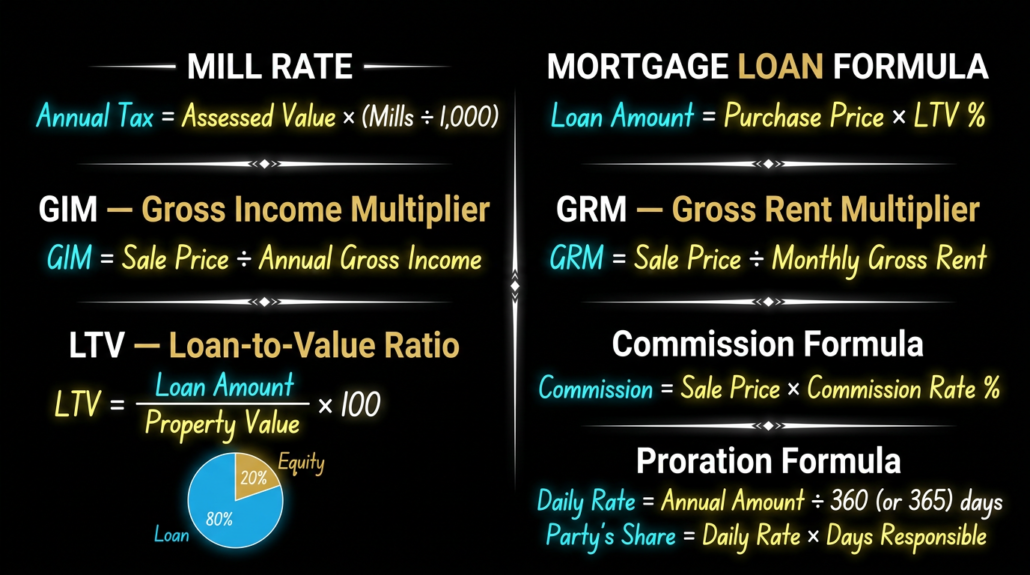
REAL ESTATE LICENSE EXAM CALCULATIONS
🏡 Real Estate Calculations: Your Complete Guide to Passing the PSI Exam Math Section
By Capital Real Estate School | PSI Salesperson Exam Prep Series
If the word “math” makes you nervous, take a deep breath. Real estate calculations on the PSI salesperson exam are not as scary as they sound. In fact, once you learn the formulas and practice them a few times, these questions can become some of the easiest points you earn on test day. This guide will walk you through every major calculation topic you need to know, give you real practice problems with step-by-step solutions, and share tips to help you crush the math section on exam day.
💡 PSI Exam Tip: The Real Estate Calculations section makes up approximately 5 questions out of 80 on the national PSI salesperson exam. That’s about 6% of your total score — enough to make the difference between passing and failing. Every point counts!
📐 Part 1: Basic Arithmetic and Measurement
Before we dive into the money math, let’s start with the foundation, area, and volume calculations. Whether you’re helping a buyer figure out the size of a lot or calculating square footage for a listing, this is essential real estate math.
Key Formulas You Must Know
| Measurement | Formula |
| Area of a Rectangle | Length × Width |
| Area of a Triangle | ½ × Base × Height |
| Volume | Length × Width × Height |
| Acres to Square Feet | 1 acre = 43,560 sq ft |
| Miles to Feet | 1 mile = 5,280 feet |
The PSI exam will provide these conversion numbers either in the problem itself or as a reminder at the top of the math section. However, memorizing them before exam day is a significant advantage because it saves you time.
Quick Example: Finding Square Footage:
A rectangular lot is 150 feet long and 80 feet wide. What is the area?
150 × 80 = 12,000 square feet
Quick Example: Converting to Acres:
How many acres is 87,120 square feet?
87,120 ÷ 43,560 = 2 acres
💰 Part 2: Commission Calculations
Commission math is one of the most common types of calculations on the PSI exam. Real estate agents earn a commission — a percentage of the sale price — when a property sells. That commission is typically split between the listing broker and the buyer’s broker, and then again between brokers and their agents.
The Commission Triangle Formula
The three key formulas are the following:
- Total Commission = Sale Price × Commission Rate
- Sale Price = Total Commission ÷ Commission Rate
- Commission Rate = Total Commission ÷ Sale Price
🧮 PSI Exam Tip: Think of these three formulas as a triangle. If you know two pieces of the puzzle, you can always ascertain the third.
🧮 Calculation #1 — Commission Split Problem
Problem: A home sells for $425,000. The listing broker charges a 6% commission. The commission is split 50/50 between the listing broker and the buyer’s broker. The listing agent receives 60% of the commission from her broker’s side. How much does the listing agent earn?
Solution:
- Total Commission: $425,000 × 0.06 = $25,500
- Listing Broker’s Half: $25,500 ÷ 2 = $12,750
- Listing Agent’s Share: $12,750 × 0.60 = $7,650
✅ The listing agent earns $7,650.
🏦 Part 3: Loan-to-Value Ratio (LTV) and Equity
The Loan-to-Value (LTV) ratio is a number lenders use to decide how risky a loan is. It compares the loan amount to the property’s appraised value. The higher the LTV, the more risk for the lender.
LTV Formulas
- LTV Ratio = Loan Amount ÷ Property Value × 100
- Loan Amount = Property Value × LTV %
- Down Payment = Sale Price × (1 − LTV %)
- Equity = Property Value − Loan Balance
💡 PSI Exam Tip: Lenders commonly require private mortgage insurance (PMI) when the LTV is above 80%. This concept may appear in exam questions on buyer qualification.
🧮 Calculation #2 — LTV (Word Problem Version)
Problem: Maria wants to buy a home appraised at $320,000. Her lender requires a maximum LTV of 80%. How much must Maria put down, and what is her loan amount?
Solution:
- Loan Amount: $320,000 × 0.80 = $256,000
- Down Payment: $320,000 − $256,000 = $64,000
✅ Maria must make a $64,000 down payment and borrow $256,000.
🧮 Calculation #3 — LTV (Math Problem Version)
Problem: A buyer takes out a $189,000 mortgage on a home that sold for $210,000. What is the LTV ratio?
Solution:
LTV = $189,000 ÷ $210,000 = 0.90 = 90%
✅ The LTV ratio is 90%.
🏠 Part 4: Gross Rent Multiplier (GRM)
The Gross Rent Multiplier is a quick tool investors use to compare income-producing properties. It tells you how many years of gross rent it would take to equal the property’s price. A lower GRM typically indicates a better deal.
GRM Formulas
- GRM = Sale Price ÷ Monthly (or Annual) Gross Rent
- Sale Price = GRM × Monthly Rent
- Monthly Rent = Sale Price ÷ GRM
🧮 Calculation #4 — Gross Rent Multiplier (GRM)
Problem: A duplex sells for $288,000. Each unit rents for $1,200/month. What is the GRM?
Solution:
- Total Monthly Rent: $1,200 × 2 = $2,400/month
- GRM: $288,000 ÷ $2,400 = 120
✅ The GRM is 120, meaning it would take 120 months (10 years) of gross rent to equal the purchase price.
📊 Part 5: Gross Income Multiplier (GIM)
The Gross Income Multiplier is similar to the GRM but uses annual gross income instead of monthly rent. It’s often used for larger commercial or multi-family properties.
GIM Formulas
- GIM = Sale Price ÷ Annual Gross Income
- Sale Price = GIM × Annual Gross Income
- Annual Gross Income = Sale Price ÷ GIM
🧮 Calculation #5 — Gross Income Multiplier (GIM)
Problem: A six-unit apartment building sells for $900,000. The annual gross rent income is $90,000. What is the GIM?
Solution:
GIM = $900,000 ÷ $90,000 = 10
✅ The GIM is 10, meaning the property costs 10 times its annual gross income.
💡 PSI Exam Tip: Don’t confuse GRM (monthly rents) with GIM (annual income). Read the problem carefully — if it says “annual income,” use GIM. If it says “monthly rent,” use GRM.
🏛️ Part 6: Mill Rate and Property Tax Calculations
The mill rate is how local governments express property tax rates. One mill = $0.001, or $1 of tax for every $1,000 of assessed value.
Property Tax / Mill Rate Formulas
- Assessed Value = Market Value × Assessment Ratio
- Annual Tax = Assessed Value × Tax Rate (in decimal)
- Mill Rate to Decimal: Divide mills by 1,000 → 30 mills = 0.030
| Mills | Decimal Equivalent | Tax per $1,000 Assessed |
| 10 mills | 0.010 | $10.00 |
| 20 mills | 0.020 | $20.00 |
| 30 mills | 0.030 | $30.00 |
| 45 mills | 0.045 | $45.00 |
| 60 mills | 0.060 | $60.00 |
🧮 Calculation #6 — Mill Rate Property Tax Problem
Problem: A home has a market value of $350,000. The town assesses property at 70% of market value. The mill rate is 28 mills. What is the annual property tax?
Solution:
- Assessed Value: $350,000 × 0.70 = $245,000
- Convert mill rate: 28 mills ÷ 1,000 = 0.028
- Annual Tax: $245,000 × 0.028 = $6,860
✅ The annual property tax is $6,860.
📅 Part 7: Prorations — Splitting Costs at Closing
Prorations are adjustments made at closing to divide ongoing expenses fairly, such as property taxes, HOA dues, homeowners’ insurance, and prepaid rent, between the buyer and seller.
The PSI exam will specify:
- Whether to use the 360-day (banker’s year) or the 365-day (calendar year) method
- Whether closing day belongs to the buyer or seller
Key Proration Formulas
- Annual Amount ÷ 360 (or 365) = Daily Rate
- Daily Rate × Days Responsible = Party’s Share
💡 PSI Exam Tip: Unless the problem tells you otherwise, the seller pays for closing day under standard PSI exam rules. Always re-read the problem to verify before calculating.
🧮 Calculation #7 — Proration Problem (Property Tax)
Problem: The annual property tax on a home is $3,600. Closing is on March 31. The seller owns the closing day. Using a 360-day year, how much does the seller owe in prorated taxes?
Solution:
- Daily Rate: $3,600 ÷ 360 = $10/day
- Days from Jan 1 through March 31 (seller’s period):
- January = 30 days, February = 28 days, March = 31 days = 89 days
- (In a 360-day year, each month is 30 days: 30 + 30 + 30 = 90 days, including closing)
- Using 30-day months: Jan (30) + Feb (28) + Mar (31) = 89 days
- Seller’s Share: 91 × $10 = $910
✅ The seller owes $910 in prorated taxes at closing
💵 Part 8: Interest Calculations and Points
Simple interest is used in many real estate financing calculations. It’s the cost of borrowing money, calculated on the principal loan balance.
Simple Interest Formulas
- Annual Interest = Loan Balance × Interest Rate
- Monthly Interest = Annual Interest ÷ 12
- Interest Rate = Annual Interest ÷ Loan Balance
What is a Point?
One discount point = 1% of the loan amount. Points are paid at closing to “buy down” the interest rate.
Example:
A buyer borrows $200,000 at 7% interest. What is the first month’s interest?
Annual Interest: $200,000 × 0.07 = $14,000
Monthly Interest: $14,000 ÷ 12 = $1,166.67
📋 PSI Exam Math: Quick Reference Cheat Sheet
| Formula | Equation |
| Commission | Sale Price × Commission % |
| Sale Price (from commission) | Commission ÷ Commission % |
| LTV Ratio | Loan Amount ÷ Property Value × 100 |
| Down Payment | Sale Price × (1 − LTV %) |
| GRM | Sale Price ÷ Monthly Rent |
| GIM | Sale Price ÷ Annual Gross Income |
| Mill Rate Tax | Assessed Value × (Mills ÷ 1,000) |
| Assessed Value | Market Value × Assessment Ratio |
| Proration Daily Rate | Annual Amount ÷ 360 or 365 |
| Simple Interest (Annual) | Loan Balance × Rate |
| Acreage | Square Feet ÷ 43,560 |
✅ Top PSI Exam Tips for the Math Section
Here’s a quick list of strategies to boost your score on real estate calculations:
- Write down your formulas first, before reading the question; jot the key formulas on your scratch paper
- Identify what you’re solving for. Is the question asking for the sale price, commission, or tax? Know your target
- Convert percentages to decimals: 6% becomes 0.06; 28 mills becomes 0.028
- Check whether the problem says 360 or 365 days for prorations; a wrong assumption changes the answer.
- Read: Who owns closing day, the seller or the buyer? This changes proration amounts significantly
- Don’t overthink it. Most PSI math problems involve only two to three steps.
- Practicing daily, even five problems per day in the week before your exam, builds tremendous confidence.
🎓 Final Thoughts from Capital Real Estate School
Real estate math doesn’t require a calculator or a finance degree. It requires knowing your formulas, reading carefully, and practicing consistently. The topics covered in this guide — mill rates, commissions, LTV, GRM, GIM, prorations, and interest — are the exact areas that are tested on the PSI salesperson exam. Master these seven calculation types, and you’ll walk into your exam with confidence.
At Capital Real Estate School, we’re here to help every step of the way. Whether you’re studying for your first attempt or retaking the exam, our PSI prep materials are designed to give you exactly what you need — no fluff, just results.
📌 Ready to test your skills? Try our full PSI Math Practice Quiz [available in your student portal] and review our full 11-topic PSI exam prep series.
Capital Real Estate School | Serving Connecticut Real Estate License Candidates | Visit Our Website.
This article is part of our CRES Real Estate License Exam Prep Series. For more PSI outline topics, visit our course library
 CRES - Capital Real Estate School, LLC
 (c) Capital Real Estate School, LLC
Leave a Reply
Want to join the discussion?Feel free to contribute!