
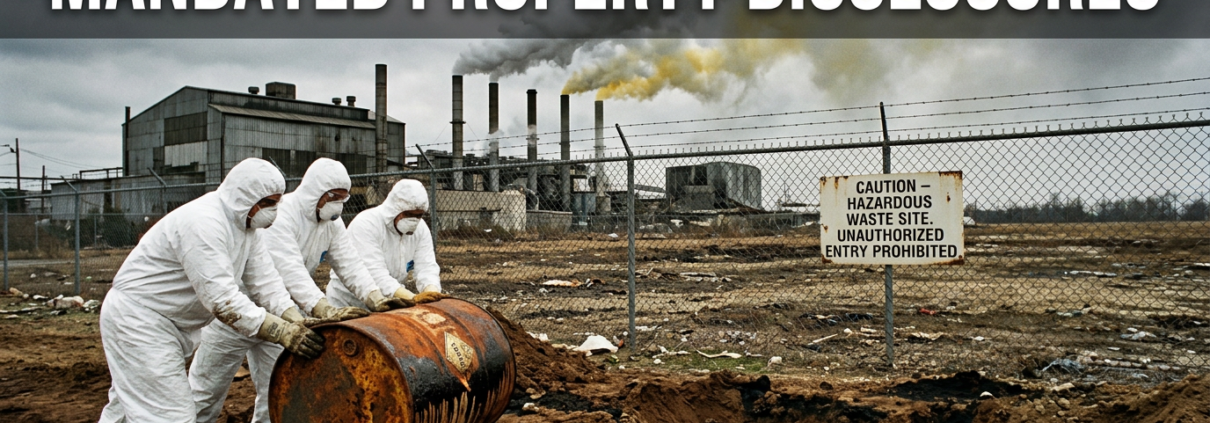
Mandated Property Disclosures: What Every Real Estate Student Needs to Know to Pass the PSI Exam in 2026

Mandated PROPERTY DISCLOSURES: oil tank removal

Mandated PROPERTY DISCLOSURES: oil tank removal

🏠 Mandated Disclosures: What Every Real Estate Salesperson Needs to Know for the PSI Exam

A study guide for real estate license candidates, built around the PSI Exam Outline

If you’re getting ready to take the PSI Real Estate Salesperson License Exam, there’s a topic that always shows up: Mandated Disclosures. This section covers Mandated (Property) Disclosures: specifically, what sellers and agents must legally tell buyers about a property’s condition and environmental hazards. On the PSI national exam, Property Disclosures make up approximately 6–7% of your total score, which means you could see anywhere from 4 to 7 questions on this topic alone. That’s not a section you want to skip.

The favorable news? Once you understand the logic behind disclosure laws, you’ll see that protecting the buyer, being honest, and not hiding problems make a lot of sense. Let’s walk through each subtopic in the PSI outline and make sure you’re exam-ready.

📋 Part 1: Property Condition & Defect Disclosure

What Does “Disclose” Actually Mean?

At its most basic level, a disclosure is simply telling the truth about what you know. In real estate, sellers and their agents are required by law to disclose any known problems with a property that could affect its value, safety, or desirability.

Most states require sellers to complete a Property Condition Disclosure Statement (PCDS) — a standardized written form that covers everything from the roof and foundation to plumbing, electrical systems, and environmental hazards. Both the seller and the buyer must sign and date the completed form to confirm receipt.

Here’s the key part for your exam: you only have to disclose what you actually know. Sellers are generally not required to hire inspectors or dig through public records to discover problems before disclosing them. However, if you know about a problem and hide it, that’s fraud — and it can lead to lawsuits, contract rescission, and license suspension.

💡 PSI Exam Tip: If a question asks whether a seller must investigate unknown defects before completing a disclosure, the answer is almost always NO — they must only disclose known defects. But if they actively conceal a known problem, that’s a willful violation.

Material Facts vs. Latent Defects

These are two terms the PSI exam loves to test. Here’s how to keep them straight:

  • Material fact: Any information that a reasonable buyer would consider important in deciding to buy the property or in setting the price. This is a broad category that includes physical defects, legal issues (like zoning violations), and environmental hazards.
  • Latent defect: A hidden problem that you can’t easily see during a normal walkthrough. Think of a cracked foundation hidden behind finished drywall or a leaky roof that only causes problems during heavy rain.
  • Patent defect: A defect that is visible and obvious during a normal inspection. Patent defects generally do not need to be disclosed because a buyer can see them for themselves.

Both sellers and real estate brokers have an independent legal duty to disclose material facts. Even if the seller doesn’t tell the agent about a defect, the agent can still be held liable if the agent reasonably should have known about it.

Property Disclosure Forms & “As Is” Sales

You’ll almost certainly see a question about “as is” sales on the PSI exam. Here’s the most important thing to understand:

“As is” does NOT mean “no disclosures.”

When a seller lists a property “as is,” they are saying they won’t make repairs after an inspection. But they are still legally required to disclose known latent defects to the buyer. Florida courts made this very clear in Rayner v. Wise Realty Co., where the court ruled that “as is” language cannot be used to shield a seller from disclosing known hidden defects.

Exam exceptions to know: Most disclosure laws do NOT apply to the following:

  • Foreclosure sales and sales by court order
  • Estate sales handled by a fiduciary (executor/trustee)
  • Transfers between spouses
  • New construction sold by the builder for the first time

💡 PSI Exam Tip: Watch for tricky wording. A question might state that a property is sold “as is” and then ask whether the seller must still disclose a known problem. The answer is YES — “as is” only eliminates the seller’s obligation to fix things, not to disclose them.

☣️ Part 2: Environmental Issues & Hazards

This part of the PSI outline requires disclosure of a range of environmental conditions during a real estate transaction. Some of these are regulated by federal law (like lead-based paint), others by state law, and some by both. Let’s go through them:

The Big 5 Environmental Hazards

HazardKey Disclosure RulePSI Exam Focus
Lead-Based PaintFederal law (Title X, 1992) requires disclosure for all homes built before 1978.Pre-1978 cut-off date; 10-day buyer inspection right; EPA pamphlet required
AsbestosMust disclose known presence; common in homes built before 1980Not always federally mandated for residential, but still a material fact
RadonOdorless radioactive gas from decaying uranium in soil; disclosure often required at contract signing.Colorless and odorless: buyers can’t detect it, and it must be disclosed
MoldIndicates past or present moisture/water intrusion; most states require disclosure of known mold.Often linked to water damage disclosures
Carbon Monoxide (CO)Produced by gas appliances, furnaces, and fireplaces, disclosure is tied to detector requirements.Know that CO detectors are mandated by state/local law


Lead-Based Paint: The Federal Gold Standard for Disclosure

Because lead paint is regulated by federal law, it appears on virtually every real estate licensing exam in the country. Here’s what you absolutely need to know:

  • Applies to any home built before 1978 (that’s the year the federal government banned lead paint in residential properties)
  • The law is called the Residential Lead-Based Paint Hazard Reduction Act of 1992, or Title X
  • Sellers, landlords, and their agents must:
    • Disclose any known lead-based paint and hazards
    • Provide buyers with the EPA pamphlet, “Protect Your Family from Lead in Your Home.”
    • Include a Lead Warning Statement in the contract
    • Give buyers a 10-day window to conduct a lead inspection (buyers can waive this in writing)
    • Please keep signed disclosure records for at least 7 years.

💡 PSI Exam Tip: The two numbers to memorize are 1978 (the cutoff year for lead-paint disclosure) and 10 days (the buyer’s inspection window). These are classic PSI question triggers.

Underground Storage Tanks, Groundwater, Brownfields & Wetlands

These topics often appear together on the exam and relate to a common theme: past industrial or commercial use can contaminate a property.

Underground Storage Tanks (USTs) store petroleum or hazardous chemicals, with at least 10% of the tank volume below the ground surface. The EPA recognizes leaking USTs as the leading source of groundwater contamination across the country. Property owners must disclose known USTs and properly close or remove tanks that are no longer in use.

Brownfields are abandoned or underused commercial or industrial sites that are known or suspected to be contaminated. Examples include old gas stations, dry cleaners, and manufacturing plants. The EPA’s Brownfields Program provides grants and liability protections to encourage redevelopment of these sites.

Wetlands are protected areas where land meets water, such as marshes, swamps, and bogs. Under the Clean Water Act (Section 404), filling, draining, or developing wetlands generally requires a federal permit from the Army Corps of Engineers. Unauthorized alteration of wetlands can trigger serious federal penalties.

💡 PSI Exam Tip: If a question mentions a former gas station, old dry cleaner, or industrial property being converted to residential use, think “brownfield” and “Phase I/II Environmental Assessment.”

Phase I and Phase II Environmental Site Assessments

These two assessments are the standard tools for environmental due diligence in real estate, especially for commercial transactions and any property with a history of industrial use.

Phase I ESAPhase II ESA
PurposeIdentify potential environmental concerns (called RECs: Recognized Environmental Conditions)Confirm whether contamination actually exists
MethodsNon-invasive: reviews historical records, aerial photos, regulatory databases, and site inspection.Invasive: soil sampling, groundwater testing, lab analysis.
Cost Range$1,500–$6,000$5,000–$50,000+
CERCLA ProtectionCompleting a Phase I establishes “All Appropriate Inquiries” (AAI), a prerequisite for the Innocent Landowner Defense.Confirms contamination type and extent
When RequiredMost commercial purchases are lender-required for SBA loansTriggered when Phase I finds RECs


An Environmental Impact Statement (EIS) is a broader federal document required under the National Environmental Policy Act (NEPA). It is required for major federal construction projects (highways, dams, military installations) that could significantly affect the surrounding environment. This document is different from a Phase I/II, which is property-specific due diligence.

💡 PSI Exam Tip: The PSI exam may ask what triggers a Phase II. The answer is a Phase I that identifies Recognized Environmental Conditions (RECs). Phase I doesn’t test the soil; it only reviews records and conducts a visual inspection.

⚖️ Part 3: Federal & State Environmental Laws

CERCLA — The Superfund Law

CERCLA stands for the Comprehensive Environmental Response, Compensation, and Liability Act. It was passed in 1980 after the country recognized the seriousness of contaminated site cleanup. CERCLA is sometimes called the “Superfund” law because it created a trust fund, originally built from taxes on the petroleum and chemical industries, to pay for cleanups when no other source of funds is available.

Here’s what makes CERCLA so powerful and so scary for property owners: it imposes three types of liability that are unusually harsh:

  1. Strict Liability: You can be held responsible even if you personally did nothing wrong. If you own contaminated land, you may owe cleanup costs, period.
  2. Joint and Several Liability: If multiple parties contributed to the contamination, any single party can be required to pay for the entire cleanup, not just their share.
  3. Retroactive Liability: The law applies even to contamination that happened before CERCLA was passed in 1980.

Who can be liable under CERCLA? The EPA refers to these as Potentially Responsible Parties (PRPs):

  • Current property owners and operators
  • Former owners and operators at the time hazardous waste was disposed of
  • Parties who arranged for the disposal of hazardous substances
  • Transporters who selected the contaminated site

The Innocent Landowner Defense is a way to escape CERCLA liability. To qualify, a buyer must prove they conducted All Appropriate Inquiries (AAI): essentially, a proper Phase I ESA, before purchasing the property, and genuinely had no knowledge of the contamination. This is one major reason why Phase I assessments are so important in commercial real estate transactions.

💡 PSI Exam Tip: Memorize the three characteristics of CERCLA liability: strict, joint and several, and retroactive. These are key points for the PSI test. Also know that completing a Phase I ESA is the key step in claiming the Innocent Landowner Defense.

Clean Water Act & Clean Air Act

The Clean Water Act (CWA) of 1972

The Clean Water Act’s goal is to “restore and maintain the chemical, physical, and biological integrity of the nation’s waters.” In real estate, this is especially important because:

  • The NPDES (National Pollutant Discharge Elimination System) permit program, which regulates discharges of pollutants into U.S. waterways
  • Section 404, which gives the EPA and the Army Corps of Engineers authority to regulate filling and developing wetlands
  • Properties near regulated water bodies or wetlands can face significant development restrictions that affect their value and usability

The Clean Air Act (CAA) of 1970 (originally 1963)

The Clean Air Act regulates both stationary sources (factories, power plants) and mobile sources (vehicles) of air pollution. Key points for the exam:

  • The EPA sets National Ambient Air Quality Standards (NAAQS) for six “criteria pollutants”: carbon monoxide, lead, nitrogen dioxide, ozone, particulate matter, and sulfur dioxide.
  • Each state must develop a State Implementation Plan (SIP) to explain how it will meet those federal standards
  • Properties near industrial facilities, highways, or in “non-attainment areas” (where air quality doesn’t meet federal standards) may require additional environmental review before development

💡 PSI Exam Tip: The Clean Water Act protects water; the Clean Air Act protects air. The CWA is most relevant for wetlands questions; the CAA is most relevant for industrial or commercial development near population centers. Both laws grant federal agencies authority to regulate activities that affect property use and development.

🔗 Key External Resources & Further Reading

Here are 8 essential links to help you deepen your understanding of each subtopic in the PSI outline:

  1. 🔗 EPA: Lead-Based Paint Disclosure Rule (Title X): The official federal rule, including what sellers, landlords, and agents must do.
  2. 🔗 EPA: Superfund/CERCLA Overview: Plain-English overview of how CERCLA works and who is responsible for cleanup.
  3. 🔗 EPA: Third-Party Defenses / Innocent Landowners: The three types of innocent landowner protection under CERCLA.
  4. 🔗 EPA: Assessing Brownfield Sites (Phase I/II): How Phase I and II assessments work on brownfield properties.
  5. 🔗 DNREC: Real Estate Professionals and Wetlands: What real estate agents need to know about wetland regulation.
  6. 🔗 GEO Forward: CERCLA Innocent Landowner Defense Explained: Detailed breakdown of how to qualify for the Innocent Landowner Defense.
  7. 🔗 Pacific Legal Foundation: What Is the Clean Water Act?: A readable overview of CWA and its impact on property rights.
  8. 🔗 US Realty Training: How to Pass the PSI Real Estate Exam: Expert tips and study strategies specifically for PSI exam candidates.

📝 Master Cheat Sheet: PSI Exam Quick Reference

TopicKey Rule / Number to RememberPSI Trap to Avoid
Material FactAny fact a reasonable buyer would want to knowDon’t confuse with patent (visible) defects
Latent DefectHidden; must be disclosed if known“As is” does NOT eliminate this duty
“As Is” SaleThe seller won’t repair, but STILL must disclose known defects“As is” ≠ no disclosures
Lead-Based PaintPre-1978 homes; 10-day buyer inspection window; EPA pamphlet requiredBoth sellers AND agents must comply
CERCLA LiabilityStrict + Joint & Several + RetroactiveAny one party can owe the full cleanup cost
Innocent Landowner DefenseMust complete Phase I ESA (AAI) before purchaseNo Phase I = no protection
Phase I ESANon-invasive; identifies RECs; does NOT test soilPhase I only reviews records and site visits.
Phase II ESATriggered by Phase I REC findings, soil/water samplingPhase II confirms contamination
BrownfieldsFormer commercial/industrial sites with known or suspected contaminationEligible for EPA grants and liability protection
WetlandsSection 404 of the Clean Water Act; Army Corps of Engineers permit required to fill/developUnpermitted filling = federal enforcement
Clean Water ActProtects the nation’s waterways and wetlandsKey to wetlands development questions
Clean Air ActSets NAAQS for 6 criteria pollutants; states must adopt SIPsKey for industrial site and development questions


Final Exam Reminders 💪

Before you walk into that testing center, burn these five facts into your memory:

  1. Sellers disclose what they KNOW: not what they haven’t discovered
  2. “As is” means no repairs, NOT no disclosures: that trap is on almost every exam
  3. Lead paint cut-off = 1978; buyer inspection window = 10 days
  4. CERCLA = strict, joint/several, and retroactive liability: three words, tons of points
  5. Phase I protects you under CERCLA: it’s the key to the Innocent Landowner Defense

Disclosure law exists for one reason: to protect buyers from being misled about what they’re purchasing. When you understand that core purpose, the rules stop feeling like memorization and start feeling like common sense. Good luck on your PSI exam — you’ve got this! 🎓

This article is part of our CRES Real Estate License Exam Prep Series. For more PSI outline topics, visit our course library

Laws of Agency: What Every Real Estate Student Needs to Know to Pass the PSI Exam in 2026.

Transfer of Title: Seller & Buyer Exchange with Agent - CRES Capital Real Estate School

Laws of Agency: Real Estate Agent showing prospective buyers their new home and legal relationship between them.

Laws of Agency: What Every Real Estate Student Needs to Know to Pass the PSI Exam in 2026

By CRES Staff writer | PSI Salesperson & Broker Real Estate Exam Prep Series – 2026

If there’s one topic that trips up more real estate exam students than just about anything else, it’s agency law. Whether you’re sitting down for the national portion of the PSI exam or studying for your state-specific questions, understanding the Laws of Agency is absolutely essential. According to PSI’s exam content outline, Laws of Agency covers what agency is, how it is created and terminated, and the difference between the many kinds of agency relationships you’ll encounter in real estate.

The good news? Once you understand the core ideas, this topic starts to make a lot of intuitive sense. Think of it this way: when someone hires you to act on their behalf in a real estate deal, there are rules that govern exactly how you must behave. Those rules are what we call the Laws of Agency.

Let’s break it all down in a way that’s clear, direct, and exam-ready.

Why Agency Law Matters on the PSI Exam

On the national (general) PSI real estate salesperson and broker candidate exams, the Laws of Agency content area is among the highest-weighted. Agency produces some of the most common questions on the PSI national real estate exam, and that’s based on exam prep instructors’ reviews of the actual PSI content breakdown. Missing these questions can seriously hurt your score, so nailing this section gives you a major edge.

Here’s what the PSI exam tests you on under Laws of Agency:

  • What agency is and how it’s defined
  • Agency and non-agency relationships
  • How agency is created (agency agreements)
  • Duties of an agent to the principal and to third parties
  • Disclosure requirements
  • How agency (legal relationship) is terminated

Let’s walk through each of these one by one.

What Is Agency? The Core Definition

Agency is a legal relationship in which one person (the agent) is authorized to act on behalf of another person (the principal) when dealing with a third party. In real estate, the agent is usually a licensee (that’s you, the salesperson), and the principal is your client — either a buyer or a seller.

This relationship creates legal duties and responsibilities that go far beyond just showing houses or writing contracts. When you become someone’s agent, you take on a serious legal obligation to act in their best interest.

💡 PSI Exam Tip: On the exam, always remember that the agent works for the principal, not for themselves. Any time a question asks whose interest the agent must protect, the answer is almost always the principal (your client).

Types of Agency Relationships

Not all agency relationships are the same. The PSI exam will test you on the specific types, so you need to know each one cold.

Seller’s Agency

A seller’s agent (also called a listing agent) represents the seller. Their job is to get the best possible price and terms for the seller. Everything they do should be in the seller’s best interest.

Buyer’s Agency

A buyer’s agent represents the buyer. This became more formally defined and regulated in recent years. The buyer’s agent works to get the best price and terms for the buyer.

Dual Agency

Dual agency occurs when the same agent or brokerage represents both the buyer and seller in the same transaction. This is a major conflict of interest that regulators closely monitor, and that is outright illegal in some states.

💡 PSI Exam Tip: When you see a dual/designated agency question, think conflict of interest. The key issue is whether proper disclosure was made and whether all parties consented in writing.

Dual/Designated Agency

In dual/designated agency, a broker assigns specific agents within their office to represent each party (one agent for the buyer, a different agent for the seller). This avoids the full conflict of dual agency while still allowing the brokerage to represent both sides.

Non-Agency (Transaction Broker)

A transaction broker (or facilitator) does NOT represent either party as an agent. They simply help the transaction along without owing full fiduciary duties to either side. The PSI exam specifically tests the difference between agency and non-agency relationships.

PSI Outline – Laws of Agency Subtopics at a Glance

The table below maps the key PSI exam subtopics for Laws of Agency, what each one tests, and how often it’s likely to show up:

PSI SubtopicWhat It TestsLikely Exam Weight
Law, Definition & Nature of AgencyWhat agency is: types of agentsHigh
Creation of Agency & Agency AgreementsHow agency is formed; listing agreementsHigh
Responsibilities of Agent to PrincipalFiduciary duties (COALD/OLD CAR)Very High
Disclosure of AgencyWhen and how to discloseHigh
Disclosure as Principal or Other InterestConflicts of interest: licensee buying/sellingMedium
Termination of AgencyHow agency ends: listing expirationMedium
Commission and FeesWhen commission is earned, and procuring causeMedium
Responsibilities to Non-Client Third PartiesHonesty and disclosure to the other sideHigh


How Agency Is Created

Agency doesn’t just happen because you say you’re someone’s agent. It has to be created in one of a few specific ways.

Express Agency

This is the most common and most straightforward form. It’s created by a written or verbal agreement, for example, when a seller signs a listing agreement with a broker, express agency is formed. Most states require written agreements.

Implied Agency

Sometimes agency is created by the parties’ actions, even without a formal agreement. For example, if you start showing a buyer homes, writing offers, and advising them on price without a signed buyer-broker agreement, you may have accidentally created an implied agency.

💡 PSI Exam Tip: Implied agency is a common trick question on the PSI exam. Just because there’s no written agreement doesn’t mean agency doesn’t exist; actions can create it.

Apparent Authority (Ostensible Agency)

This scenario happens when a principal (such as a broker) allows someone to appear to be their agent, even if no formal agency has been created. A third party who reasonably relies on that appearance can hold the principal responsible.

Agency by Ratification

If an agent acts on behalf of someone without authorization, but that person later approves the action after the fact, agency by ratification has occurred.

The Fiduciary Duties — OLDCAR and COLD/AC

This is arguably the most tested concept in the entire Laws of Agency section. When you represent a client as their agent, you owe them fiduciary duties. A helpful acronym to remember them all is OLD CAR (or some textbooks use COALD):

LetterDutyWhat It Means
OObedienceFollow all lawful instructions from your principal
LLoyaltyAlways put the client’s interests first
DDisclosureReveal all material facts that affect the client’s decisions
CConfidentialityProtect your client’s personal information, even after the deal closes
AAccountingHandle money and documents honestly and accurately
RReasonable CareUse your professional skills and knowledge to serve the client well


💡 PSI Exam Tip: The PSI exam loves to test whether an agent violated one of these duties. Read each scenario question carefully and ask yourself: “Which duty is being described or broken?

Agency Disclosure | When and How

Agency disclosure is one of the most important legal protections in real estate. Agents are required by law to disclose the nature of their agency relationship to all parties involved in a transaction.[3]

When Must Disclosure Happen?

In most states, disclosure must occur:

  • At the first substantive contact with a potential client or customer
  • Before any confidential information is shared
  • Before an offer is made or accepted

What Must Be Disclosed?

  • Who the agent represents (buyer, seller, or both)
  • Whether dual agency exists
  • Whether the licensee has any personal interest in the transaction

💡 PSI Exam Tip: If a question states that an agent failed to disclose their representation status, the answer will almost always indicate a violation of agency law, which may result in license suspension or revocation.

How Agency Is Terminated

Just like a job, the agency relationship doesn’t last forever. The PSI exam tests several ways that an agency can come to an end.

Here are the most common termination methods:

  1. Completion of the purpose: the transaction closes, and the agency is done
  2. Expiration of the listing period: the agreed-upon time runs out
  3. Mutual agreement: both parties agree to end the relationship
  4. Revocation by the principal: the client fires the agent (note: the client may still owe a fee)
  5. Renunciation by the agent: the agent quits (note: this could be a breach of contract)
  6. Death or incapacity: if either party dies or becomes legally incompetent, the agency ends
  7. Destruction of the property: if the subject property is destroyed, the agency typically ends
  8. Bankruptcy: In some cases, the bankruptcy of either party can terminate the agency

💡 PSI Exam Tip: The holdover clause (also called the broker protection clause) is frequently tested. This clause states that even after a listing expires, if the broker introduced the buyer to the property during the listing period, the seller may still owe the broker a commission if a sale occurs within a specified period.

Commission and Procuring Cause

Real estate agents work largely on commission — they get paid when a deal closes. But the PSI exam goes beyond just how much commission is earned. You’ll be tested on when it’s earned and who earns it.

When Is a Commission Earned?

A broker typically earns their commission when they have:

  1. Procured a ready, willing, and able buyer: meaning the buyer wants the property and can pay for it
  2. The buyer and seller reach an agreement on price and terms

This is referred to as being the procuring cause of the sale. The agent who was the primary cause of bringing the buyer and seller together is the procuring cause and is entitled to the commission.

💡 PSI Exam Tip: Commission amounts are always negotiable between the broker and the client. There is no “standard” commission rate set by law. Any question that suggests a fixed, required commission rate is testing whether you know this!

Agent Duties to Third Parties (Non-Clients)

You have extra-strong duties to your client, but what about the other side of the deal?

Even when you don’t represent someone, you still owe them basic honesty. Specifically, agents must:

  • Never misrepresent (lie about) the property or any material facts
  • Disclose known material defects that could affect the value or desirability of the property
  • Treat all parties with honesty and fairness

The difference is that non-clients don’t get the full fiduciary protection — they just get basic honesty and fair dealing.

💡 PSI Exam Tip: Watch out for the phrase “material fact.” A material fact is any fact that could change a buyer’s decision to buy, or change the price they’d offer. Agents must disclose material facts, even to non-clients!

Top PSI Exam Tips for Laws of Agency

Now that you’ve walked through the entire Laws of Agency section, let’s talk strategy.

Here are proven test-taking tips specific to the agency questions you’ll face on the PSI exam:

General PSI Test-Taking Strategies

  1. Read every question at least twice. Agency questions are full of tricky wording, such as “except,” “not,” and “only.” Missing one word can flip the entire meaning of a question.
  2. Answer every single question — even if you’re guessing. A blank answer is always a guess; a guess gives you at least a 25% chance.
  3. Don’t add information that isn’t in the question. If a question only mentions a seller’s agent, don’t assume dual agency exists.
  4. Use the process of elimination. Even ruling out one wrong answer improves your odds significantly.
  5. Go through the exam at least twice. On your first pass (45 minutes or less), answer what you know and flag what you don’t. Then go back.
  6. Never answer from field experience. The PSI exam is a book test, not a field test. Answer based on what your textbook says, not what you’ve seen done in real life.

Agency-Specific Tips

  • Memorize OLD CAR or COLD/AC. You will see fiduciary duty questions, guaranteed. (care, obedience, loyalty, disclosure, accounting, confidentiality)
  • Know the difference between clients and customers. Clients get fiduciary duties. Customers just get honest dealings.
  • Dual agency = always disclosure + written consent. If consent isn’t mentioned, it’s a problem.
  • The holdover clause protects the broker after listing expiration — know when it applies.
  • Implied agency is sneaky; know that actions, not just paperwork, can create agency.

Quick Reference — Agency Relationships Side by Side

Use this table to quickly compare the different types of agency relationships you’ll be tested on:

Agency TypeWho Is RepresentedFiduciary Duties OwedDisclosure Required?
Seller’s AgencySeller onlyFull fiduciary to the sellerYes, to buyer/all parties
Buyer’s AgencyBuyer onlyFull fiduciary to the buyerYes, to seller/all parties
Dual AgencyBoth buyer and sellerLimited (conflict exists)Yes, written consent is required
Designated AgencyEach party has their own agentFull fiduciary to each clientYes, by brokerage
Non-Agency / Transaction BrokerNeither partyHonesty and fair dealing onlyYes, explain role

Wrapping It All Up

The Laws of Agency section is one of the most rewarding parts of your real estate education to master because it directly reflects what you’ll do every single day as a licensed agent. Understanding agency means understanding your legal role, your responsibilities, and the ethical backbone of the entire profession.

Here’s your final study checklist before exam day:

  • ✅ Know the definition and types of agency relationships
  • ✅ Be able to explain how agency is created (express, implied, apparent, ratification)
  • ✅ Memorize OLD CAR or COLD/AC fiduciary duties (care, obedience, loyalty, disclosure, accounting, and confidentiality)
  • ✅ Understand disclosure requirements, who, when, and how
  • ✅ Know how agency (legal relationship) is terminated (including the holdover clause)
  • ✅ Understand what non-clients are owed (honesty, not full fiduciary protection)
  • ✅ Know procuring cause and when commission is earned
  • ✅ Understand dual agency, designated agency, and non-agency roles

Good luck on your PSI exam! You’ve got this. Study smart, read carefully, and remember, in agency law, it always comes back to one simple question: whose interests are you serving?

Contracts in Real Estate: What Every Real Estate Student Needs to Know to Pass the PSI Exam in 2026

CRES - Real Estate Broker with buyers and sellers reviewing purchase and sales contract

Real Estate Broker with buyers and sellers reviewing purchase and sales contracts.

Real Estate Contracts: Everything You Need to Know for Your PSI Licensing Exam

If you’re studying for your real estate salesperson license exam, contracts are one of the most important topics you’ll face. In fact, the PSI exam places a heavy emphasis on contracts because real estate agents deal with them every single day. Whether you’re writing up a listing agreement, submitting an offer on a home, or handling a counteroffer situation, knowing how contracts work is not just exam knowledge; it’s your real-world survival kit.

Let’s break this topic down in plain English so you can walk into your PSI exam with confidence.

What Is a Real Estate Contract?

A real estate contract is a legally binding agreement between two or more people regarding a property transaction. It outlines what everyone is promising to do, the price, the terms, the timeline, and what happens if things go wrong. Think of it like a rulebook both parties agree to follow.

For a contract to be legally valid, it has to meet five basic requirements. Miss even one of these, and the contract could fall apart in court.

The 5 Elements of a Valid Contract

These five elements are tested heavily on the PSI exam. Know them cold:

ElementWhat It MeansPSI Exam Tip
Competent PartiesBoth parties must be legally able to sign, meaning adults of sound mindA minor cannot enter into a valid contract
Offer and AcceptanceOne party makes an offer; the other accepts it exactly as statedAny change creates a counteroffer, NOT acceptance
ConsiderationSomething of value exchanged by both sidesCan be money, a promise, or anything of value
Lawful PurposeThe contract must be for a legal activityContracts for illegal acts are automatically void
Consent (Mutual Agreement)Both parties must agree freely, without pressure or fraudDuress or misrepresentation can make a contract voidable


📝 PSI Exam Tip: The PSI exam loves to test whether a contract has all five elements. If a question describes a contract in which one party is 16 years old or signed under threat, look for answers involving “void” or “voidable.”

Types of Contracts You Must Know

The PSI exam will ask you to classify contracts using specific legal terms. Here’s a breakdown:

Express vs. Implied

  • An express contract is written or spoken out loud, and the terms are clearly stated
  • An implied contract is created by actions or behavior, not words

Bilateral vs. Unilateral

  • A bilateral contract is one in which both parties make promises to each other. For example, in a standard purchase agreement, the buyer promises to pay, and the seller promises to deliver the deed.
  • A unilateral contract means only one party makes a promise; an option contract is the classic example; the seller promises to sell, but the buyer is not obligated to buy.

Executory vs. Executed

  • Executory means the contract is signed but not yet fully performed (closing hasn’t happened yet)
  • Executed means everything has been completed; the deal is done

Valid, Void, Voidable, and Unenforceable

Contract StatusMeaningExample
ValidMeets all legal requirements; fully enforceableStandard purchase agreement with all elements present
VoidHas no legal effect at all; never existed in lawContract for an illegal purpose
VoidableAppears valid, but one party has the right to cancel itContract signed by a minor
UnenforceableWas valid but cannot be enforced (often due to Statute of Frauds)Oral agreement for sale of real estate


📝 PSI Exam Tip: The Statute of Frauds requires that ALL real estate contracts be in writing to be enforceable in court. This is a go-to exam question. An oral agreement to buy a house might have all five elements and still fail in court because it wasn’t written down.

Listing Agreements: Getting the Property on the Market

A listing agreement is a contract between the seller and the real estate broker (not the salesperson directly). It gives the broker permission to market and sell the property.

The four types of listing agreements:

  1. Exclusive Right to Sell — The broker earns a commission regardless of who finds the buyer, even if the seller finds the buyer themselves. This is the most common type and the most protective for brokers.
  2. Exclusive Agency — The broker earns a commission only if they or another agent finds the buyer. If the seller sells it themselves, no commission is owed.
  3. Open Listing — The seller can work with multiple brokers, and only the broker who actually brings in the buyer earns a commission. The seller can also sell themselves without paying any commission.
  4. Net Listing — The seller sets a minimum price they will accept, and the broker keeps anything above that amount as their commission. This type is risky and illegal in many states due to potential conflicts of interest.

📝 PSI Exam Tip: Net listings are a warning sign. The PSI exam often uses them to test your knowledge of ethics. The broker’s personal financial interest might conflict with securing the best price for the seller, which would constitute a violation of fiduciary duty.

Every listing agreement must include these essential terms:

  • Names of the parties (seller and broker)
  • Property description
  • Listing price
  • Commission amount or percentage
  • Duration/expiration date
  • Duties and responsibilities of both parties

Buyer Representation Agreements

Just as a seller signs a listing agreement, a buyer signs a buyer representation agreement (also called a buyer agency agreement) with their agent’s brokerage. This contract outlines:

  • Who the agent represents
  • The scope of the agent’s services
  • How the agent will be compensated
  • The duration of the agreement

This has become more prominent following recent industry changes regarding buyer-agent compensation transparency.

Purchase and Sale Agreements: The Heart of the Deal

The purchase and sale agreement (also called a purchase contract or sales contract) is the main contract between the buyer and seller. This is where the actual transaction gets locked in.

Essential components include:

  • Property description: legal description of what’s being sold
  • Purchase price and financing terms
  • Earnest money deposit: a good-faith payment from the buyer, held in escrow
  • Contingencies: conditions that must be met for the sale to go through
  • Closing date and possession date
  • Prorations: how taxes, insurance, and HOA fees are divided between buyer and seller at closing

📝 PSI Exam Tip: Earnest money is NOT the same as consideration. Consideration is required for a valid contract; earnest money is optional. However, earnest money demonstrates the buyer’s good faith.

Contingencies: The “What If” Clauses

Contingencies are conditions written into the contract that must be satisfied before the sale can close. Think of them as escape hatches — if the condition isn’t met, the buyer (or occasionally the seller) can back out without penalty.

The four most common contingencies on the PSI exam:

  1. Financing Contingency: The buyer must secure a mortgage loan. If they can’t get financing, they can cancel the contract and get their earnest money back.
  2. Inspection Contingency: The buyer is entitled to have the property professionally inspected. If they find major problems, they can negotiate repairs or walk away.
  3. Appraisal Contingency: The property must appraise at or above the purchase price. If the appraisal comes in low and the lender won’t cover the gap, the buyer can cancel.
  4. Sale of Buyer’s Property Contingency: The buyer’s purchase depends on selling their current home first. This is the weakest contingency in a competitive market.

📝 PSI Exam Tip: When a contingency is not met, the contract becomes voidable — the protected party has the right to cancel it. If they waive the contingency, the sale moves forward. Understanding who has the right to cancel based on which contingency failed is a common PSI question type.

Counteroffers and Multiple-Offer Situations

When a seller receives an offer and doesn’t accept it exactly as written, they issue a counteroffer. The original offer is then considered rejected: it no longer exists. The counteroffer is a new offer, and the buyer now has to decide whether to accept, reject, or counter again.

In multiple-offer situations, the seller may:

  • Accept one offer outright
  • Counter one offer while putting others on hold
  • Ask all buyers to submit their “highest and best” offer

A backup offer is an offer from a second buyer that becomes effective if the first accepted offer falls through. The backup buyer must be notified in writing when their offer becomes the primary contract.

📝 PSI Exam Tip: Any change to an offer — even something minor like changing the closing date — creates a counteroffer and voids the original offer. This is a favorite PSI question.

Contract Performance and Remedies

What happens when someone doesn’t do what the contract says? That’s called a breach of contract.

  • A material breach is a serious violation that defeats the whole purpose of the contract (like a seller refusing to close)
  • A minor breach is a smaller violation that doesn’t kill the deal, but may result in damages

Remedies for Breach of Contract:

RemedyWhat It MeansWho Typically Uses It
Specific PerformanceThe court forces the breaching party to complete the contractBuyer sues to force the seller to sell the property
Compensatory DamagesMoney paid to cover actual lossesEither party
Liquidated DamagesPre-agreed amount (usually earnest money) the non-breaching party keepsThe seller keeps the earnest money if the buyer defaults.
RescissionThe contract is canceled, and the parties are returned to their original positionsEither party’s earnest money is returned
RestitutionOne party returns what was received under the contractUsed with rescission


📝 PSI Exam Tip: Specific performance is unique to real estate because every piece of real property is considered one-of-a-kind. Money damages can’t truly replace a specific property, which is why courts allow buyers to force a sale. Expect this topic on your exam.

Assignment and Novation

Assignment means transferring your rights and benefits under a contract to a third party. However, the original party usually remains responsible for the obligations unless the other party agrees otherwise.

Novation is different — it replaces the original contract entirely with a new one, or substitutes a new party for the old one. With novation, the original party is completely released from all obligations.

📝 PSI Exam Tip: Think of novation as a complete swap-out. The old contract (or old party) is gone. Assignment keeps the original party engaged. This distinction is a classic PSI question.

“Time Is of the Essence”

When a contract includes the phrase “time is of the essence,” it means that every deadline in the contract is strictly enforceable. Missing a deadline, even by a day can be considered a material breach of the contract. This clause is commonly included in purchase agreements, and the PSI exam will test whether you know its legal significance.

Quick-Reference PSI Exam Tips: Real Estate Contracts

Here are the most common contract traps on the PSI exam:

  • ✅ All real estate contracts must be in writing (Statute of Frauds) to be enforceable
  • ✅ A contract signed by a minor is voidable, not void
  • ✅ Earnest money is not required for a valid contract, but consideration is
  • Counteroffer = rejection of the original offer
  • Specific performance applies because real estate is unique
  • Novation replaces assignment transfers (but doesn’t release liability)
  • Rescission returns everyone to where they started
  • Liquidated damages are set in advance; actual damages are proven after the breach

Helpful Study Resources

Here are some additional links to strengthen your understanding and practice PSI-style questions on contracts:

  1. 🔗 Real Estate Contract Basics – Investopedia
  2. 🔗 Types of Listing Agreements – Realtor.com
  3. 🔗 Purchase Agreement Explained – Bankrate
  4. 🔗 Real Estate Contingencies – Zillow
  5. 🔗 Breach of Contract – Cornell Law LII
  6. 🔗 Statute of Frauds in Real Estate – Nolo
  7. 🔗 Specific Performance in Real Estate – Legal Match
  8. 🔗 Understanding Real Estate Contracts for the PSI Exam – RealEstateU (Video)

Contracts constitute a significant portion of your PSI salesperson exam, and mastering this topic will pay dividends not just on test day but throughout your entire real estate career. Focus on the five elements of a valid contract, memorize the four listing types, know your contingencies cold, and practice spotting the difference between void, voidable, and unenforceable, and you’ll be well ahead of most test-takers.